
A blockchain has to answer one question millions of times a day: what does everyone own right now? Storing that "state" and proving it honestly, without forcing every user to download everything, is one of the deepest engineering problems in crypto. The elegant answer is a structure called a Merkle tree, and it quietly underpins the whole system.
What state means
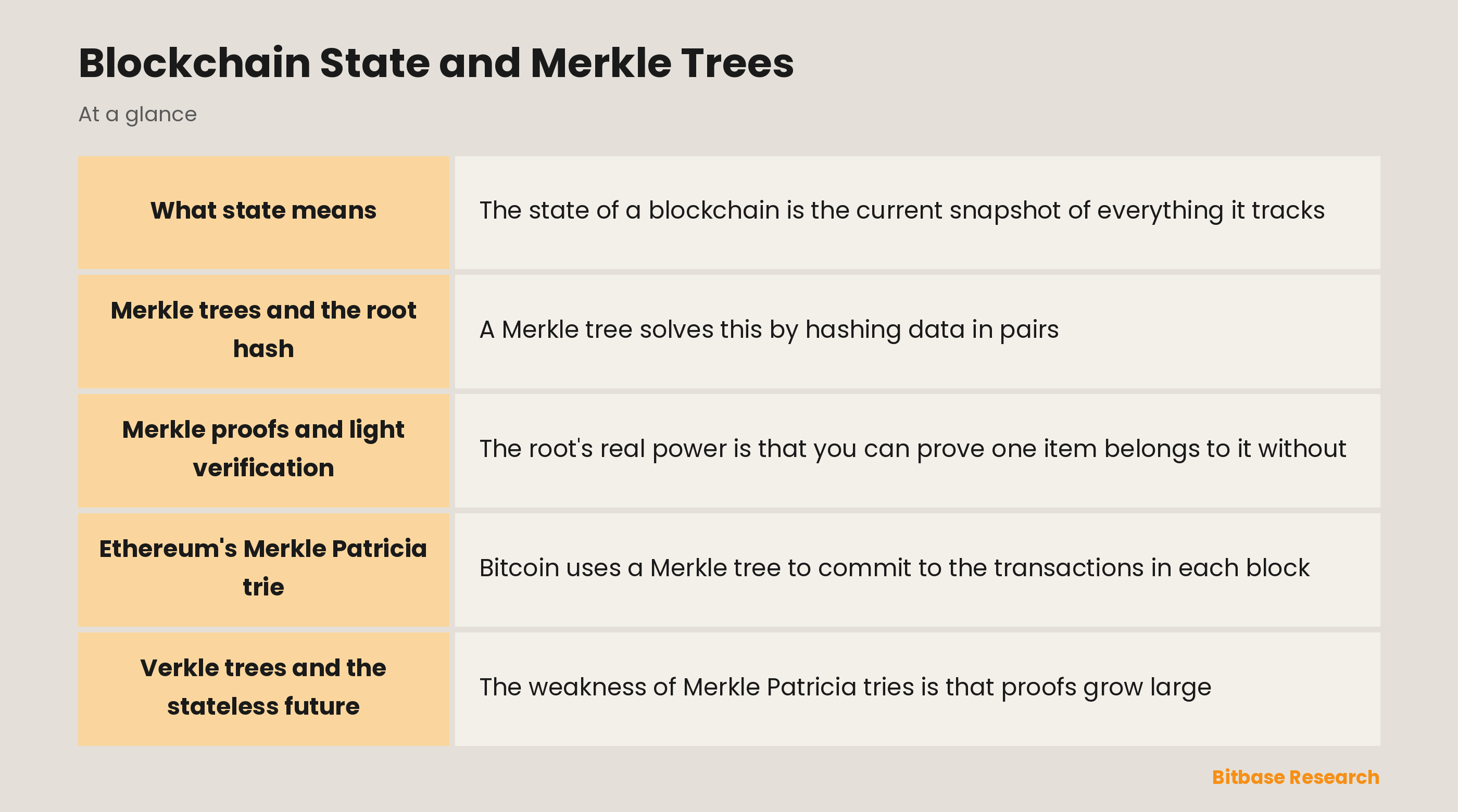
The state of a blockchain is the current snapshot of everything it tracks: account balances, contract code, and the data each smart contract stores. Blocks are the history — the ordered list of changes — while state is the up-to-date result of applying all of them. When you check your balance, you are reading state, not replaying every transaction since the beginning. Because state is enormous and constantly changing, a chain needs a way to summarise and verify it efficiently.
Merkle trees and the root hash
A Merkle tree solves this by hashing data in pairs, repeatedly, until everything collapses into a single value called the root hash. Each piece of data is hashed, then pairs of hashes are hashed together, level by level, up to one root at the top. The magic is that this root acts as a fingerprint of the entire dataset: change any single item, even by one bit, and the root changes completely. A tiny root can therefore commit to a massive amount of data.
Merkle proofs and light verification
The root's real power is that you can prove one item belongs to it without revealing the rest. A Merkle proof is just the short chain of sibling hashes needed to recompute the root from your single item. Anyone holding only the trusted root can check that proof and confirm the item is genuinely included — while downloading almost nothing. This is exactly how light clients verify a transaction, and how proof-of-reserves lets you check your balance is in an exchange's total.
Ethereum's Merkle Patricia trie
Bitcoin uses a Merkle tree to commit to the transactions in each block. Ethereum needs more, because its state is a huge, frequently updated key-value map of accounts and storage. It uses a variant called a Merkle Patricia trie, which combines Merkle hashing with an efficient tree for looking things up and updating them. Each block header carries a state root summarising the entire world state, so any node can verify a specific account or storage slot against it with a compact proof.
Verkle trees and the stateless future
The weakness of Merkle Patricia tries is that proofs grow large, which blocks the dream of stateless clients that verify without storing the whole state. The proposed upgrade is the Verkle tree, which uses more advanced cryptography to make proofs dramatically smaller — on the order of a few hundred bytes where a Merkle proof would need many kilobytes. That roughly twenty-fold shrinkage is what could finally let lightweight nodes verify blocks carrying only tiny witnesses, protecting decentralisation as state keeps growing.
The bottom line
State is what a blockchain currently is; Merkle trees are how it commits to that state in a single hash and proves any piece of it cheaply. From Bitcoin's transaction trees to Ethereum's Merkle Patricia trie and the coming Verkle upgrade, the same idea recurs: compress vast data into one root, then prove membership with a short path. It is the unglamorous machinery that makes trustless verification — the whole point of a blockchain — actually practical.
Disclaimer: This article is educational content from Bitbase Academy, provided for informational purposes only. It is not investment, trading, tax, or financial advice. Written as of July 2026; rely on the latest official information.
References
[1] Ethereum.org, "Verkle trees" ethereum.org
[2] Investopedia, "Merkle tree" investopedia.com