Proof of work and proof of stake are the famous ways blockchains agree, but they are only the entry point. Underneath sit deeper questions — how fast a block becomes irreversible, how thousands of machines agree without a leader, how to be fast without becoming fragile. This is a tour of the advanced consensus ideas shaping the fastest chains of 2026.
Beyond proof of work and stake
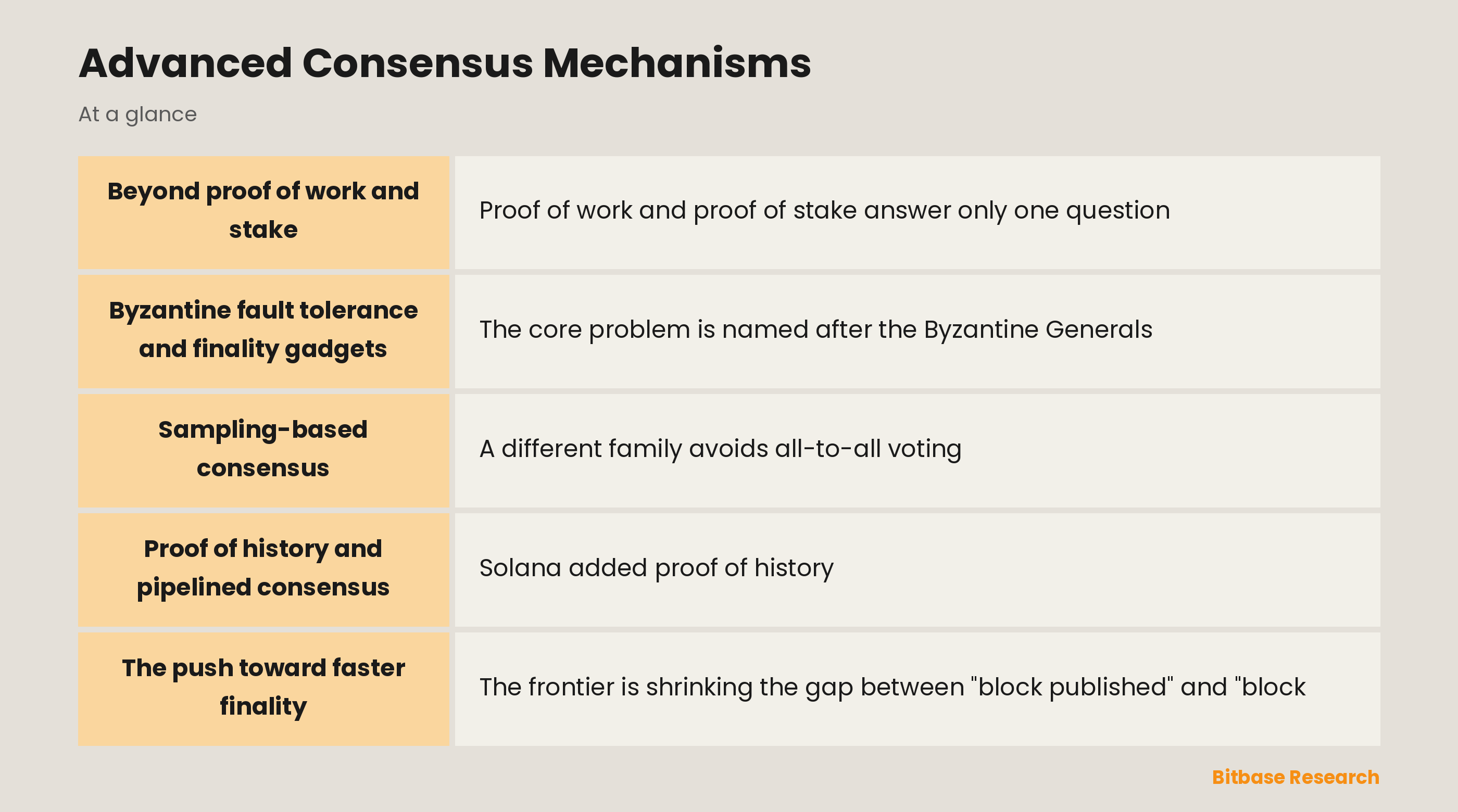
Proof of work and proof of stake answer only one question: who gets to propose the next block. A full consensus mechanism must also decide when everyone agrees a block is final, how the network behaves if participants misbehave or go offline, and how quickly it recovers. These design choices are where modern blockchains genuinely differ, and they explain why two proof-of-stake chains can feel worlds apart in speed and finality.
Byzantine fault tolerance and finality gadgets
The core problem is named after the Byzantine Generals: how can honest participants agree when some are faulty or malicious? Byzantine-fault-tolerant (BFT) protocols solve this by having validators vote in rounds, reaching absolute finality once a supermajority signs off. Ethereum layers a finality gadget on top of its chain, so blocks move from probabilistic (very likely permanent) to finalized (economically irreversible) after enough validators attest. Finality, not just block production, is the real prize.
Sampling-based consensus
A different family avoids all-to-all voting, which is slow at scale. In sampling-based consensus, popularised by the Avalanche approach, each validator repeatedly asks a small random group what they favour and adopts the majority answer. Through many quick rounds the whole network snaps to agreement, a property called metastability. This scales to large validator sets with low communication, trading the clean guarantees of classical BFT for speed and a probabilistic, but overwhelmingly strong, notion of finality.
Proof of history and pipelined consensus
Solana added proof of history, a verifiable clock that timestamps events so validators need not constantly negotiate ordering, enabling very high throughput. Its 2026 overhaul, Alpenglow, is described as the biggest consensus change in the chain's history: it replaces the older TowerBFT voting and removes proof of history from the core agreement, targeting finality in roughly a tenth of a second rather than the previous double-digit seconds. It shows how live chains keep re-engineering consensus for speed.
The push toward faster finality
The frontier is shrinking the gap between "block published" and "block irreversible." Ethereum research aims at single-slot finality, collapsing today's roughly fifteen-minute finalisation into a single slot, though it is expected only after other major upgrades. Every design here wrestles with the same trade-off between speed, decentralisation, and security: make finality faster and you usually demand more of validators, so each chain picks a different balance point.
The bottom line
Advanced consensus is about far more than picking a block proposer; it is about how and how fast a network becomes certain. Byzantine-fault-tolerant voting delivers hard finality, sampling-based designs trade it for scale, proof-of-history and pipelining chase raw throughput, and single-slot finality aims to make settlement nearly instant. There is no single winner — only different answers to the eternal tension between being fast, open, and safe.
Disclaimer: This article is educational content from Bitbase Academy, provided for informational purposes only. It is not investment, trading, tax, or financial advice. Written as of July 2026; rely on the latest official information.
References
[1] Ethereum.org, "Single slot finality" ethereum.org
[2] CoinDesk, "Solana's Alpenglow consensus overhaul is live for testing" coindesk.com