
IREN has reported a 58% quarterly decline in Bitcoin mining revenue to $28 million as the Nasdaq-listed company prepares to substantially complete its move away from cryptocurrency mining by December 31, 2026.
Summary
- IREN’s Bitcoin mining revenue fell 58% to $28 million as the company reduced mining operations.
- AI cloud revenue surged 182% to $200 million, accounting for most of IREN’s quarterly revenue.
- IREN plans to substantially complete its Bitcoin mining transition by December, with limited operations continuing.
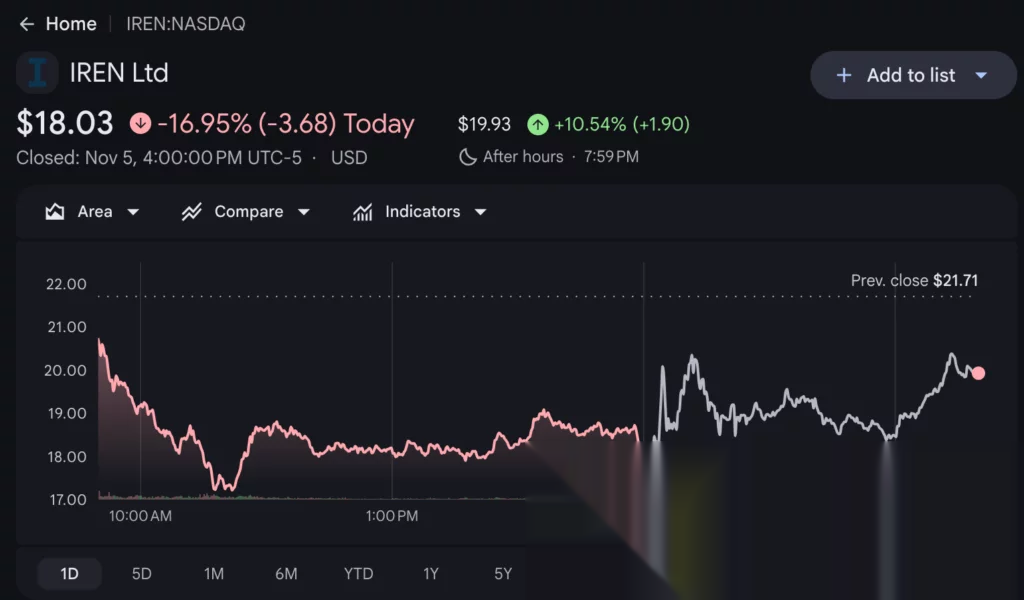
- IREN shares closed at $18.03 on November 5, falling 16.95% during the trading session that day.
- Microsoft’s requested infrastructure changes pushed IREN’s $4 billion annual recurring revenue target into early 2027.
The company’s November 5 earnings release showed that AI cloud revenue climbed 182% to $200 million during the three months ended September 30, up from $71 million in the previous quarter. Total revenue reached $228 million, an increase of 66% from $137 million in the June quarter.
The company reported a net loss of $263 million, compared with a $684 million loss in the preceding quarter. Adjusted EBITDA rose from $19 million to $66 million.
IREN Bitcoin mining revenue falls as company winds down operations
In its quarterly filing, IREN confirmed that Bitcoin mining revenue fell from $67 million in June to $28 million in September. Compared with the same quarter in 2025, when mining revenue reached $233 million, the decline was approximately 88%.
Bitcoin production decreased to 402 BTC from 2,039 BTC a year earlier. Average operating hashrate fell from 45.3 exahashes per second (EH/s) to 8.8 EH/s over the same period as the company removed mining equipment to make room for AI infrastructure.
IREN attributed the lower mining revenue to reduced production and weaker average Bitcoin prices. At September 30, its installed mining capacity stood at approximately 7.9 EH/s, representing around 180 megawatts of data center capacity.
“We aim to substantially complete this transition by December 31, 2026, with immaterial Bitcoin mining operations expected to continue through calendar year 2027,” the company stated in its quarterly filing.
IREN continues to sell its mined Bitcoin daily and reported holding no BTC on its balance sheet at the end of September.
Moreover, other Bitcoin miners are pursuing similar AI infrastructure projects. MARA has partnered with Starwood to develop AI data centers, while CleanSpark has expanded into AI computing alongside its Bitcoin mining business.
As crypto.news reported during its European expansion, IREN had already begun reducing mining operations earlier in 2026 while developing additional AI computing capacity.
AI cloud revenue reaches $200 million as Microsoft deployment begins
The company’s AI cloud operations accounted for nearly 88% of quarterly revenue, compared with approximately 52% in June.
Of the $200 million generated by the business, AI cloud services contributed $135 million, while cloud leasing added $65 million. The leasing revenue followed Microsoft’s acceptance of the first Horizon data center deployment in August.
“This quarter Horizon 1 went into service for Microsoft with NVIDIA Exemplar status, AI Cloud revenue nearly tripled to $200 million, and operating ARR doubled to a billion,” said IREN co-founder and co-CEO Daniel Roberts.
The company reported an 86% AI cloud segment gross margin, unchanged from the previous quarter. Its revenue backlog reached $20.3 billion, up 22%, with approximately two-thirds tied to investment-grade counterparties.
IREN previously announced $2.8 billion in contracts in July, when it raised its projected annual recurring revenue target above $4 billion.
However, the latest results moved the expected delivery of that target from December 2026 to January 2027, with a possible extension through February.
“The more than $4 billion of contracted ARR is funded and now targeted for January,” said Roberts, citing a customer-requested design change and supplier timing.
During the earnings call, Roberts identified Microsoft as the customer requesting changes to network infrastructure for its 200-megawatt deployment.
IREN shares fall 17% as company revises revenue timeline
IREN shares closed November 5 at $18, down nearly 17% from the previous session’s $21.71 close. The stock subsequently recovered some ground in extended trading following the earnings release.
The revised revenue schedule coincided with concerns about the cost of delivering AI infrastructure. IREN expects approximately $15 billion in remaining capital expenditure during fiscal 2027.
According to management, $9 billion would come from cash, committed financing and customer prepayments. The remaining $6 billion depends on targeted financing sources, including additional GPU and data center funding.
An October report on AI infrastructure borrowing costs detailed IREN’s separate financing arrangements for its Microsoft deployment and other GPU projects.
The company reported $20.6 billion in total assets at September 30, including $6 billion in data center assets.
Following the quarter, IREN expanded an existing agreement with an AI research company and signed a five-year contract carrying approximately $22 million in annual revenue per megawatt.
Roberts said the customer agreed to prepay 90% of the associated GPU capital spending. The company separately signed a shorter agreement valued at $40 million in annual revenue per megawatt.
IREN reported operating AI cloud capacity of approximately 93 megawatts at September 30, with additional construction underway at its Childress, Mackenzie and Sweetwater facilities.
The company said its Horizon 2 through Horizon 4 projects had reached late-stage construction, while development continued at its 100-megawatt Mackenzie site and Sweetwater 1 campus.