





Original | Odaily Planet Daily (@OdailyChina)
Author | Asher (@Asher_0210)

Yesterday, the results of the US midterm elections were finalized. The Democratic Party won both the Senate and the House of Representatives, and Trump lost the majority support in Congress. The room for advancing legislation and implementing policies in the next two years will be significantly limited.
As the election results settled, the crypto market, after a brief decline, welcomed a long-awaited strong rebound last night. BTC briefly broke through $81,000, while ETH approached $2,450.The market seems to be beginning to expect that as Trump's governance is subject to more constraints, the impact of policy flip-flops may weaken, and the capital market finally has a chance to catch its breath.The previous concerns about the Republicans losing both chambers were gradually released, and after the "bad news landed," buying began to return.
The long-dormant crypto market has welcomed a rebound. BTC and ETH have taken the lead. Which altcoins should be positioned next? Protocols that are still consistently profitable this year may be worth focusing on.Below, Odaily Planet Daily, starting from protocol revenue and combining token buyback, burn, and other mechanisms, sorts out four altcoins worth watching for everyone.
Hyperliquid: Tens of millions of dollars in monthly revenue, plus US market expectations beyond buybacks
Apart from the two stablecoin issuers Tether and Circle,Hyperliquid is the most profitable crypto-native project in the past 30 days, with revenue as high as $66.87 million.
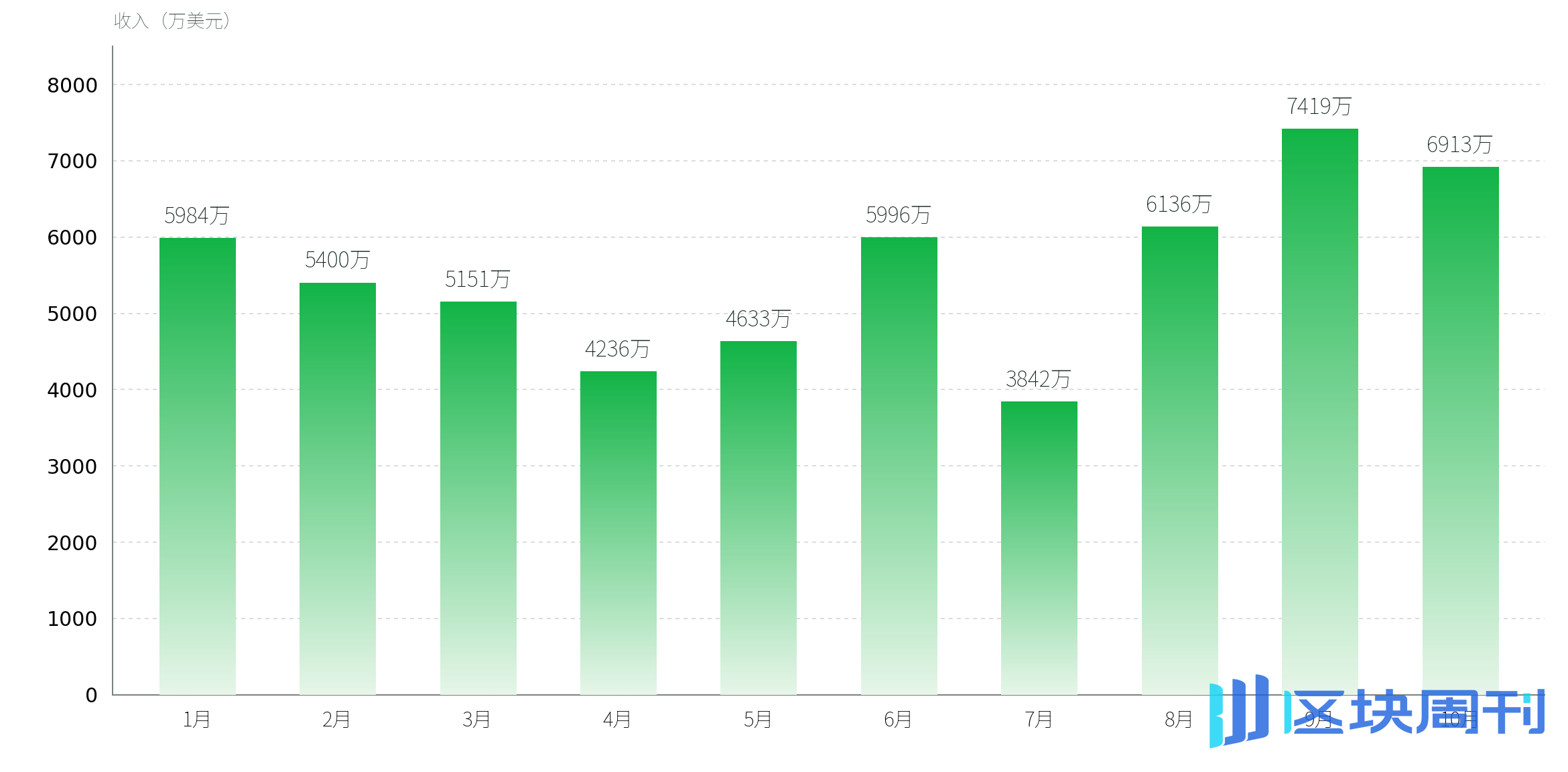
From monthly data, Hyperliquid's protocol revenue from January to October this year was approximately $59.84 million, $54 million, $51.51 million, $42.36 million, $46.33 million, $59.96 million, $38.42 million, $61.36 million, $74.19 million, and $69.13 million, totaling about $557 million. After revenue fell to a yearly low in July, it returned above $60 million in August, hit a new yearly high of $74.19 million in September, and although it pulled back in October, it remained higher than the levels of each month in the first half of the year.
Hyperliquid's revenue mainly comes from perpetual contract and spot trading fees.Currently, the platform uses a tiered fee schedule. For ordinary users, the base Taker/Maker fees for perpetual contracts are 0.045% and 0.015%, respectively, while for spot they are 0.07% and 0.04%. The higher the trading volume and HYPE staking amount, the lower the fees.Funding rates are paid directly between longs and shorts and are not part of Hyperliquid's protocol revenue.
Almost all the money Hyperliquid earns is used to buy back and burn HYPE.Currently, about 99% of the fees generated by the protocol go into the Assistance Fund (SEC filings disclose that Hyperliquid increased the proportion of protocol fees entering the Assistance Fund from 97% to 99% in August 2025), which is used to continuously buy HYPE from the secondary market and permanently burn the purchased HYPE.
Beyond existing revenue,Hyperliquid is also advancing its layout in the US market.In September, Payward, the parent company of Kraken, announced plans to provide on-chain perpetual contract trading for US customers based on Hyperliquid through its licensed entities. In October, Hyperliquid further opened the HIP-3* testnet feature, supporting deployers to manage trading access through an on-chain whitelist. The relevant business still requires regulatory approval before it can go live.
"Able to earn, continuously buying back, and now with the imagination space of the US market," perhaps this is the most noteworthy investment logic for HYPE at present.
Pump.fun: The "shovel seller" of the Meme track, earning from round after round of coin issuance booms
Another project whose revenue scale is close to Hyperliquid and which once briefly surpassed it is the leading Meme issuance platformPump.fun — with protocol revenue of about $56.97 million in the past 30 days.
From monthly data, Pump.fun's revenue from January to October this year was $47.98 million, $37.89 million, $36.29 million, $30.63 million, $34.40 million, $26.56 million, $32.85 million, $55.50 million, $49.39 million, and $62.43 million, totaling about $414 million. After revenue fell to a yearly low in June, it gradually recovered, broke through $50 million in August, and hit a new yearly high of $62.43 million in October, up about 26% from September.

Pump.fun's core revenue comes from continuous trading of new coins on the platform. Currently, it is free for users to create tokens themselves, but buying and selling during the Bonding Curve phase requires paying trading fees. According to Pump.fun's latest fee schedule,the total fee rate per transaction on the Bonding Curve is 1.25%, of which 0.95% goes to the protocol and 0.30% is distributed to the token creator. In addition, when a token graduates from Pump.fun to PumpSwap, a graduation fee of 0.015 SOL is also charged.
The money Pump.fun earns is also continuously converted into buying pressure for PUMP. In April this year, Pump.fun reduced the buyback ratio from 100% to 50%, but as platform revenue recovered, buyback spending in the past 30 days still reached about $26.16 million, averaging about $870,000 per day.Although the buyback ratio has been halved, the platform is still continuously spending real money to buy PUMP and permanently burning the repurchased tokens.
In September, Pump.fun launched Custom Pairs and Holder Rewards, supporting new coins to pair with assets such as PUMP and tokenized stocks, and allowing creators to distribute fees to token-holding users, expanding coin issuance and trading玩法.
If you believe the Meme track will exist forever, PUMP may be more worth watching than betting on the next Meme.
Uniswap: DEX leader turns on the fee switch, UNI finally begins to "capture" protocol revenue
In the past 30 days, Uniswap became the most profitable DEX with $8.04 million in revenue.Although there is still a gap compared with platforms like Pump.fun and Hyperliquid that earn tens of millions of dollars a month, within the DEX track, Uniswap's profitability has returned to the first tier.
From monthly data, Uniswap's protocol revenue from January to October this year was approximately $2.86 million, $3.21 million, $4.59 million, $4.50 million, $3.85 million, $5.13 million, $4.41 million, $9.33 million, $15.49 million, and $8.51 million, totaling about $61.88 million. Revenue in the first seven months basically remained at around $3 million to $5 million per month, rose significantly in August, hit a new yearly high of $15.49 million in September, and although it fell back to $8.51 million in October, it remained higher than the levels of each month in the first half of the year.

Uniswap's revenue comes from the Protocol Fee charged during transactions. Currently, the protocol fee has been enabled in all Uniswap v2 pools and some v3 pools, and is gradually expanding from Ethereum to multiple chains such as Arbitrum, Base, OP Mainnet, BNB Chain, and Polygon. Taking v2 as an example, users still pay a 0.30% fee per transaction, of which 0.25% goes to LPs and 0.05% goes to the protocol; v3 charges a corresponding proportion of protocol fees based on different fee-tier pools.
Since the UNIfication proposal was implemented at the end of 2025, Uniswap has officially enabled the Protocol Fee and uses the revenue for UNI burning (for more related content, you can read: After the Uniswap fee switch landed: Is the "report card" of this DeFi revolution good enough?). The protocol fee will enter the TokenJar, and external participants who want to take away the assets accumulated therein need to simultaneously burn a corresponding amount of UNI.
The UNI token has transformed from a "pure governance asset" into an "asset clearly linked to protocol fees and usage." If DEXs will still be the most fundamental entry point for on-chain transactions, dollar-cost averaging into UNI now is at least no longer just an investment in Uniswap's brand and position.
Chainlink: Not Chasing Hype, Building the "Toll Booth" of On-Chain Finance
Not relying on Meme hype, nor on contract trading volume, Chainlink still generated $4.28 million in revenue over the past 30 days. Compared with platforms like Pump.fun and Hyperliquid whose revenue fluctuates with market trading activity, Chainlink is in a more infrastructure-oriented business — as long as on-chain applications such as DeFi, stablecoins, and RWA are still running, the demand for oracles, cross-chain communication, and data services will not disappear.
Looking at monthly data, Chainlink's revenue from January to October this year was approximately $5.66 million, $4.49 million, $4.45 million, $5.80 million, $4.65 million, $4.60 million, $5.76 million, $4.48 million, $4.46 million, and $5.35 million, totaling about $49.70 million. Monthly revenue remained basically between $4.40 million and $5.80 million, with a decline in August and September, and a rebound to $5.35 million in October.

Chainlink's revenue comes from fees paid by developers, protocols, and institutions for using Chainlink services such as Data Feeds, CCIP, Automation, and VRF, covering on-chain foundational needs such as price data, cross-chain communication, and automated execution. Today, Chainlink's services no longer only serve DeFi, but are increasingly entering stablecoin, RWA, and institutional asset tokenization scenarios. Official data shows that as of July 2026, its cumulative Transaction Value Enabled (transaction value facilitated by Chainlink) had reached $36.42 trillion.
Currently, Chainlink has launched Payment Abstraction and Chainlink Reserve, gradually converting Chainlink's business growth into sustained demand for LINK. The on-chain and off-chain service revenue paid by users and enterprises can be automatically converted into LINK through Payment Abstraction and enter Chainlink Reserve for continuous accumulation.
If more financial assets truly move on-chain in the future, Chainlink may not need to bet on which public chain or which DeFi project will ultimately win — as long as on-chain finance continues to expand, this "toll booth" will generate more and more revenue.