


Compiled & Translated by: Deep Tide TechFlow

Deep Tide Introduction: From an immigrant teenager in Vancouver, to the founder of the world's largest crypto exchange, to being imprisoned and then pardoned by the president four months later. In this video podcast, CZ systematically reviews for the first time the rise of Binance, the tweet that crushed FTX, the truth about prison and the pardon, and his real judgments on Hyperliquid, DEX, and the next bull market. He has no regrets, but he has also drawn the "red line" he will never cross.
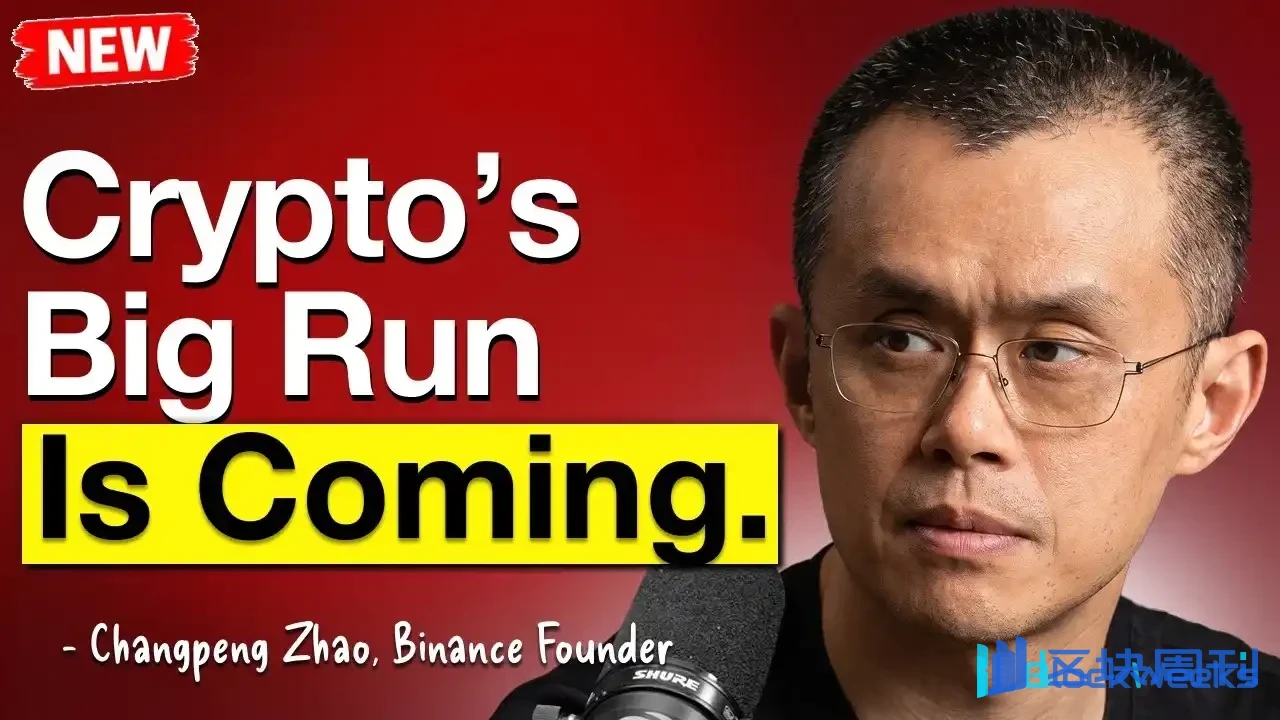
Guest: CZ, Founder of Binance
Host: Kevin, host of When Shift Happens
Podcast source: When Shift Happens
Original title: CZ Binance Founder: This Crypto Bull Run Could Make You Rich | E187
Air date: September 25, 2026
Key Takeaways
- FTX was not brought down by a single tweet: When Binance exited its FTX equity, it recovered about $2.1 billion equivalent in cash, BUSD, and FTT. What really crushed FTX was its misappropriation of billions of dollars in customer funds. Coindesk reported three or four days before CZ tweeted that it might be insolvent.
- Going to prison for a single violation of the Bank Secrecy Act is rare in U.S. history: CZ was sentenced to four months on this one charge. His biggest fear in prison was being repeatedly hit with additional charges and held indefinitely. In 2025 he received a presidential pardon from Trump, with zero contact with Trump himself throughout.
- Binance started from a 15 to 20 person B2B team: Its predecessor BG Tech sold trading systems to collectibles markets, and 80% to 90% of customers were not crypto exchanges. In May 2017, a decision was made in a meeting room to pivot to a crypto-to-crypto exchange, and with a solid team it became the world's largest in six months.
- For security incidents, press the "red button" first: In May 2019, Binance was hacked for $40 million. CZ immediately suspended all withdrawals, kept trading open, halted withdrawals for a week, and used the opportunity to migrate the architecture from servers to serverless. He believes anyone at an exchange should be able to press the red button to stop everything.
- Crypto penetration is still less than 1%, and now we need to grow the pie together: From a holder perspective, penetration is about 5% to 15%, but from a net worth perspective, actual investment is less than 1%. So he welcomes DEXs like Hyperliquid with open arms and opposes treating peers as enemies.
- The "villain" narrative of the 10/10 crash was amplified by competitors: The timeline was first Trump tariffs, then stock and crypto crashes. The stablecoin that had problems on Binance had a very small market cap. During that period Binance still had net inflows and voluntarily used about $800 million to compensate affected users, with no obligation to do so.
- CZ believes he cannot move a $3 trillion market: He tweets five to ten times a day, each bullish. One time landing exactly five hours before a positive Trump speech was pure probability. When he has advantageous information, he does not tweet.
- After stepping away from the front line, he focuses on education and regulation: Giggle Academy has reached about 1.3 million children, exponential growth compared with 100,000 in early 2026. He believes AI-customized free education is the investment with the greatest long-term positive impact.
II. Highlights
- "If one of your competitors can bring down your company with a single tweet, then you never really had a real company."
- "In my case, in American history, no one had ever gone to prison just for violating the Bank Secrecy Act once, and to this day no one has."
- "Hard work means different things to different people. But I think producing results and being efficient is more important than working long hours."
- "In Asian culture, once people follow a leader, they follow almost blindly, so sometimes it is hard to solicit feedback for your ideas."
- "In terms of penetration, we are probably not even at 1%. And the current market size is not the future market size."
- "We see exchanges as helping to grow the pie. Because right now, the market is far from saturated."
- "I actually really hope they expand and take the path they took in the U.S. That is great. That is actually good for the industry."
- "If you are bullish and tweet five times a day, one of those times will happen to be five hours before positive news."
- "Positive impact makes people happy. If you know you are contributing and helping others, it makes you happy from the inside."
- "If you are good at math and bad at English, you will spend less time on math and more time on English, pulling you toward the average."
III. Main Text
I. From Second-Generation Immigrant to Founding Binance
Kevin: What happened in your life that can explain how you became one of the 20 richest people in the world before age 50?
CZ: First, I think that ranking is not accurate. I might be in the top 100 or top 500. And my social circle at the high end is heavily skewed toward crypto.
Kevin: Where does that inner drive come from?
CZ: I cannot remember any traumatic childhood experiences, but I grew up in a fairly poor environment. My family immigrated to Canada. Both my parents earned close to minimum wage, while many of my friends were from wealthy investment immigrant families from Taiwan and Hong Kong, which put some pressure on me.
Kevin: You mentioned your sister. What does she do now?
CZ: She is also a tech person. She previously worked at a startup in Tokyo, and later became one of the managing directors at Morgan Stanley. There are about 400 managing directors globally, and the company has nearly 100,000 employees. She retired around age 42 and now counsels people experiencing depression.
Kevin: You said second-generation immigrants usually see how hard their parents work and want to push forward; but the third and fourth generations "decline." How do you prevent that from happening to your children?
CZ: I still do not know what solution works, and I do not have a third generation or second generation, so I can push that question further down the road. I think it is education, but it is very hard.
Kevin: Take me back to Binance's first day. If I were in your living room then, what would I see or hear?
CZ: Binance's start was a bit different. We had a team of 15 to 20 people running a company called BG Tech, selling trading systems to other exchanges. In May 2017, I called everyone into a meeting room and said now might be a good time for us to build a crypto-to-crypto exchange. That moment was the moment.
Kevin: What does "hard work" mean to you?
CZ: Producing results and being efficient is more important than working long hours. Many people work long hours but produce nothing. Passionate people measure not hours but how committed they are and how high-quality the results they can produce in a short time are.
Kevin: What is the biggest misunderstanding people have about Binance?
CZ: Some people think it is a Chinese company. It is not; we just have a large number of Chinese employees. Others think centralized exchanges are bad and evil in the industry, but we actually invest heavily in decentralization. Most people today prefer centralized exchanges, but I think the future is decentralized.
II. The FTX Collapse and That Tweet
Kevin: FTX co-founder Sam Bankman-Fried said it was your tweet that brought down FTX. Do you have even a sliver of feeling that he is right?
CZ: No, absolutely not. If one of your competitors can bring down your company with a single tweet, then you never really had a real company. If he was running a company that I could kill with one tweet, then he could not have owned that company.
Kevin: So you did not expect it at all, or you underestimated the impact your tweet could have?
CZ: I don't think my tweet had that big an impact. It was more like a public disclosure tweet. As part of Binance exiting its FTX equity, we recovered about $2.1 billion equivalent in cash, BUSD, and FTT. I said we would liquidate all remaining FTT on our books. At the time, I actually didn't know they would have problems, and I didn't expect it to have any impact.
Kevin: What happened before you tweeted?
CZ: Coindesk published an article saying they might be insolvent, about three or four days before my tweet. The fact is they lied to customers and misappropriated customer funds. Alameda's CEO tweeted 20 minutes after my tweet, and many people said her tweet might have revealed more information than mine.
Kevin: What's a truth about the week of FTX's collapse that no one else knows?
CZ: They misappropriated billions of dollars of customer funds, used it to buy other things, and then when the market had a downturn, customers couldn't withdraw their money. It's that simple.
III. Prison and Trump's Pardon
Kevin: You served a few months in prison. What belief did you go in with that you came out without?
CZ: It wasn't really a belief. I was very worried I would be kept there indefinitely, that they would find another charge, that there would be endless accusations. In my case, no one in American history had ever gone to prison for just one violation of the Bank Secrecy Act, and to this day no one has. Most people aren't even prosecuted.
Kevin: Was there anyone who disappeared when things got hard that surprised you?
CZ: No one at Binance ever disappeared. All the co-founders from 2017 are still here, not one left. That was a very cohesive team. In the industry, many people promise the whole world and then disappear a few months later.
Kevin: The U.S. president signs roughly 10 to 40 presidential pardons a year. You got one of them last year. Walk me through the pardon process, from the first phone call to the final signature.
CZ: I discussed with lawyers what the process would look like. Trump said during the campaign he would pardon Ross Ulbricht, and later Arthur Hayes also got a pardon, and his case was more similar to mine. Through friends, I contacted the same lawyer who handled their pardons and submitted a petition in April 2025, after Arthur Hayes was pardoned in March.
Kevin: Did you need to meet Trump in person?
CZ: I've never met Trump in person, never spoken with him on the phone, never emailed him, don't have his number. The closest I came to seeing him in person was at Davos, he was on stage and I was in the audience. We never shook hands, and he had no idea I was in the audience.
Kevin: Some people see the pardon as proof that political influence matters more than anything else. Where are they wrong?
CZ: In my case, my view is obviously biased, so I'll let others judge. Many people have said I was treated unfairly and should have been corrected. I was charged because Binance's KYC program wasn't strong enough, but I personally never handled any transactions. Right now this administration is discussing that Polymarket has no KYC, they just geo-block international markets, and they would do the same for perp DEXs. If I were judged by today's standards, then there wouldn't be a problem.
IV. The "Red Button" for Security Incidents
Kevin: We had Ben Zhu from Bybit on last year, just two days after they suffered a $1.5 billion hack. You publicly advised pausing withdrawals, while Ben chose not to. In hindsight, was Ben right and you wrong?
CZ: I don't think there's a right or wrong in that situation, it's just a judgment call. Ben obviously had more information about the incident than I did. My style is to take a much more conservative approach, and I would pause withdrawals first.
Kevin: What did you do when Binance was hacked for $40 million in 2019?
CZ: In May 2019, Binance was hacked for $40 million all at once. The first thing I did was pause all withdrawals, in fact pause all systems. I have a virtual big red button in my head. When a security incident happens, you press it first, then go figure out what happened and what the impact is.
Kevin: How does this red button work specifically?
CZ: Anyone, anyone on the exchange platform should be able to press that red button and say stop everything. Only after you've analyzed things more clearly and are very certain do you slowly turn things back on. In 2019 we paused withdrawals for a week but kept trading going, because we didn't want prices to diverge from other exchanges. During that week we also migrated the system from a server architecture to a serverless architecture.
Kevin: If Bybit had taken your advice, would the outcome have been vastly different?
CZ: No, not much difference. The hack already happened once. Whether you pause withdrawals or not, only a second hack would have made a world of difference, and thankfully there wasn't one. It was a tough choice, and opinions vary.
V. Views on Competition with Hyperliquid and DEXs
Kevin: Many people in Crypto feel that Binance sees Hyperliquid as its first real competitor, and that some of your public comments are attempts to slow their momentum. What would you say to those people?
CZ: No, they're wrong. I encourage more Crypto exchanges to innovate. We see exchanges as helping to make the cake bigger. In terms of penetration, maybe only 5% to 15% of people hold some kind of Crypto, but in terms of net worth, the proportion they invest in Crypto is very small. In terms of funds and value, we're not even at 1% penetration.
Kevin: So you welcome decentralized exchanges like Hyperliquid?
CZ: We welcome more decentralized exchanges. A pioneer in a field isn't necessarily the biggest winner in the long run. Look at Google, far from the first search engine, and Binance is far from the first centralized exchange. Even with a first-mover advantage, it doesn't mean they always win. Making the industry bigger is much better than making a single platform bigger.
Kevin: Where is Hyperliquid stronger than Binance today?
CZ: Well, they don't have KYC, but that's a very small point.
Kevin: Why can't $HYPE be bought on Binance spot even now, when it's one of the best-performing assets of the past two years, up about 25x and in the top 10?
(Deep Tide note: This podcast was recorded a few days before HYPE was listed on Binance spot)
CZ: By the time Hype took off, I had already stepped back from Binance and was no longer managing Binance. My understanding is that for a long time the Hype token wasn't in circulation, and Binance has a policy of having to hold those tokens to guard against counterparty risk. Today that may no longer be an issue, but I don't know what the situation is now.
VI. The 10/10 Crash and the "Villain" Narrative
Kevin: Another thing happened last year, 10/10, that is, October 10, 2025, which sent most altcoins to zero or nearly zero within minutes, creating the largest liquidation event in Crypto history. Every financial crisis has its own villain. Why do you think the market wants a villain, and why did it choose you?
CZ: Obviously, one of our competitors heavily promoted that narrative, saying the problem was caused by Binance. In fact, the price movement first happened on that specific exchange. The sequence of events was Trump announcing tariffs, the stock market crashed, Crypto crashed, and then there was a technical issue on Binance related to a small stablecoin, which wasn't even USDT or USDC, it was Athena's USD, with a market cap in the single-digit billions, not at all the cause of the 10/10 crash.
Kevin: But many media outlets pinned the blame on Binance.
CZ: Chinese media picked it up, and a Chinese competitor operating a centralized exchange tried very hard to amplify it. Dragonfly's Hasib posted a timeline chart showing that prices started going down as soon as Trump announced tariffs, while Binance's problems came much later. Cathie Wood later candidly said she didn't think Binance caused the entire crash, and only mentioned that Binance had a technical issue that was part of the crash.
Kevin: What did Binance do at the time?
CZ: Binance put out about $800 million to compensate users who suffered losses on its platform, even though it had no obligation to do so. But during the entire period when people were saying bad things about Binance, Binance had net inflows, and its market share didn't drop at all. If you look at the money, Binance's users knew that Binance didn't cause that problem.
Kevin: Did you post "4"?
CZ: No. I usually only post "4" when a traditional media outlet publishes a negative article. When it's some small media outlet in the community or a few KOLs who may have been paid to post tweets, that's not enough to make me post "4".
Editor's note: CZ's "4" originates from his 2023 New Year's resolution to ignore FUD (fake news and negative narratives), and since then the community has responded to negative reports with "4".
Seven, Long-Term Bullish Stance
Kevin: You're known for always being bullish. On August 19, when Bitcoin was around 60k or 64k, you tweeted that if you wanted your future self two years from now to thank you for what you did today, that was a clear hint to buy Bitcoin, and then the market went up about 20% within a few days. Does CZ have the ability to move that roughly $3 trillion Crypto market?
CZ: No. The short answer is no, I don't have that ability. I've posted so many bullish tweets, every one of my tweets is bullish, I tweet about five times a day. It's just that that tweet happened to come about five hours before President Trump spoke at the Crypto summit, and I absolutely did not know that was going to happen.
Kevin: So you tweeted because you knew about the positive news in advance?
CZ: Whenever I feel I have information that gives me an edge, I don't tweet about that information. That tweet was posted on the road, when I was reading a book and someone in it said a quote, and I thought I could adapt it into a positive quote about Crypto. Heaven knows, five hours later Trump said they were going to bring Hyperliquid into the United States, and the entire speech was very positive, but I didn't know any of that content at all.
Kevin: If you're bullish and tweet five times a day, one of those times will happen to occur five hours before positive news, and that explains why the market moved?
CZ: Right, but today nobody is complaining, everyone is making money. Crypto follows a four-year cycle, I just didn't wait until October to post that tweet.
Eight, Giggle Academy Education Philanthropy
Kevin: If Binance disappeared tomorrow, what would you want your contribution to Crypto to be?
CZ: I don't know, I just do what I can. Even if Binance is still here today, I actually don't spend any time on that centralized exchange, I spend all my time talking with other countries about Crypto regulatory frameworks. 70% to 80% of our investments are still in the Web3 space, and I also spend time on Giggle Academy.
Kevin: What are you optimizing for most in your life right now?
CZ: Positive impact. If you know you're contributing and helping others, it makes you happy from the inside. In the short term, it's helping different countries formulate Crypto regulatory frameworks; in the longer term, I think Giggle Academy probably has the greatest positive impact. It's free education for everyone in the world, growing very fast, reaching only 100,000 children at the beginning of the year, and now it's already 1.3 million, in less than seven months, and the growth is exponential.
Kevin: Regarding education, what different ideas do you have?
CZ: I think today's education system wants to produce average, predictable people. If you're good at math and bad at English, you'll spend less time on math and more time on English, pulling you toward average. But in tomorrow's extremely competitive world, you need to be in the top 1%, hopefully the top 0.1%; being 0.1% better probably lets you earn 10 times more money, so you need to specialize in the few things you're good at.
Kevin: What about teachers?
CZ: The teacher system is extremely expensive and not very good. American teachers earn an average annual salary of $30,000, the highest in the world, so the average quality is very low. I believe an AI-driven, app-driven, individually customized curriculum would be much more effective. Today robots are still a bit clumsy, but app delivery is free, and once it's done well, whether 100,000 or 1.3 million people use it, the marginal cost is basically zero.