



Author: The Mispriced
Compiled by: Deep Tide TechFlow
Deep Tide Introduction: When the interest rate structure may have fundamentally reversed, holding an index is no longer equivalent to a neutral decision. This investor letter dissects the tension between AI capital expenditure, liquidity cycles, and the crypto market reset. There is only one core question: if the cost of capital remains elevated, how will each asset in your hands answer?
Introduction
For most of my investing career, falling interest rates were just part of the backdrop.
For most investors, their significance went far beyond that.
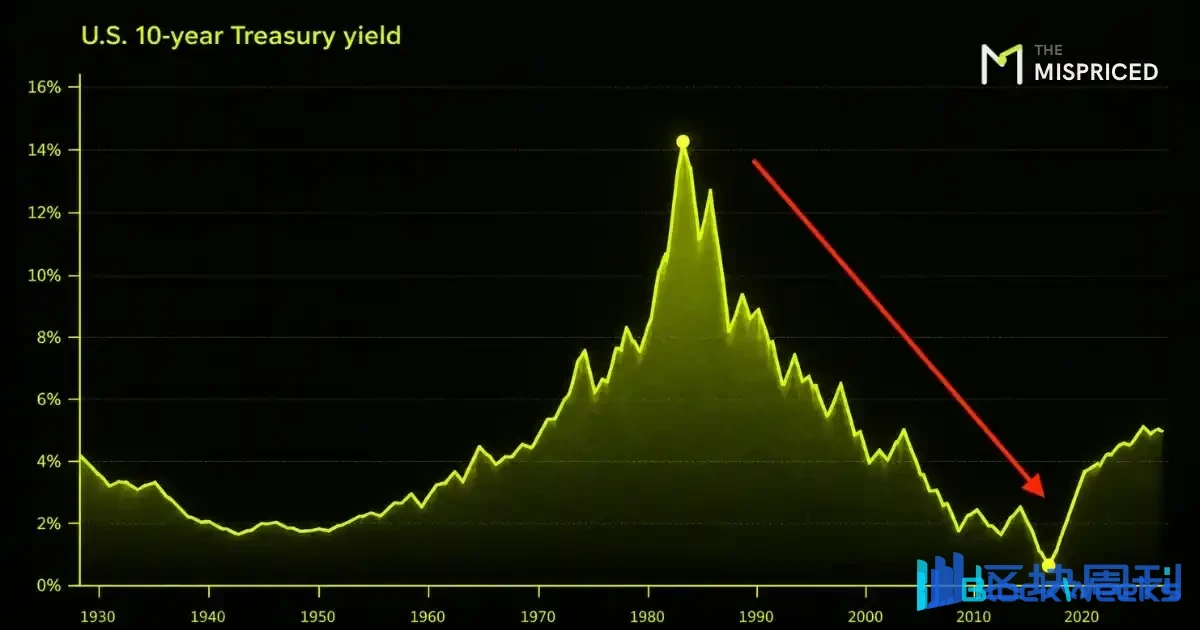
From the early 1980s to 2021, the world experienced a great long-term decline in interest rates.
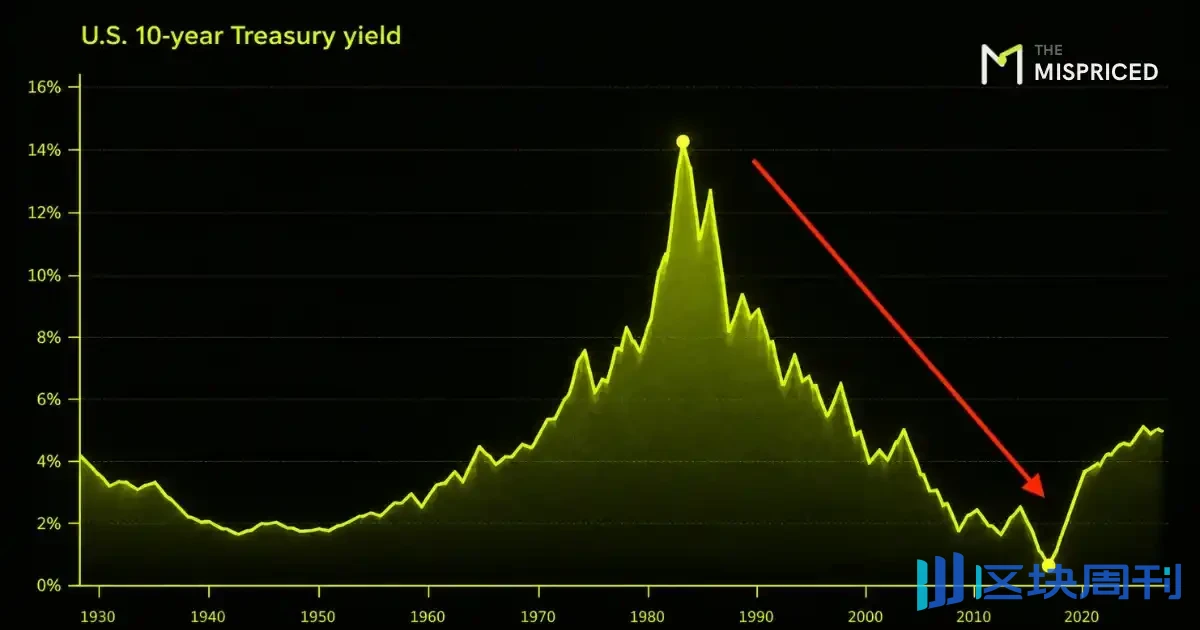
The specific reasons changed over time, but the direction was remarkably persistent. Lower inflation, globalization, demographics, central bank credibility, technological progress, and ultimately quantitative easing together created a world where capital became increasingly cheap.
This cycle broke in 2022.
I don't know if we are at the beginning of a forty-year cycle in the opposite direction.
No one knows.
But I think building a portfolio that depends on the return of the old world is a mistake.
When the risk-free real return available to investors rises, everything else must compete with it.
Long-duration assets become more sensitive to assumptions.
Weak companies must refinance at higher costs.
Growth driven by cheap money becomes harder to sustain.
Most importantly, the hurdle rate for investment has risen.
The Risk Is Being in the Wrong Position
I don't think the most valuable question today is whether the market will rise or fall.
A better question is:
If capital remains expensive, what will happen to each asset I hold?
This leads to a very different portfolio.
In my view, the biggest risk is not necessarily a full-scale market crash.
It is holding the wrong companies, the wrong industries, or the wrong assets in an environment of structurally higher capital costs, harder-to-predict inflation, and increasingly divergent performance.
That last point is important.
After years when holding an index was enough, I think the returns from stock picking are becoming attractive again.
George Noble recently made a similar observation: dispersion is rising, and pullbacks are appearing beneath the surface of the market. His conclusion is more bearish than mine, especially on consumer stocks, but the underlying observation is valuable.
I am not bearish on stocks. I am just becoming more selective about which stocks deserve capital.
The Index Is No Longer a Neutral Decision
Passive investing is one of the greatest financial innovations ever.
I don't think indexing is dead.
I do think that in certain periods, the expected return from simply buying an index becomes relatively less attractive, and it becomes more worthwhile to do work beneath the index.
Now may be such a period.
As of today, the top ten companies account for roughly 38% of the S&P 500. The largest component alone (Nvidia) accounts for close to 8%.

This does not mean the index is bad.
It means that buying the index today is effectively placing a larger implicit bet on a handful of companies than many investors realize.
And some of those companies are undergoing fundamental changes.
Tech companies are increasingly starting to look like industrial companies.
AI Is Starting to Look Like an Industrial Business

Not because software is disappearing, but because AI is extremely capital-intensive.
The AI revolution is creating enormous demand for physical infrastructure. Recent reports show that financing needs have grown so large that even corporate bond investors are starting to distinguish between traditional issuers and AI-related borrowers.
This changes the questions I want to ask.
The question is no longer: "Will AI change the world?"
I think it probably will.
For investors, the question is: "Will the returns on capital invested in AI be sufficient to justify the scale of capital required?"
These are two very different questions.
A technology can transform society while still delivering disappointing returns to some of the investors who financed it.
From Valuation Bubble to Earnings Problem
I think this is where the debate around AI becomes more interesting.
Everyone is talking about valuations.
What I am increasingly focused on is the possibility of an earnings bubble.
Not necessarily because current earnings are fake, but because today's earnings expectations may be implicitly assuming that massive capital expenditures will generate extraordinary future economic returns.
That assumption deserves to be tested.
Growth creates value only when the return on incremental invested capital exceeds the cost of capital. When the return on capital is below the cost of capital, more investment actually destroys value. This principle is simple, but it becomes far more important when both the scale of investment and the cost of financing are rising.
Free cash flow matters for the same reason. Growth capex can be extremely valuable, but only if those investments ultimately create economic value. Spending more money does not equal becoming more valuable.
Who ultimately captures the economic gains: model providers, chip companies, hyperscalers, utilities, data centers, software companies, or end customers?
I don't have the answer yet.
That uncertainty is precisely the point.
If market prices assume a very favorable answer, then the bar for proof is higher.
Graham understood this decades ago: the more growth a valuation requires, the more sensitive the investment is to small errors in the growth assumptions.
Price and quality are not separate.
Price determines the odds.
Liquidity Matters More Than Before
There is another variable I am spending more time studying: liquidity.
Modern financial markets depend not only on the level of interest rates, but also on the availability and direction of flow of balance sheet capacity.
Michael Howell's "Capital Wars" framework studies the relationship between the stock of debt and global liquidity. His argument is that a highly indebted financial system continuously needs liquidity, because a large amount of existing debt must be refinanced.
When liquidity grows faster than refinancing needs, financial assets tend to benefit.
When liquidity becomes scarce relative to debt, pressure rises.
I don't treat any single macro indicator as a trading system.
But this framework is useful.
It helps explain why liquidity can drive markets even when the fundamental story hasn't changed much.
It also reinforces something I increasingly believe:
Cash does not mean I don't know what to buy. Cash is an option.
Its value is not just the yield earned while holding it.
Its real value lies in the ability to deploy capital when future expected value improves significantly.
If the market becomes more differentiated, this option becomes more valuable.
Gold, and the Leverage Embedded in Gold Miners
Gold plays a different role.
It does not need earnings growth to serve a portfolio function. Gold can benefit when market confidence in fiscal discipline, monetary stability, or fiat purchasing power deteriorates.
This does not mean gold only goes up.
Cathie Wood's current view is almost the opposite of my base case: she believes technology-driven productivity gains, lower inflation, and possibly a stronger dollar will create the conditions for a significant decline in gold.
That scenario deserves attention.
My interest in gold is not based on the certainty that currencies must depreciate. It is based on the payoff if that risk becomes more important.
Gold miners are a different bet.
They introduce operational risk, political risk, management risk, cost risk, and execution risk, but they can also provide operating leverage to the gold price. In the first quarter of 2026, the World Gold Council reported that average profit margins for gold producers rose much faster than the gold price, because the increase in realized prices exceeded the rise in mining costs.
So I view these two exposures differently.
Gold is a hedge. Gold miners are a leveraged equity expression of that judgment.
Position sizing should reflect that difference.
Crypto Is Recalibrating
Crypto is at the other end of the portfolio.
Bitcoin has recently strengthened again after a long cooling-off period, touching an eight-month high in September.
I am also watching the improving momentum below Bitcoin, especially in some of the higher-quality protocols on our watchlist, including NEAR, Uniswap, Raydium, and Jupiter.
Digital Asset Review: September 2026
I do not interpret this as permission to chase.
Quite the opposite.
My personal view is to use short-term overheated phases to reduce risk, or selectively express tactical downside views through small leveraged short positions, while using meaningful weakness to accumulate crypto assets where I believe the long-term asymmetry remains attractive.
The word "daily" matters. Due to daily resetting, path dependency, volatility, and compounding effects, leveraged inverse products can perform very differently from a simple long-term short. For me, this is a tactical tool, not a long-term hold.
Crypto itself remains a high-volatility allocation.
This means that even if the judgment is correct, the position can still go wrong if the position size is wrong.
I Am Not Investing for Black Swans
It is easy to build a portfolio around everything that could go wrong:
Debt crisis;
Currency crisis;
There is always a next disaster worth guarding against.
I don't think this is a useful way to invest.
Black swans are by definition hard to predict. Building an entire portfolio around predicting black swans is just another form of market timing.
I prefer to think in terms of probabilities.
The useful approach is not to pretend we know which future will happen, but to outline several plausible futures, assign rough probabilities, and then ask how our decisions would perform under those scenarios.
I remain optimistic about technology, entrepreneurship, productivity, and long-term economic progress.
But optimism is not a valuation method.
And diversification does not mean holding fifty things that all depend on the same macro environment.
The optimal portfolio should not require low interest rates, record profit margins, ever-expanding valuations, abundant liquidity, and extraordinary AI growth all at the same time.
It should have several different ways to work.
High-quality businesses that can compound capital.
Select stocks whose expectations are low enough to create asymmetric outcomes.
Cash that provides optionality.
Gold that provides different drivers of currency returns.
Gold mining stocks when returns are sufficient to justify the additional operating risk.
Cryptocurrencies whose upside is still large enough to justify the volatility.
And, importantly, the ability to choose not to act.
What matters is already in the price
I don't know where the S&P 500 will trade next year.
I don't know whether the 10-year U.S. Treasury yield will be 3% or 6%.
I don't know where Bitcoin will end this cycle.
I also don't know whether today's enormous AI investment cycle will bring extraordinary returns on capital, or merely extraordinary capital expenditures.
Fortunately, I don't think I need to know.
The goal of this project is not to precisely predict the future.
It is to understand what kind of future current prices already require.
And then compare the upside if reality turns out better with the downside if reality turns out worse.
The opportunity I see today is not necessarily in predicting the next bull or bear market.
It is in the widening gap between two types of assets: one that requires almost everything to go right, and another that has almost no success priced in.
Divergence is opportunity.
And if the world really enters a new regime in which capital once again has a real cost, I expect this distinction to matter far more than it did over the past decade.