
Overview
Altcoin trading volume has surged relative to Bitcoin, with recent spot activity approaching four times BTC spot volume and reaching its strongest relative level since September 2025. The shift is notable because it is occurring alongside broader market participation rather than an obvious surge in leverage. Glassnode reported that 72.5% of the altcoins it tracks outperformed Bitcoin over the latest week, while overall exchange spot volume had more than doubled from its August low. At the same time, altcoin perpetual open interest measured in coins had barely increased over the previous 30 days, suggesting that the latest rotation has been driven more by spot-market participation than by a rapid build-up of leveraged derivatives positions.
The 4x ratio should not be interpreted as four times more capital flowing into altcoins than Bitcoin. Trading volume measures turnover, so the same capital can be counted repeatedly as positions change hands. Higher volume also captures both buying and selling. The more accurate conclusion is that trading attention and liquidity have broadened decisively beyond BTC.
That distinction matters because spot-led altcoin rallies tend to carry a different risk profile from leverage-led expansions. If breadth remains strong without funding rates and open interest accelerating sharply, the move may be less exposed to immediate liquidation cascades. However, rising exchange deposits and stronger profit-taking could still turn high turnover into distribution rather than durable demand.
Key Takeaways
- Altcoin spot trading activity has approached four times Bitcoin spot volume.
- 72.5% of tracked altcoins recently outperformed BTC, indicating broad market participation.
- Altcoin perpetual open interest has remained relatively restrained compared with prior overheated periods.
- The 4x ratio measures trading turnover, not net capital inflows.
- The key question is whether spot breadth can remain strong without leverage and exchange deposits turning into sustained selling pressure.
Why Is Altcoin Trading Volume Nearly 4x Bitcoin?
The Ratio Signals Rotation in Market Activity, Not Four Times More Capital
The most important analytical point is that the altcoin trading volume ratio measures how actively assets are changing hands rather than how much new money has entered the market. If the same $1 million is used to trade several altcoins repeatedly during a session, that capital can generate many millions of dollars in recorded volume. A direct comparison with Bitcoin therefore describes relative market activity, not a one-for-one transfer of invested capital.
What the ratio does show is that risk appetite has broadened substantially. Bitcoin typically dominates attention during the early stages of a market recovery because it has the deepest liquidity, strongest institutional participation and clearest macro sensitivity. As confidence improves, traders often begin looking further down the risk curve for higher-beta opportunities. A sharp increase in altcoin spot volume is consistent with that process because more trading activity is taking place outside the largest asset.
The breadth data strengthens that interpretation. Glassnode reported that 72.5% of tracked altcoins outperformed Bitcoin during the latest week, compared with a high of only 39% during the August squeeze. This suggests that the move is not being driven solely by one or two large-cap tokens. A broader set of assets is participating, which is generally a more meaningful sign of rotation than isolated rallies in a handful of names.
Spot Volume Has Recovered Alongside Broader Exchange Activity
The altcoin move is also taking place within a wider recovery in spot trading. Glassnode reported that aggregate exchange spot volume had more than doubled from the August low, while activity was distributed across multiple trading venues rather than concentrating in a single exchange. That matters because a broad recovery in market turnover is generally more robust than one driven by a temporary spike at one venue.
However, rising volume alone does not establish directional demand. Every trade has both a buyer and a seller, and high turnover can accompany either accumulation or distribution. If holders move more assets onto exchanges while prices rise, stronger volume may eventually become a source of selling pressure. This is why the 4x ratio should be interpreted alongside exchange deposits, stablecoin liquidity, funding rates and realized profit-taking rather than as a standalone bullish signal.
The strongest conclusion at this stage is that altcoins have reclaimed market attention. Whether that attention turns into sustained capital formation depends on what happens after the initial rotation.
Is This an Altcoin Season?
Breadth Matters More Than a Single Volume Ratio
The phrase “altcoin season” is often used loosely whenever smaller tokens outperform Bitcoin, but a more rigorous definition should include both breadth and persistence. If only a small number of tokens rally while most of the market remains weak, the move is better described as selective speculation. By contrast, broad relative strength across many assets indicates that risk appetite is spreading through the market.
The latest data is therefore notable because the share of tracked altcoins outperforming BTC reached 72.5%. That is a much stronger breadth reading than the market showed during August. Combined with higher spot turnover, it suggests that traders are actively reallocating attention beyond Bitcoin rather than simply chasing one isolated narrative.
Still, one week of broad outperformance does not establish a durable cycle. Altcoin rallies can reverse quickly if Bitcoin weakens sharply, stablecoin liquidity contracts or traders begin realizing profits aggressively. A sustainable rotation usually requires several conditions to persist at the same time: healthy spot demand, improving breadth, controlled leverage and enough liquidity to absorb selling.
Why Spot-Led Rallies Differ From Leverage-Led Rallies
The most important difference between the current setup and some previous altcoin booms is the behavior of derivatives. Glassnode noted that altcoin perpetual open interest, measured in coins, has barely grown over 30 days and that fewer than half of tracked markets added positions. In overheated periods such as February 2021 and December 2024, open interest rose much more aggressively across a broad set of assets.
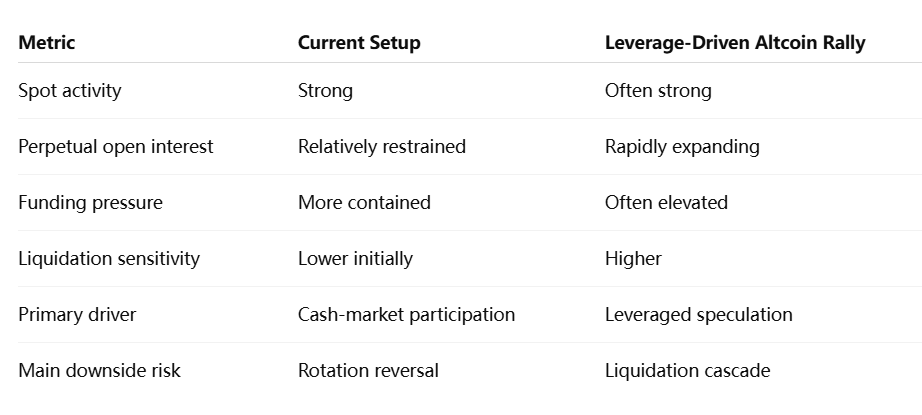
This difference matters because leverage changes how quickly a rally can unwind. When traders build large futures positions using borrowed collateral, a relatively small decline can trigger forced liquidations, which create additional selling and amplify volatility. Spot holders can still sell aggressively, but they are not automatically forced out by margin requirements.
A spot-led rally can therefore be structurally healthier, but it is not automatically safer. If prices rise faster than underlying liquidity or if exchange inflows accelerate, spot holders can still create a large supply overhang. The absence of extreme leverage simply removes one mechanism that can make corrections more violent.
Does Higher Altcoin Trading Volume Mean Stronger Demand?
High Turnover Can Reflect Buying, Selling or Both
Not necessarily. Trading volume measures transactions, not investor intention. Strong buying interest can generate higher turnover, but so can profit-taking, market-making and short-term arbitrage. This is particularly important in altcoin markets, where liquidity can be thinner and prices more sensitive to relatively small changes in order flow.
If tokens are moving onto exchanges at the same time that trading volume increases, the interpretation becomes more complicated. Deposits may reflect traders preparing to sell, post collateral or reposition between assets. Rising exchange balances do not guarantee immediate selling, but they increase the amount of supply available to the market.
A better demand analysis therefore combines volume with directional indicators. Spot cumulative volume delta, exchange net flows, stablecoin inflows, realized profit metrics and order-book depth can help distinguish genuine accumulation from high-frequency turnover.
The same logic applies to Bitcoin. A decline in BTC's share of spot activity does not automatically mean Bitcoin holders are selling in order to buy altcoins. Some of the change can result from new trading activity entering altcoins directly while Bitcoin volume stays relatively stable. Describing the trend as a rotation in trading activity is therefore more defensible than claiming a confirmed one-for-one capital migration.
Why Can Altcoin Rotation Matter for Bitcoin?
Higher Risk Appetite Often Appears Later in a Market Advance
There is a recurring market-cycle logic behind altcoin rotation. Bitcoin usually attracts capital first because it is more liquid and less volatile than most alternative tokens. Once BTC has produced a meaningful move and traders become more confident, some participants seek higher-beta assets with greater short-term upside potential. This can cause trading activity to move progressively down the market-cap spectrum.
Glassnode has noted that periods of increasing appetite for higher-risk crypto assets have sometimes appeared near local Bitcoin peaks. The mechanism is intuitive: when traders become more willing to move away from the market's largest asset, speculative intensity is usually increasing.
That historical pattern is useful context, but it should not be treated as a mechanical signal that Bitcoin is about to top. Market structure, institutional participation and liquidity conditions change between cycles. Altcoin strength can persist while Bitcoin continues rising if overall crypto liquidity is expanding.
The more useful interpretation is that the market has entered a higher-risk phase. From that point, monitoring leverage, breadth and profit-taking becomes more important because a deterioration in those indicators can signal that rotation is moving from healthy participation toward overheating.
What Should the Market Watch Next?
Perpetual Open Interest Is the Most Important Overheating Signal
The current rally looks materially different if altcoin perpetual open interest suddenly begins rising across most markets. A broad increase in leverage would indicate that traders are no longer relying primarily on spot capital and are beginning to amplify exposure through derivatives. If funding rates rise at the same time, the market would become more vulnerable to long-liquidation cascades.
Bitcoin dominance is another useful metric. A controlled decline in dominance alongside rising total crypto liquidity can support a broad altcoin rotation. A sharp dominance drop during stagnant or declining market capitalization would be more consistent with capital simply moving between existing assets rather than new liquidity entering the market.
Exchange deposits should also be monitored. If altcoin inflows to centralized exchanges rise significantly while prices remain elevated, the probability of profit-taking increases. Conversely, strong spot turnover combined with stable or declining exchange balances would provide a cleaner indication of demand.
Finally, breadth needs to persist. A market in which 70% or more of tracked altcoins continue outperforming BTC is structurally different from one where leadership narrows back to a small number of tokens.
MEXC View: Spot Breadth Matters More Than the “Altseason” Label
The more useful question is not whether the market can officially be labeled an “altseason,” but whether broad spot demand can remain strong without leverage and exchange inflows turning into sustained selling pressure. The current combination of rising spot volume, wider altcoin outperformance and relatively restrained perpetual open interest is more constructive than a rally driven primarily by leveraged speculation.
That does not remove downside risk. Altcoins remain more sensitive to liquidity conditions than Bitcoin, and a sudden BTC drawdown can quickly reverse relative strength across the market. The quality of the rotation should therefore be judged by how it behaves when volatility rises, not only by how fast volumes expand during favorable conditions.
For traders, the most important confirmation would be continued breadth without a sharp rise in funding and open interest. That would suggest the market is absorbing more risk through actual spot participation rather than simply borrowing against collateral to chase short-term momentum.
Altcoin Rotation Looks Real, but 4x Volume Is Not 4x Capital
Altcoin trading volume approaching four times Bitcoin spot volume is a meaningful sign that crypto market activity has broadened. Combined with 72.5% of tracked altcoins recently outperforming BTC and overall spot volume recovering strongly from August lows, the data indicates a genuine shift in trading attention toward higher-beta assets.
The structure of the move is particularly important. Altcoin perpetual open interest has remained relatively restrained compared with previous overheated periods, suggesting that the current rally has so far relied more heavily on spot-market participation. That reduces the immediate risk of a derivatives-driven liquidation cascade, but it does not guarantee that the rotation will continue.
Volume should not be confused with capital. The same funds can trade repeatedly, and higher turnover can reflect profit-taking as easily as accumulation. Rising exchange deposits, narrowing breadth or a sharp acceleration in perpetual leverage would all weaken the current setup.
The strongest conclusion is therefore more measured than declaring a new altcoin season. Risk appetite has clearly expanded beyond Bitcoin, and the rotation has a healthier spot component than several previous speculative episodes. Whether altcoin trading volume remains elevated will depend on the market's ability to sustain breadth without allowing leverage, selling pressure or liquidity fragmentation to overwhelm the move.
Sources
https://research.glassnode.com/the-week-onchain-week-38-2026/
https://research.glassnode.com/btc-market-pulse-week-39-2026/
https://www.mexc.com/crypto-pulse/article/mexc-on-chain-daily-report-160877
Risk Disclaimer: This article is for reference only and does not constitute investment advice. The cryptocurrency market is highly volatile. Please make decisions cautiously based on your individual circumstances.