Original | Odaily Planet Daily (@OdailyChina)
Author | Wenser (@wenser 2010 )
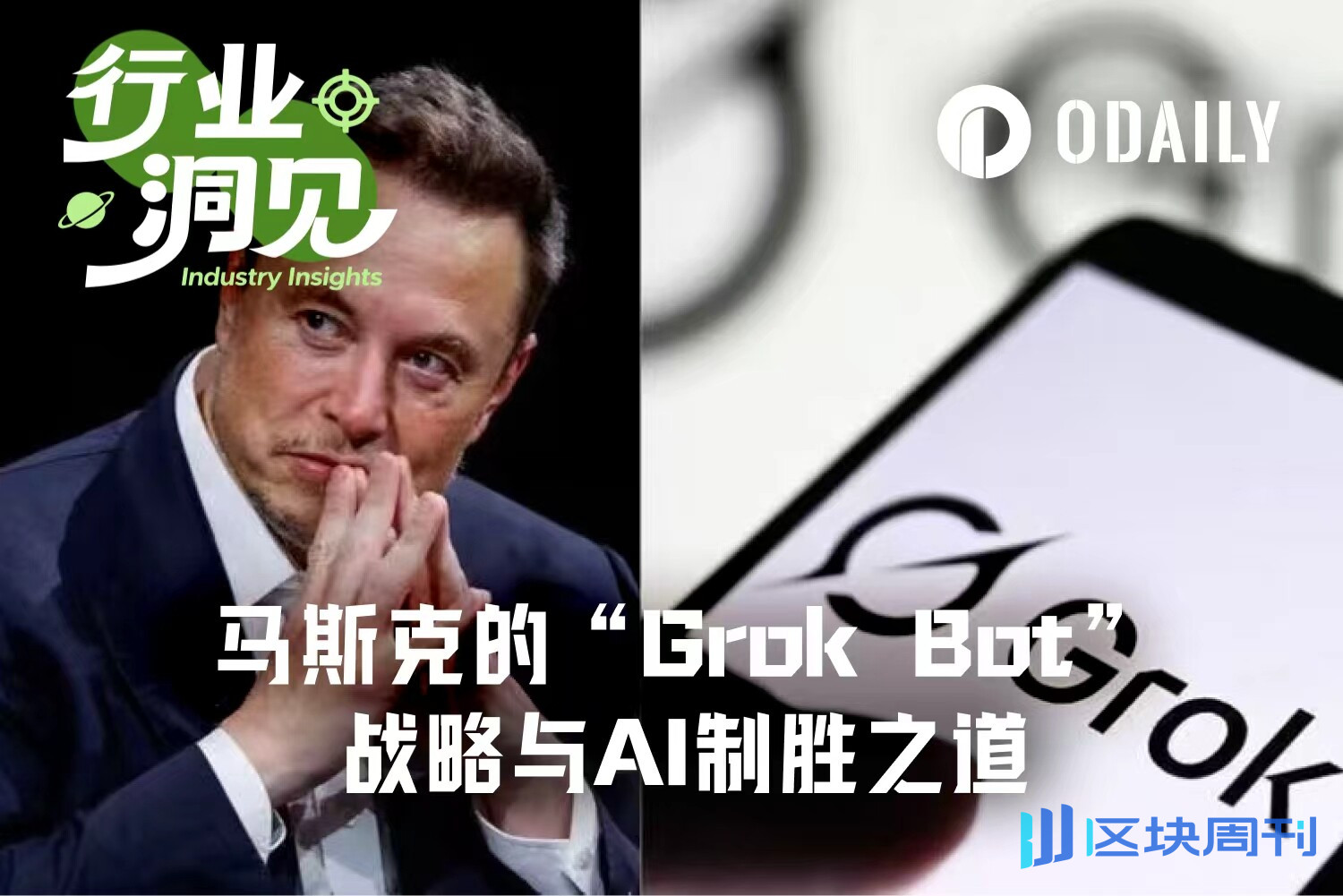
If you follow Musk's X platform account, you'll find that recently his frequency of mentioning "Grok Bot" is nothing short of crazy, even rivaling the frequency before Tesla and SpaceX product launches. Such high-frequency promotion naturally brought Grok Bot more and more attention and usage, and controversy and skepticism followed.
On November 1, someone called out to Musk saying "Grok Bot's quota consumption has been especially fast recently, when will there be a quota reset?" Musk responded that "the cost of providing services for Grok Bot is unsustainable relative to revenue," and stated that "even if the AI abundance era will eventually arrive, unlimited usage is not possible at this stage"; he also mentioned that users feeling that high-quota plans have become too expensive, and whether to lower quotas and notify in advance, are all matters that need to be weighed.
From publicly badmouthing new cloud vendors a while ago to his recent continuous betting on and endorsement of Grok Bot, what this reflects is not only Musk's optimism and affirmation of Grok Bot, but also hides his greater ambition to "seize the AI high ground." Today, let's look from a different angle at whether Musk's "AI layout" can work.
Behind Grok Bot's Explosive Popularity: The Personal Agent Tailwind Is Rising, the Cursor Team Is Going All Out
At present, we can simply and crudely divide the AI industry into 3 layers:
- First, infrastructure such as chips, computing power, and energy and electricity;
- Second, large models such as OpenAI's GPT Astra and Anthropic's Claude Opus 5.5;
- Third, Agent applications such as Meta's Muse and Grok's Grok Bot.
Musk has layouts in all 3 of these areas, and his focus is constantly adjusting, developing in coordination. Specifically, his layout can be divided into the following 3 parts:
First, the chip and computing power layer, which leans toward infrastructure construction. In this regard, Musk's earlier mention that competition in the cloud vendor track is intensifying and that new players may face accelerated elimination and clearing out is a major open stratagem. For more information, see "Badmouthing New Cloud Vendors, Musk's Top-Level Open Stratagem." As for his layout, on the one hand, there are the power energy and computing power chips previously reserved by SpaceX, and the cooperation previously reached with Anthropic is also an important part of its strategic transformation; on the other hand, the future development route has also been marked out: Musk previously made a bold claim that space computing power is expected to surpass ground computing power by the end of 2028; in addition, Terafab, a chip manufacturing enterprise jointly established by SpaceX and Tesla, plans to achieve the first batch of chip mass production in the third quarter of 2028. Mastering infrastructure is equivalent to locking in key resources in advance and ensuring that one is at least in an invincible position.
Second, the AI model layer, where AI giants are currently gathered. In the past, Musk had high hopes for Grok, but as time passed, the Grok model has always struggled to catch up with the latest models under OpenAI and Anthropic in industry competition. Ultimately, although the Grok model team was retained, in May of this year Musk still made a decision to "form alliances"—joining hands with Anthropic to oppose OpenAI. For more information, see "Musk and Anthropic Are Going to Space to Find Power."
Finally, there is the increasingly mature Agent application layer after the OpenClaw "lobster fever" at the beginning of the year. Meta's Muse and the previously troubled Manus are precedents that have provided a certain degree of user education and scenario breakthroughs for Agent applications. After the Cursor team successfully merged into SpaceXAI, Grok Bot is the painstaking work of that team. It is precisely under the main push of the Cursor team, which pursues the ultimate user pursuit, that Grok Bot is now advancing rapidly under rapid iterative updates, and backed by the data advantages of the X platform, it has further boosted Grok Bot's scenario expansion and user growth momentum.
In summary, SpaceX's successful listing this year, the lavish acquisition of Cursor with over $60 billion in stock, and a series of previous accumulations have opened new possibilities for Musk's "infrastructure + model + application three-step AI strategy." With the help of the popular application Grok Bot, SpaceXAI, the "AI mega-group organization" under Musk, has for the first time realized the possibility of connecting the upstream and downstream of the AI industry through a curved path to seize the high ground of track development.
After all, no matter how powerful the infrastructure resources and no matter how formidable the AI large models, an application is always needed as a channel and entry point to reach users and open the market.To some extent, this is the "new solution for AI industry layout" that Musk found after ending the litigation dispute with OpenAI.
Potential Hidden Worries Behind Musk's "Three-Line Layout": Infrastructure Stability, the Threat of a Large-Model Singularity, and White-Hot Application Competition
Of course, at the current juncture when Anthropic is about to IPO and AI industry sector stocks are experiencing a sharp correction, this does not mean that Musk and SpaceXAI can already rest easy. Because, from the perspective of the industry development stage, it has not even reached the "second half of AI industry development" yet, nor can it even be called the mid-stage. Therefore, if Musk and SpaceXAI want to occupy more advantageous positions and grasp more initiative, they still need to face the following risks:
First, SpaceX's borrowing pressure and infrastructure stability assurance. Although Musk is full of confidence in space computing power and chip layout, judging from his past "credibility score," it is still hard to fully believe the "2028 pie" he has given; his earlier mention that "SpaceX has completed $40 billion in GPU-related debt financing" once encountered negotiation obstacles is also a major example.
Second, the threat of a "singularity moment" in the chaotic battle of AI large models. If top-tier leading AI large models subsequently usher in a strong-update "singularity moment," and the flagship models of major leading AI vendors achieve historic capability breakthroughs, then after the Grok model's capabilities fall out of the first tier, the market and users will withdraw at any time and turn to embrace the newest and strongest AI large models.
Third, a more intense industry competitive landscape at the application level. The OpenClaw "lobster fever" at the beginning of the year was in full swing, but now it has been integrated into the underlying rules of various applications and models; Work Agent and Personal Agent are only different forms and applicable scenarios of Agent applications at present, and subsequently there will inevitably be more comprehensive Personal Assistant roles and applications. Not only are AI giants doing this, but internet technology giants are also competing hard, and individual independent developers as well as startups have also targeted this market. Although the differences in the underlying models called are limited, the differences in user experience and penetration at the application level do exist in real terms. Grok Bot's current popularity does not explain much in terms of user numbers and ROI input-output ratio.
Summary: After Work Agent and Personal Agent, the Next Step for AI Agent Is Life Agent
Finally, as a heavy user of Grok Bot, I'll briefly share my current experience.
With AI large models having experienced nearly 4 years of rapid development, today's AI Agent has officially crossed the threshold from "intern" to "regular employee." Tasks related to junior employees can already be confidently handed over to Grok Bot, Muse, and domestic applications such as WorkBuddy and Qwen, as long as security management and disaster recovery backups are done well. Then the next "strategic battleground" for AI Agent is online and offline consumption scenarios—clothing, food, housing, transportation, eating, drinking, playing, travel, shopping, entertainment, and so on.
This not only means a more complex and changeable payment environment and payment amounts that can be large or small, but also means that the user market will place higher demands on AI Agent applications' convenience, integration, high-frequency scheduling, and other aspects of performance.
Yesterday, the livestream room of well-known e-commerce streamer Li Jiaqi also officially opened the buying and selling of "AI Token quota packages," which means that "AI Token" is entering ordinary households just like mobile payment tools such as Alipay and WeChat Pay. What is left for Grok Bot and Musk is not only the broad proposition of infrastructure resource construction, but also more refined issues such as improving per-unit Token productivity and computing power conversion rates.
The high ground of the AI industry is not only about underlying large models; applications that truly interact with frontline users also deserve great attention.