The scenes from sci-fi movies The Matrix and Transcendence are being
Diandian
brought into reality by Musk.
Today, Neuralink dropped a latest development, and it's honestly a bit shocking—
This time, Musk directly connected SpaceXSI's Grok straight into the human brain!
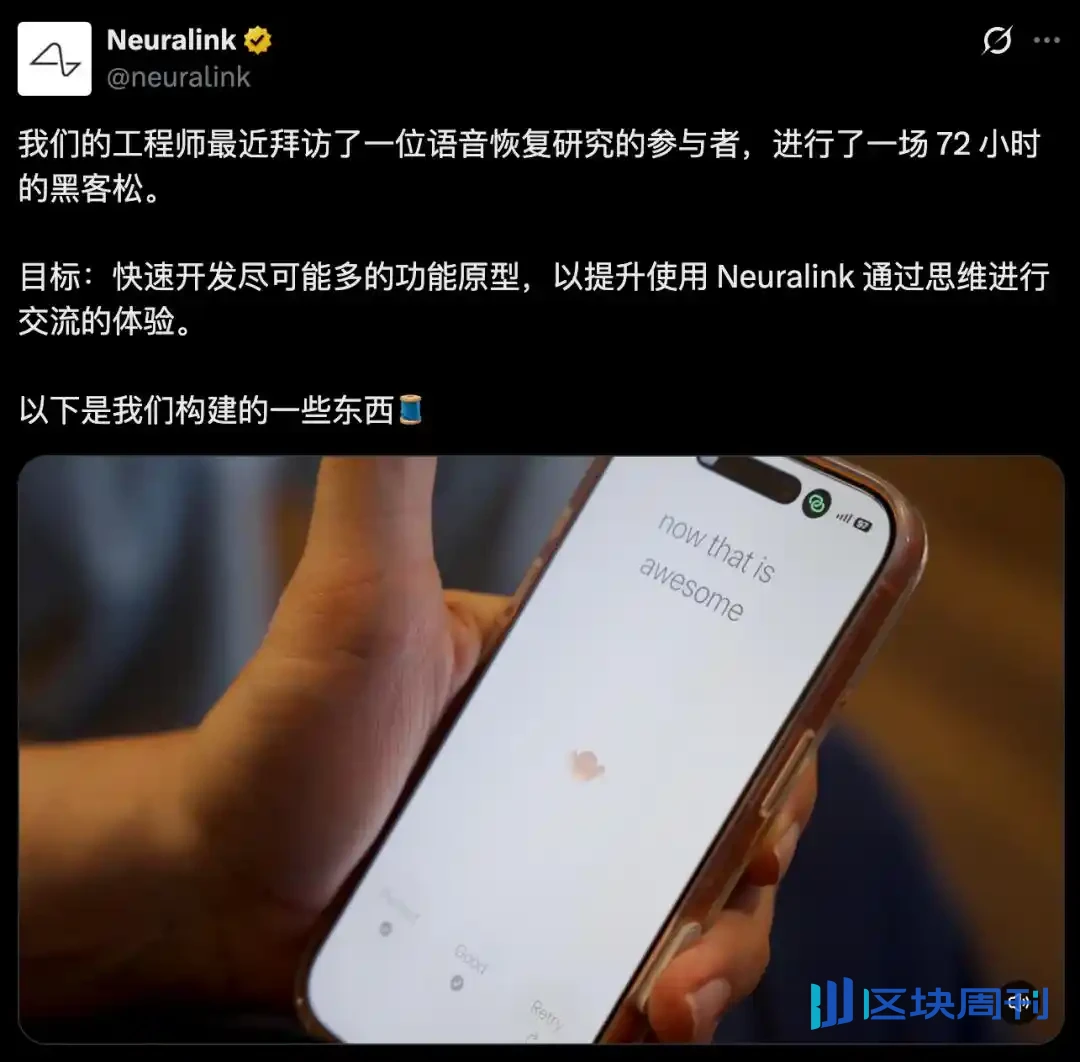
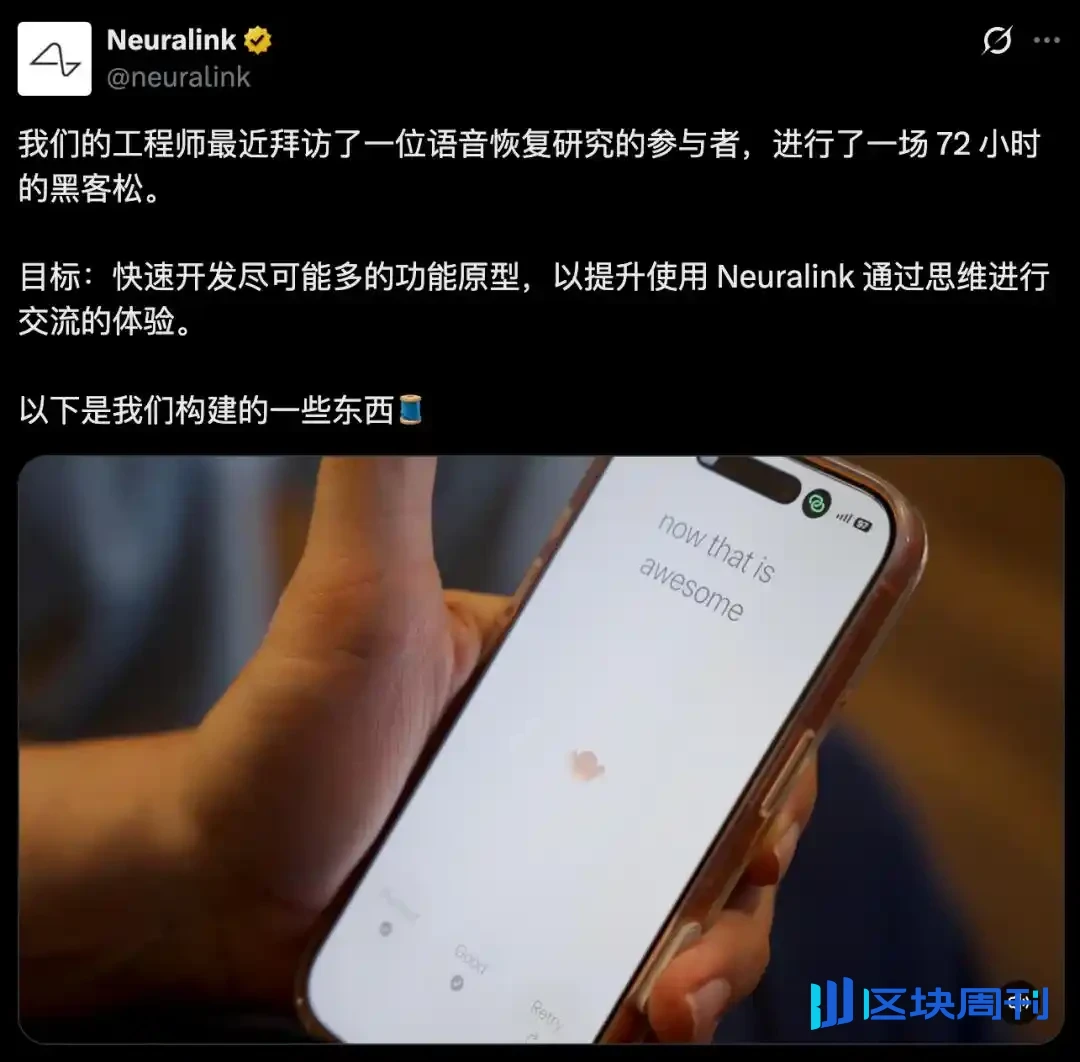
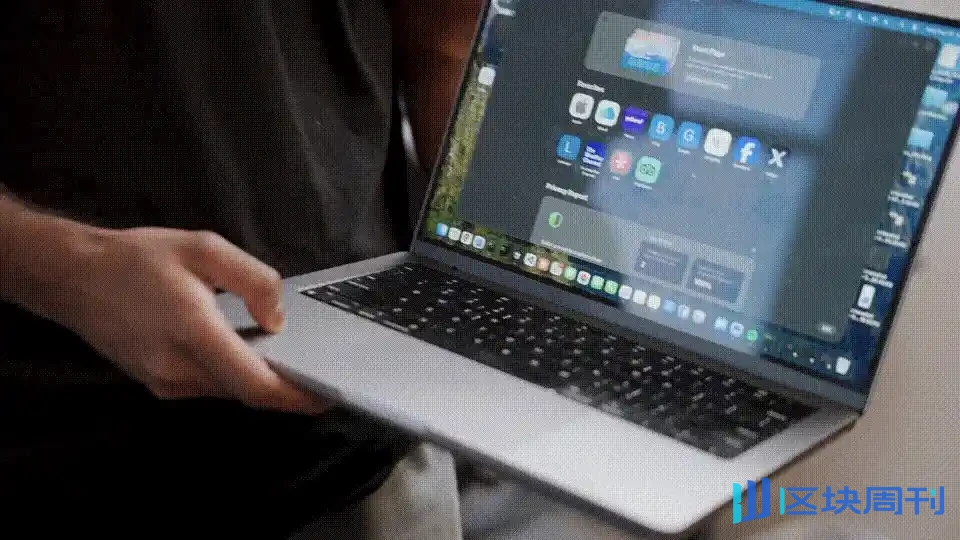
A patient only needs to silently say "Hey Neuralink" in their mind, then think about the task they want to do, and the Grok Agent on the computer will instantly be awakened.
Next, Grok will fully automatically take over the screen and go straight onto YouTube.
And the most touching moment was a special phone call.
The chip in the brain of a severely paralyzed and speech-impaired patient directly converted "the words he wanted to say" into a pure audio stream, injecting it in real time into the underlying microphone call layer of the iPhone.
After seven years, he finally used his mind to make a phone call to his wife.

Humanity has taken another extremely crazy step toward true "mechanical ascension."
A 72-Hour Legendary Record, the Most Ruthless Upgrade of "Brain-Computer Interface"
All of this was made possible thanks to a "tough battle" the Neuralink team fought a few days ago.
Several core engineers packed their bags and moved into the subject's home, eating and living together, carrying out a full 72-hour extreme closed-door development sprint.

For three full days and nights, they crammed work that normally takes several weeks into just a few hours, grinding out 8 brand-new features in one go.
In the past, our understanding of brain-computer interfaces was still stuck at "using thoughts to move the mouse cursor."
After these 72 hours, the brain has officially become AI's native input terminal.

This patient is named Kenneth, who has been diagnosed with ALS (amyotrophic lateral sclerosis) for seven full years and is a Neuralink P21 subject.
Along the way he has been particularly optimistic, just as he often says, "ALS sucks, but my life doesn't."

Shout in Your Mind, and Grok Takes Over
The most sci-fi feature this time, of course, is Grok.
A brain-computer interface patient only needs to imagine saying "Hey Neuralink" in their mind, along with the task they want completed, to trigger a Grok agent that autonomously executes it on the computer.

No need to type on a keyboard with your hands, and no need to actually make a sound with your mouth—the command is issued from the neural activity end.
Breaking this chain down makes it easy to understand: the brain-computer interface is responsible for converting expressive intent into usable input, the Grok agent takes on the task, and then operates the computer.
The so-called "access" is essentially a complete reconstruction of the interaction dimension:
Mind-controlled cursor: The brain outputs low-level actions like "a little to the left, click once," and completing a task requires dozens or hundreds of steps, with the person having to watch the whole time;
Mind-driven Agent: The brain outputs only a single sentence of "intent," and breaking down the steps and operating the interface are all handed over to AI.
The biggest bottleneck of brain-computer interfaces has always been bandwidth: both the number of electrodes and the decoding speed have physical limits.
The value of the Agent lies in that it "amplifies" one sentence into a series of operations—without adding a single electrode, it multiplies what can be accomplished with each thought.
As Neuralink itself said, this is only an early exploration, but it has solidly proven that:
As long as communication between the brain and the computer becomes smoother, the barrier between "thinking of it" and "doing it" can be smoothed away.
Breaking Down the Eight Core Technologies
The eight technical prototypes born in these 72 hours range from low-level signal capture all the way through system-level interaction, and finally connect to the top-level AI large model.
Neural Voice Activity Detection (VAD): Completely Throwing Away the Physical Switch
Before this hackathon, if Kenneth wanted to speak with his mind, he still faced a very awkward paradox—you first had to manually press a button to tell the software "I'm about to start thinking," and after speaking you had to press it again to stop recording.
For patients with ALS or high-level paraplegia, pressing this button itself is a huge burden.
To this end, the engineers directly rewrote a "Neural Voice Activity Detection (Neural VAD)" system from the ground up.
This algorithm is like a neural sentinel on duty 24 hours a day, monitoring in real time the stream of EEG signals sent back by the implant.
It can extremely keenly distinguish whether the brain at this moment is in a resting state of "spacing out and doing nothing," or has already mobilized the motor cortex and is "preparing to open the mouth and speak."
Once the intent pulse to speak is captured, the APP automatically starts decoding within milliseconds; as soon as the words end, the system automatically goes dormant.
Zero button presses and zero hand movement throughout the entire process, truly achieving pure mind-based "speaking as soon as you open your mouth."
Real-Time Neural Signal Visualization: Patients and Models "Train Together"
The field of brain-computer interfaces has always had a headache-inducing black-box problem: even the subject themselves does not know exactly "how to think" in their brain to stimulate the strongest and clearest neuron firing?
You should know that the higher the signal-to-noise ratio of the input signal, the more astonishingly accurate the backend machine learning decoder will be.
The team turned the signal strength and spatial distribution detected by the implant into real-time visual feedback for Kenneth. He could try "pronouncing in his mind" in various ways and immediately see which method mobilized the most neural activity.

In neuroscience, this belongs to closed-loop neurofeedback: not only is the model adapting to the brain, but the brain is also adapting to the model in turn.
What was originally invisible and intangible parameter tuning has become a "level-clearing game" with instant feedback.
Ordering Coffee on a Phone, Without Using Hands the Whole Time
Over the past few months, Neuralink has been quietly polishing a dedicated app called Bloom internally, with only one goal: to fit the massive speech brain-computer decoding system into a phone.
Taking advantage of this hackathon, the engineers simply pushed Kenneth to step out of his home, bring Bloom, and head straight to a noisy public place.
In a real café, for the first time Kenneth did not rely on someone else to relay his words, but used Bloom on his phone to order himself a cup of coffee with his mind.
And this was only the beginning.
For ALS patients, Apple's built-in software keyboard and Siri voice dictation are almost unusable. So the team directly called iOS low-level interfaces and hand-built a system-level brain-computer input method: BCI Keyboard Dictation.
As long as the keyboard is brought up, the words Kenneth wants to say in his mind will go through neural decoding and flow continuously like water into any App on the iPhone.
Writing memos, replying to messages, browsing social networks—no need to switch back and forth between different modes throughout the process; it works wherever you point.
Of course, decoding inevitably makes errors.
To this end, during the hackathon the engineers continuously iterated several versions of the correction interface, and ultimately embedded a predictive modification process directly into the keyboard: once recognition deviates, several high-probability candidate words immediately pop up above the keyboard, and Kenneth can scan them with his mind to complete "light-speed replacement" in any App.
There is also one detail that lowered the threshold for starting daily communication to almost zero.
The engineers cleverly borrowed the iPhone's "Live Activities" and Dynamic Island mechanisms to let Bloom reside permanently on the lock screen.
Kenneth does not need to unlock the phone; as soon as the screen lights up, he can see the current brain-computer connection status; as soon as a thought moves, he can directly "speak" in the locked state, truly achieving "instant reply."
Paralyzed for Seven Years, He Finally Made a Phone Call with His Mind
Among all the features, "making a phone call with the mind" is not the highest in technical difficulty, yet it became the tearjerker of the whole event.
Technically, the team connected Bloom with iPhone calls, allowing the speech generated by the brain-computer interface to be directly fed into the call's microphone audio stream.
But the weight of this matter lies not in the technology, but in the story.
Kenneth and his wife's love began over the phone. When the two first met, their feelings were slowly cultivated through one phone call after another. That telephone line was once the most important line between them.
Later, illness made it difficult for him to speak again. That line also gradually fell silent.
This time, the engineers had just finished building the call function, and he picked up his phone and dialed his wife.
The call connected. He didn't open his mouth. The words he thought of in his mind were captured by the implant, translated by the decoder, then synthesized into sound and sent directly into the call line.
On the other end of the receiver, his wife's laughter came through.
The two began to tease and bicker with each other, just like when they were dating over the phone back in the day.
The engineers just stood by and watched. Neuralink later said this was one of the most unforgettable moments of the entire week.
In engineering, few things are more fulfilling than this. You watch a person use the code you wrote that very morning to talk to the person they love.
Thought-driven AI becomes reality
In the past, the brain's bandwidth was too narrow, and people could only "squeeze toothpaste" to machines one letter and one click at a time.
Now, the brain only needs to output a single intention, and the rest—decomposition, execution, operation—is handed over to AI. When Grok connects to the brain-computer interface, the brain is for the first time expected to become AI's direct input source.
This will become a major leap in human-computer interaction.
In the future, as there are more electrodes, faster decoding, and smarter Agents, "think it and it's done" may move from the lab into more people's daily lives.

In "The Matrix," Neo plugs in a wire and learns kung fu in seconds; in "Transcendence," human consciousness connects to the network and can directly mobilize the entire digital world.
These imaginations that once belonged only to the screen are being written into reality one
点点
at a time.
This article is from the WeChat public account "Xinzhiyuan," author: ASI Revelation