
Author: Robbie Petersen
Compiled by: Deep Tide TechFlow
Deep Tide Introduction: This long article by a16z crypto presents a counterintuitive judgment: what crypto truly disrupts is not trading efficiency, but the supply side of the market. When issuing tokens, listing, and market making no longer require approval, any risk can become a tradable asset. For market makers, exchanges, and investors, this means a whole new market space is being opened up.

For most of financial history, the supply of new markets (rather than demand) has been the bottleneck. Blockchain eliminates this bottleneck. I believe this will unleash a whole new wave of market explosions.
Markets are mechanisms for transferring risk. Every trade is essentially two counterparties agreeing to transfer some risk exposure at a certain price. Abstractly, risk can unfold along two independent dimensions:
- Underlying: the underlying risk exposure (e.g., a company's cash flows, a barrel of oil, an election outcome, a borrower's credit, a GPU hour)
- Instrument: the mechanism for transferring that exposure (e.g., spot, dated futures, perpetual contracts, options, event contracts)
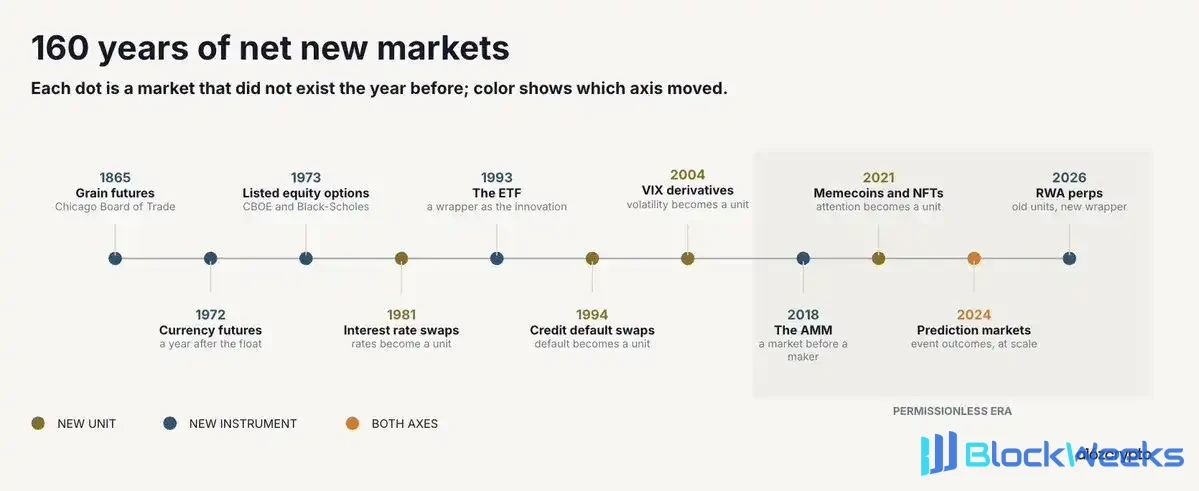
Almost all of financial history is a story of slow innovation along only one dimension at a time. Spot grain markets existed for thousands of years before Chicago listed grain futures in 1865. Currencies floated in 1971, and futures only came in 1972. Stock options existed as customized dealer contracts for centuries until they became listed markets after CBOE and Black-Scholes appeared in 1973. ETFs did not exist until 1993.
New risk underlyings are even rarer. Interest rates were not widely traded until 1981. Default risk waited until credit default swaps in 1994. Volatility waited until VIX derivatives in 2004. Event outcomes only became a true market through prediction markets in recent years.
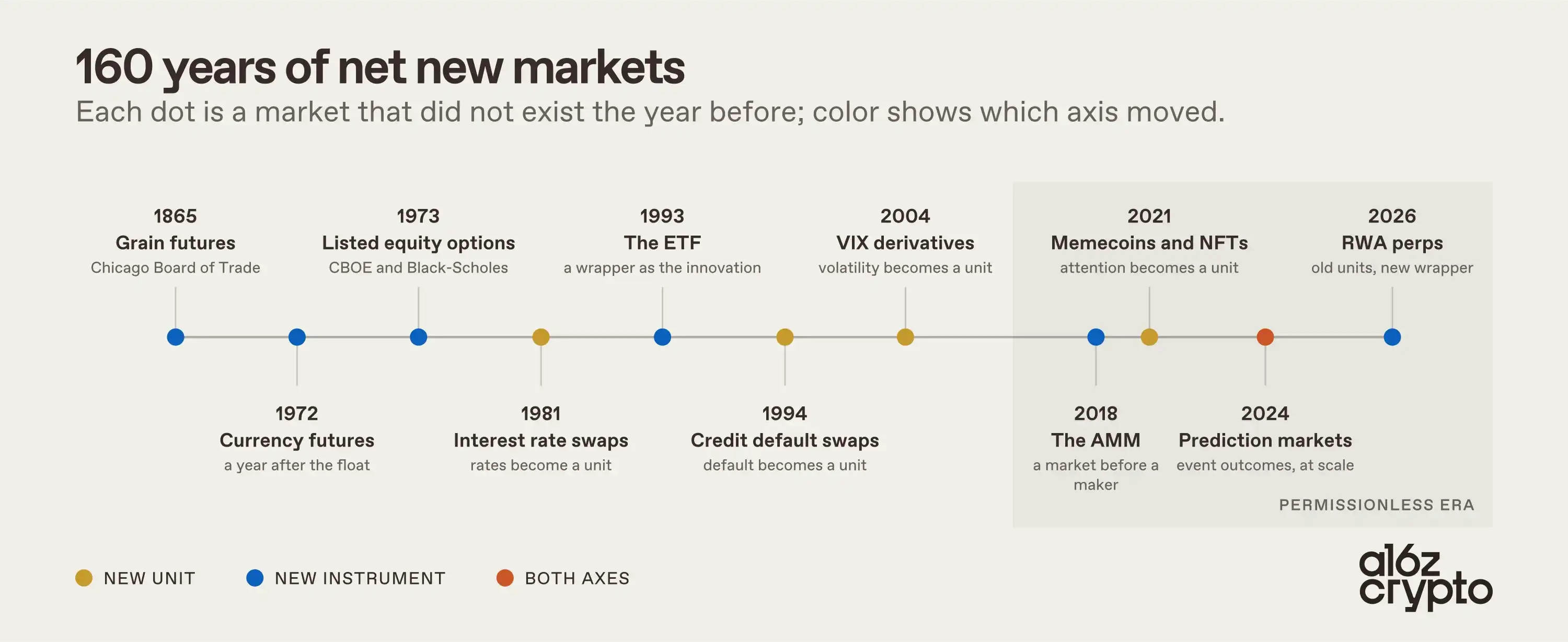
Demand for these markets has never been the problem. Farmers wanted to hedge their harvests long before CBOT. Creditors wanted to transfer default risk long before CDS. What has always slowed growth is the supply of these markets. And historically, two factors have been suppressing supply:
- Listing committees and legal frameworks
- Geographic fragmentation
Blockchain eliminates both at the same time. It makes issuance permissionless and distribution global. In my view, this is the purest form of the killer use case: blockchain is the first technology that allows market supply to catch up with global potential demand.
This argument also holds empirically. Almost every category-defining achievement in crypto is a downstream result of this killer use case. From perpetual contracts and decentralized spot exchanges to prediction markets, lending markets, memecoins, NFTs, and tokenized real-world assets, value has flowed to those who have the right to issue and/or trade entirely new markets on-chain.
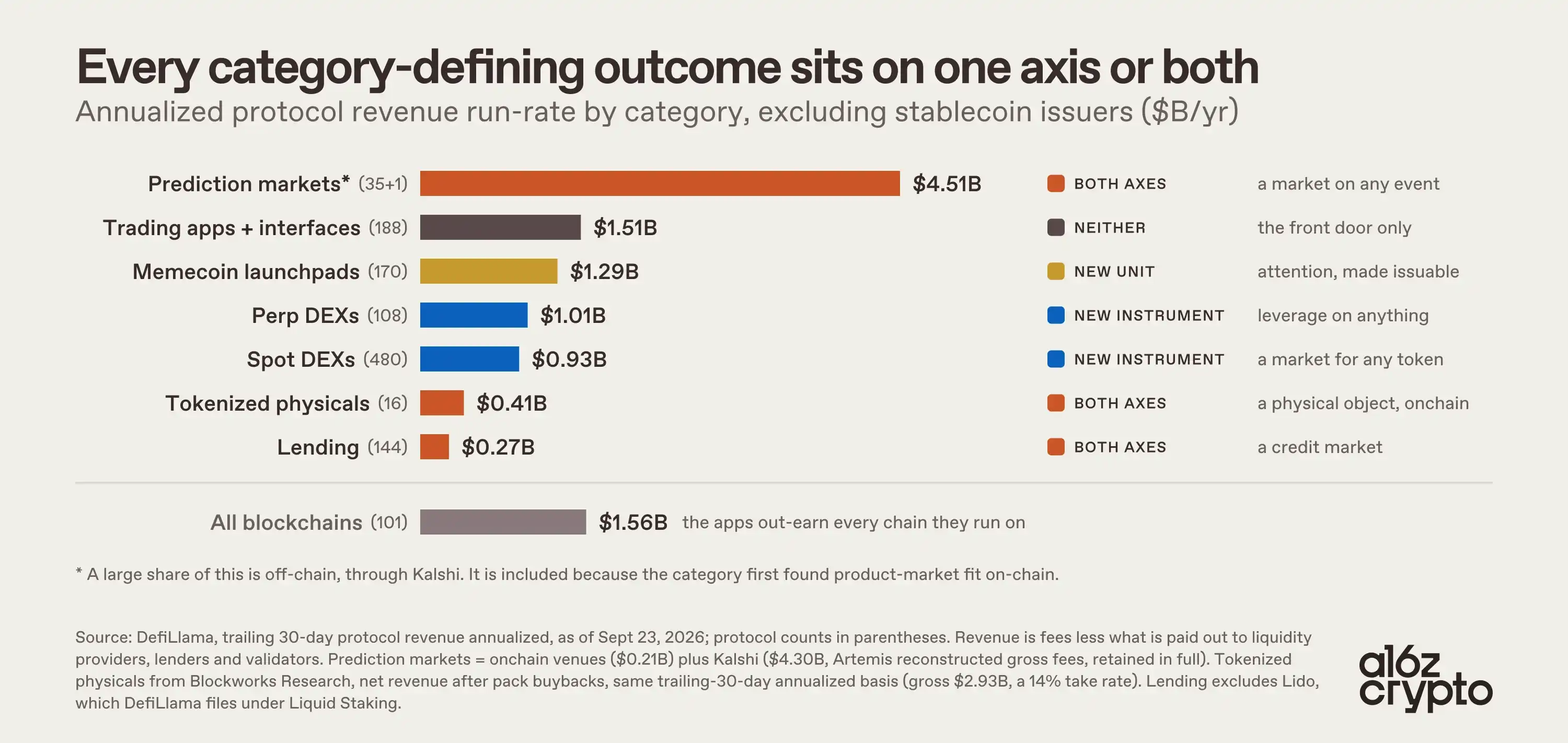
Each of these categories either created an entirely new risk underlying in a permissionless way, or created an entirely new way to transfer risk.
On the underlying side, crypto has engineered risk exposures that previously had almost no financial expression. Prediction markets can be traced back to the Iowa Electronic Markets, but they found product-market fit on-chain and exploded, turning discrete events (an election, a Fed decision, a court ruling) into tradable underlyings. Peer-to-peer lending markets turned individual credit relationships into something with real-time continuous pricing. Pre-IPO markets turned exposures previously monopolized by a few secondary brokers into something users can trade and hold at scale. Even memecoins and NFTs turned abstract risk underlyings (such as attention flows and cultural relevance) into readable, tradable markets.
Moreover, crypto has also created or amplified entirely new mechanisms for transferring these risk underlyings. Automated market makers allow markets to exist before a market maker agrees to quote. Perpetual contracts, first proposed in 1993, found product-market fit on-chain, compressing dated, fragmented exposures into a single contract balanced by funding rates. Binary contracts turned event outcomes into a tradable market worth $1 or zero. Pool-based lending replaced bilateral loans with shared pools and utilization curves. Bonding curves merged issuance and price discovery, giving assets a market from the first buyer.
Permissionless issuance also generates a lot of noise. This is the cost of removing listing filters. The point is not that every new market is good. The point is that the market itself (rather than some committee) becomes the self-selection mechanism for which markets survive.
Perpetual Contracts Are the Proof
There is nothing that expresses this argument more purely than perpetual futures, and no purer evidence than the recent growth in on-chain trading volume of non-crypto assets.
Because perpetual contracts are synthetic, the listing constraint shrinks to two things: a robust oracle, and two traders willing to be counterparties to each other. As long as these two conditions are met, a leveraged market can exist for almost anything. In this sense, perpetual contracts are one of the most effective coordination mechanisms ever created.
By the same logic, Hyperliquid is the closest thing we have to a global financial coordination platform. HIP-3 and HIP-4 allow users to issue their own derivatives, plug into the platform's global front end, and earn accordingly. Lowering the friction of issuing markets means more markets, and demand will naturally select the winners from them.

It is no coincidence that one of the fastest-growing markets in crypto (and increasingly one of the fastest-growing markets in all of finance) is issued permissionlessly on-chain and distributed globally. In July, on-chain RWA perpetual contract trading volume reached an annualized run rate of $1.4 trillion, accounting for half of Hyperliquid's book. Abstractly, this is just existing risk underlyings (stocks, oil, meme stocks) meeting a new transfer instrument in a permissionless way. Downstream, this recombination has brought an explosion in trading volume.
Also note that every quarter some entirely new market takes dominance. Q4 2025 was US stocks and commodities; H1 2026 was oil, natural gas, and metals; most recently it has been semiconductors and meme stocks. This again reflects the core argument. The supply of entirely new markets is catching up with what the world wants to trade each quarter.

However, the deeper downstream implication is that permissionless, 24/7 trading has become a wedge for on-chain price discovery. During this year's oil shock, when CME was closed, WTI found price discovery on trade.xyz as one of the most liquid markets globally. Similarly, we saw pre-IPO markets for Cerebras and SpaceX price IPOs more accurately than bankers, with the marginal difference between the last-hour price of pre-IPO perpetuals and the actual opening price being minimal.
The market is increasingly proving that the structural constraints of traditional markets (lack of 24/7 trading, geographic restrictions, lack of pre-IPO access, margin isolation) are sustainable competitive advantages for on-chain markets.
Markets transfer risk instruments. For almost the entire history of finance, they have been constrained by geography, listing committees, and legal frameworks. These constraints have now disappeared. The addressable space of on-chain markets is not the set of assets that exist today, but any risk that anyone (or any agent) anywhere wants to trade.
This means we will continue to see an explosive growth of new markets on-chain. There are new ways to transfer old risks: commodity and FX perpetuals, indices, round-the-clock equity exposure. There are also entirely new units of risk themselves: compute futures, perpetuals on macro indicators like CPI, music, social trends, sports, and anything that can be captured by an oracle and has both long and short sides. The applications and protocols that issue these markets, as well as the venues that trade them, are the ultimate objects that capture value.