
Transaction malleability is the ability to change a Bitcoin transaction's identifier without changing what the transaction actually does. It sounds harmless, but it once broke real systems and was blamed in one of crypto's biggest collapses. Here is what malleability was, why it caused trouble, how SegWit fixed it, and why it is worth understanding today.
What malleability was
Every Bitcoin transaction has an ID, or txid, which is a hash of the transaction's data. The problem was that, in the original design, this hash also covered the signature that authorizes the spend. A signature can be re-encoded in slightly different but still-valid ways, so a third party could tweak it and produce a transaction with the same effect — the same coins to the same recipient — but a different txid. The payment was unchanged; only its identity moved.
Why it caused problems
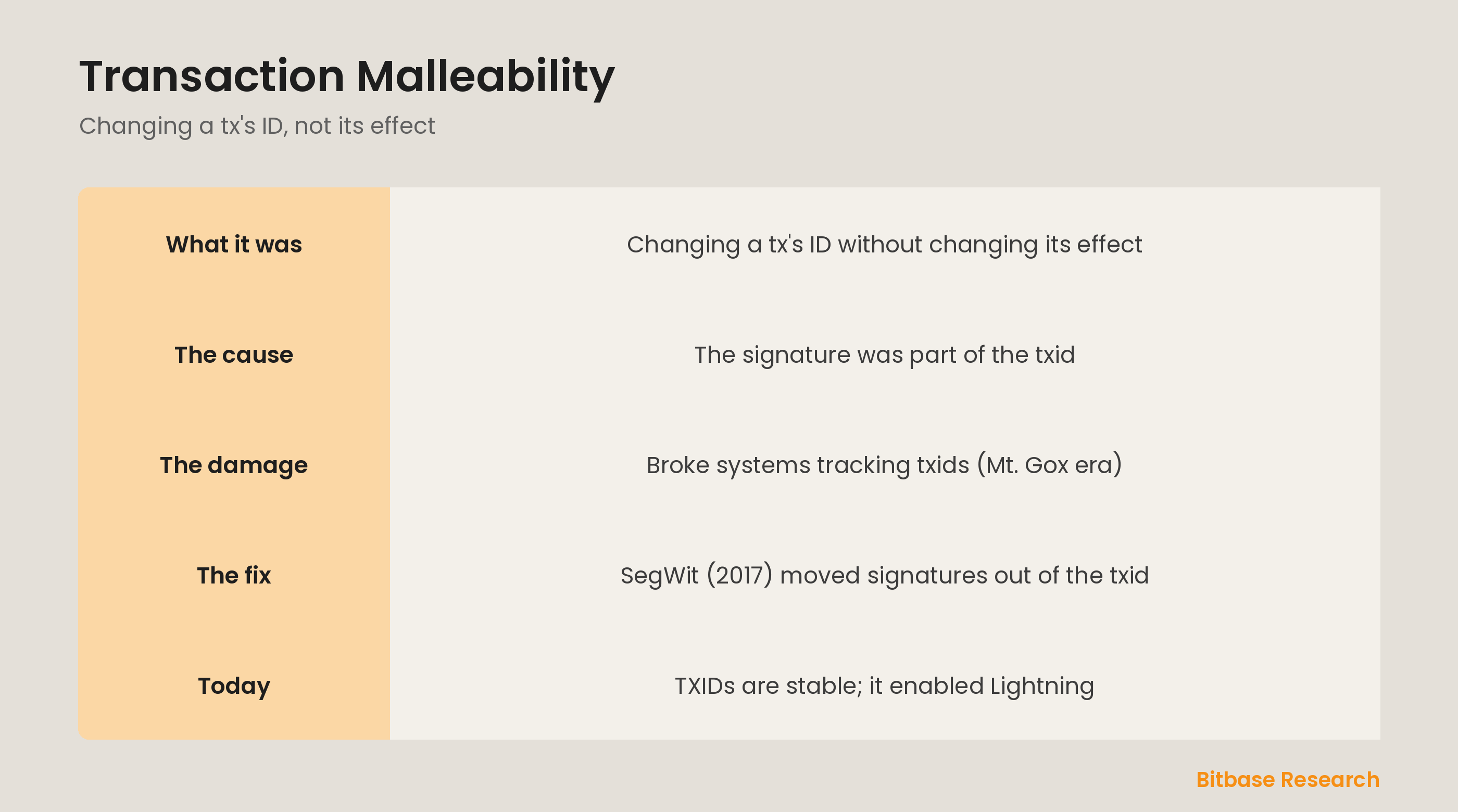
Many systems tracked a payment by its txid, and that is exactly what malleability could break. If a service sent a withdrawal and someone altered the txid before it confirmed, the service might look up the original ID, not find it, and wrongly conclude the payment had failed — then send it again. The Japanese exchange Mt. Gox pointed to malleability when it collapsed in February 2014, though many argue it was more excuse than sole cause.
The SegWit fix
The fix was Segregated Witness, or SegWit, activated in 2017. SegWit separates the signature data, called the witness, from the rest of the transaction and removes it from the txid calculation. Because the identifier is now computed only from the core transaction fields, changing a signature no longer changes the txid. That closed the malleability hole for upgraded transactions and, as a bonus, also made room for more data in each block.
Why it still matters
Malleability is mostly history now, but understanding it explains a few things. It is why modern transaction IDs are stable and safe to rely on, and it removed a roadblock for second-layer systems: the Lightning Network, which chains transactions together, needed non-malleable txids to work. So a fix aimed at a subtle bug also helped unlock faster, cheaper Bitcoin payments off the main chain.
The bottom line
Transaction malleability let someone change a Bitcoin transaction's ID without altering the payment itself, confusing any system that trusted the ID too early. SegWit solved it in 2017 by taking signatures out of the ID calculation, and along the way enabled the Lightning Network. Today it is a settled problem, but it is a neat example of how a small design detail can have outsized consequences. To keep learning the fundamentals, follow more from Bitbase Academy.
Disclaimer: This article is educational content from Bitbase Academy, provided for information only. It does not constitute investment, trading, tax, or financial advice. Crypto assets are volatile; assess your own risk. Written as of June 2026; refer to the latest official information.
References
[1] Wikipedia, "Transaction malleability problem" wikipedia.org
[2] Bitcoin.com, "What Is Bitcoin SegWit? Segregated Witness Explained" bitcoin.com
[3] Bitcoin Improvement Proposals, "BIP-141: Segregated Witness" github.com