
When you hold crypto on an exchange, you are trusting that the exchange actually has the coins it says you own. History has shown that trust can be misplaced. Proof of reserves is an attempt to replace blind trust with something you can check: a way for an exchange to demonstrate it holds enough assets to cover its customers. Here is what proof of reserves is, how it works, and the important things it still cannot show on its own.
What proof of reserves is
Proof of reserves, or PoR, is a method by which a custodial exchange tries to prove it actually holds enough crypto to cover what all its customers are owed. Instead of just claiming to be solvent, the exchange publishes evidence. The idea gained wide attention after several exchange collapses revealed that customer funds were not always backed one-to-one, and PoR became a way for platforms to offer reassurance.
How a Merkle tree makes it work
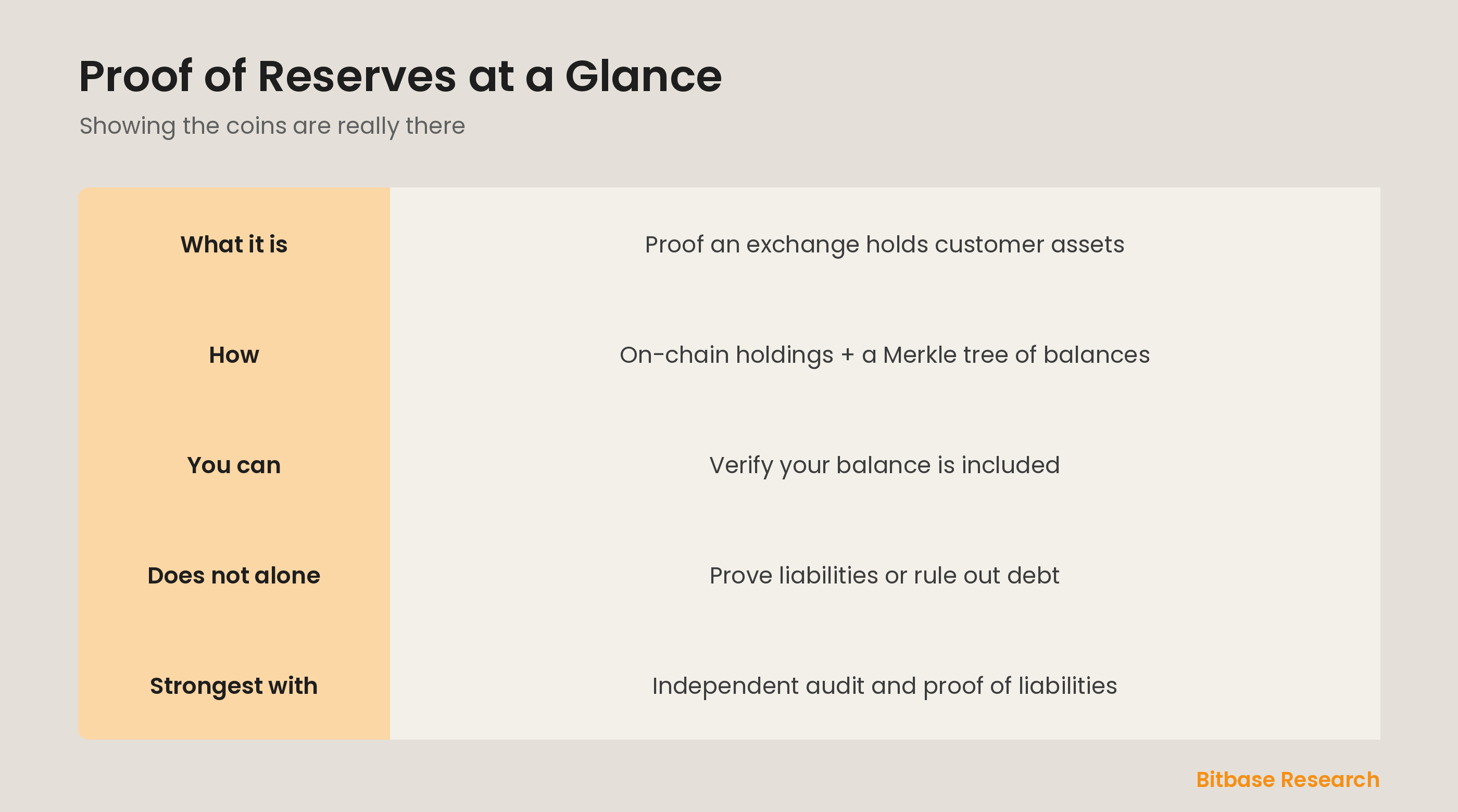
The common method uses a Merkle tree. Every customer balance is turned into a hash, then pairs of hashes are combined and hashed again, level by level, until the whole set condenses into one value called the Merkle root. Changing any single balance would change that root. The exchange also proves, on-chain, that its wallets hold the assets. You can then check that your own balance is included in the tree, without seeing anyone else's.
What it does not prove on its own
Here is the crucial limit. A basic proof of reserves shows assets exist and that your balance is in the total, but it does not, by itself, prove the exchange's liabilities — what it actually owes. An exchange could hold billions in assets and still owe more in hidden debt, which PoR alone would not reveal. It also does not confirm the assets are not borrowed just for the snapshot. Reserves without liabilities is only half the picture.
How to read it as a user
Treat proof of reserves as a transparency signal, not a full guarantee. It is stronger when paired with a proof of liabilities and reviewed by an independent auditor, and when it is done regularly rather than once. Newer approaches add cryptographic techniques to prove balances are non-negative and the totals honest. Look for exchanges that publish frequent, audited PoR, and remember that funds you truly control sit in self-custody, not on any platform.
The bottom line
Proof of reserves lets an exchange demonstrate it holds enough crypto to cover customer balances, often through a Merkle tree you can check yourself. It is a real step toward transparency, but on its own it proves assets, not liabilities, so it cannot confirm full solvency. Value regular, independently audited PoR paired with proof of liabilities, and keep in mind that only self-custody puts the coins fully in your hands. To keep learning the fundamentals, follow more from Bitbase Academy.
Disclaimer: This article is educational content from Bitbase Academy, provided for information only. It does not constitute investment, trading, tax, or financial advice. Crypto assets are volatile; assess your own risk. Written as of June 2026; refer to the latest official information.
References
[1] Investopedia, "Audit: What It Means in Finance and Accounting, and 3 Main Types" investopedia.com
[2] Investopedia, "Custodian: What It Means in Banking and Finance" investopedia.com
[3] CFTC, "Customer Advisory: Understand the Risks of Virtual Currency Trading" cftc.gov