
Dust in crypto means amounts so small that the network fee needed to spend them costs more than the amounts are worth. These tiny leftovers pile up in wallets, effectively stranded because moving them is uneconomical. Here is what dust is, the dust limit that guards against it, how it accumulates, and why dust can also be used against you.
What dust is
On a UTXO chain like Bitcoin, your balance is made of separate chunks of coin. Dust is a chunk so small that spending it would cost more in fees than the chunk contains — so it just sits there, technically yours but not worth moving. As a rough sense of scale, Bitcoin's smallest unit is the satoshi, and dust is measured in a few hundred sats: real, but economically useless on its own.
The dust limit
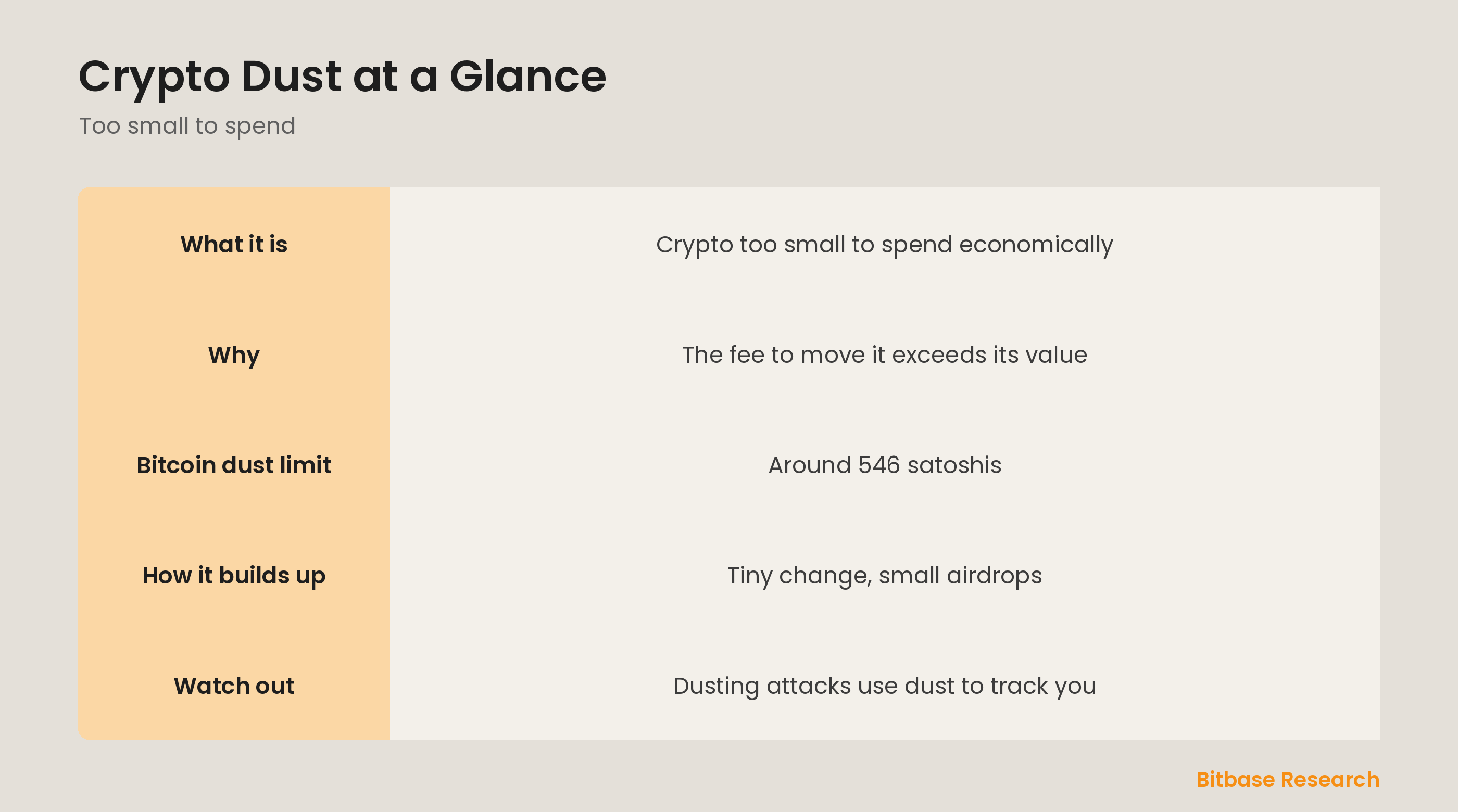
To stop the network filling up with these unspendable scraps, Bitcoin software enforces a dust limit — a minimum output size, commonly around 546 satoshis, below which nodes will not relay or mine a transaction. The point is to keep the set of unspent outputs from bloating with tiny entries that everyone must store forever. Different coins and address types set slightly different thresholds, but the idea is the same everywhere.
How dust builds up
Dust accumulates naturally. Change from a payment can come back as a tiny output, small airdrops or promotional sends leave specks behind, and consolidating many little inputs later costs its own fee. There is also a moving target: as a coin's price and network fees rise, the amount that counts as “too small to spend” goes up, so more old outputs quietly slip below the line and become unspendable dust over time.
Dust and the dusting attack
Dust is not only an inconvenience; it can be a tracking tool. In a dusting attack, someone sends tiny amounts of crypto to many addresses, then watches the blockchain to see when that dust is combined with other coins in a transaction. Linking those inputs can help de-anonymize a wallet's owner. The simple defense is not to spend or consolidate unexpected dust, and to use wallets that let you avoid touching it.
The bottom line
Crypto dust is value too small to be worth the fee to move it — real coins that are effectively stuck. A dust limit keeps the network from drowning in these scraps, and rising fees slowly turn more small outputs into dust. Beyond the nuisance, treat unexpected dust with caution: leaving it untouched avoids both wasted fees and the privacy risk of a dusting attack. To keep learning the fundamentals, follow more from Bitbase Academy.
Disclaimer: This article is educational content from Bitbase Academy, provided for information only. It does not constitute investment, trading, tax, or financial advice. Crypto assets are volatile; assess your own risk. Written as of June 2026; refer to the latest official information.
References
[1] Bitcoin Optech, "Uneconomical outputs" bitcoinops.org
[2] Investopedia, "Dusting Attack: Definition and How It Works" investopedia.com
[3] Investopedia, "Satoshi: The Smallest Unit of Bitcoin" investopedia.com