Double spending is the act of trying to spend the same cryptocurrency twice. With ordinary digital files this would be trivial, and solving it without a trusted middleman is the core problem Bitcoin was invented to fix. Here is what double spending is, how a blockchain prevents it, the brief window where risk remains, and the rare attack that can still break it.
What double spending is
Money only works if you cannot spend the same unit twice. Physical cash solves this naturally — hand over a coin and you no longer have it — but a digital token is just data, and data can be copied. Double spending is the attempt to exploit that: sending the same funds to two different people, hoping both payments go through. For digital money to be trustworthy, the system has to make this impossible.
How blockchain prevents it
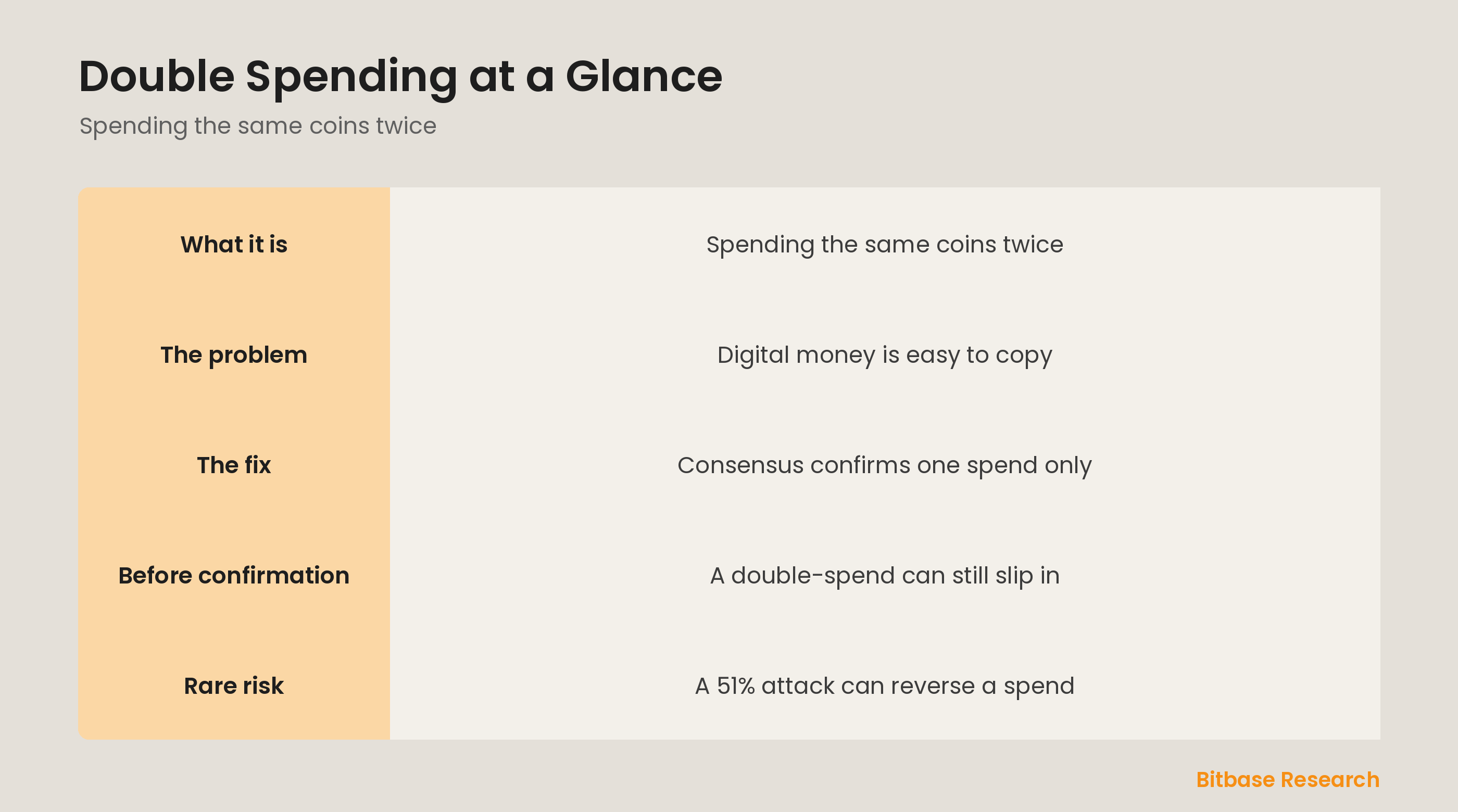
A blockchain stops double spending with consensus and a shared ledger. When you spend coins, the transaction is broadcast and miners or validators record it in a block that everyone agrees on. Once those coins are marked as spent, the network will reject any later transaction that tries to spend them again. There is no central referee; the rule is enforced by every node checking that no coin is spent twice.
The window before confirmation
The protection is not instant. A transaction that has been broadcast but not yet included in a block — “zero confirmations” — is only a proposal, and a determined sender could broadcast a conflicting one spending the same coins. Until a block confirms which transaction wins, a double-spend attempt can still succeed. This is exactly why merchants and exchanges wait for one or more confirmations before treating a payment as final.
The 51% attack
Even a confirmed transaction is not absolutely irreversible. An attacker who controlled a majority of a chain's mining or staking power could secretly build a longer chain and force a reorganization that erases their earlier payment, letting them spend those coins again — the “51% attack.” On large networks like Bitcoin this would cost an astronomical amount, which is why deep confirmations are considered safe in practice.
The bottom line
Double spending is the problem of copying digital money to spend it twice, and a blockchain's whole design exists to prevent it without a trusted third party. Confirmations are your protection: an unconfirmed transaction can still be double-spent, while one buried under several blocks is effectively permanent. Understanding this is understanding why crypto waits for confirmations at all. To keep learning the fundamentals, follow more from Bitbase Academy.
Disclaimer: This article is educational content from Bitbase Academy, provided for information only. It does not constitute investment, trading, tax, or financial advice. Crypto assets are volatile; assess your own risk. Written as of June 2026; refer to the latest official information.
References
[1] Investopedia, "Double-Spending: What It Is and How It Works" investopedia.com
[2] Bitcoin Wiki, "Irreversible Transactions" en.bitcoin.it
[3] Investopedia, "51% Attack: Definition, Who Is at Risk, Example" investopedia.com