Your login is the front door to your crypto, and a single weak point there can undo everything else. Good login security is not one setting but a few layers stacked together, each covering a gap the others leave. None of them are hard to set up, and together they make your account far more trouble to break into than it is worth. Here are the layers that matter and how to put them in place.
Start with a strong, unique password
The foundation is a password that is long, random, and used nowhere else. Reusing a password means one leak from an unrelated site can unlock your exchange, so uniqueness matters as much as strength. The easiest way to manage this is a password manager, which generates and stores a different complex password for every account, so you only have to remember one master password.
Add two-factor authentication
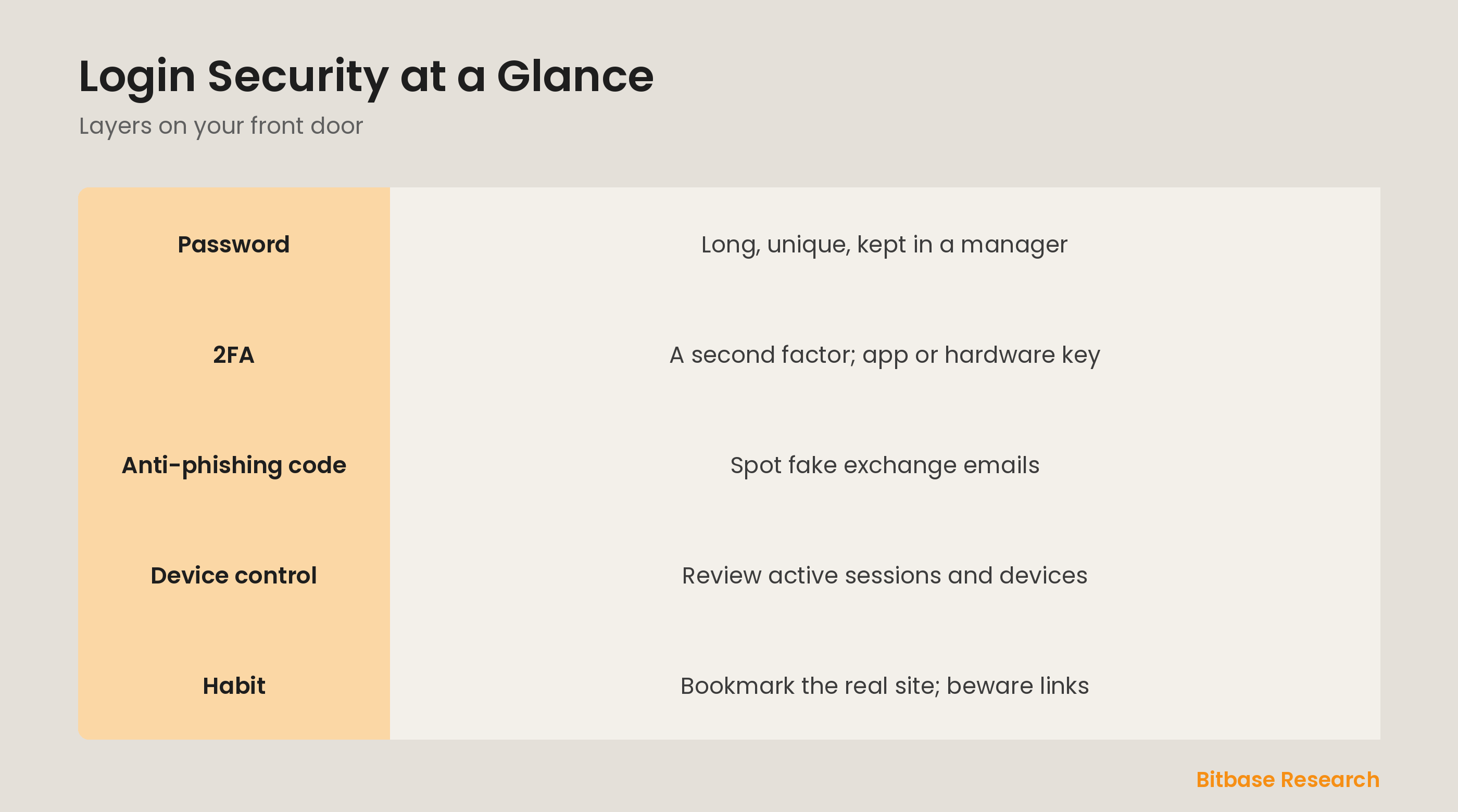
A password alone can be phished or leaked, so add a second factor that an attacker cannot easily get. Two-factor authentication asks for a code from an authenticator app or a tap on a hardware key at login. An app or key is much safer than SMS, which is vulnerable to SIM-swap attacks. This single step blocks the vast majority of account takeovers that start with a stolen password.
Use the extra controls exchanges offer
Most exchanges give you more than a password and 2FA. An anti-phishing code helps you spot fake emails; a withdrawal address whitelist lets funds leave only to addresses you pre-approved; and a device or session list shows every place your account is logged in, so you can log out anything you do not recognize. Turning these on closes gaps that a password and 2FA alone leave open.
Build safe login habits
Even perfect settings can be undone by a careless moment. Reach your exchange through a bookmark you saved, not a link in an email or a search ad, so you never land on a look-alike site. Avoid logging in on public Wi-Fi or shared computers, keep your device and browser updated, and be suspicious of any message that pressures you to log in urgently — that urgency is a classic phishing tactic.
The bottom line
Login security works in layers: a long, unique password in a manager, 2FA from an app or hardware key, the extra controls your exchange offers, and careful habits around how you sign in. No single layer is enough on its own, but stacked together they make your account a hard target. Set them up once, and every future login rests on a much stronger footing. To keep learning the fundamentals, follow more from Bitbase Academy.
Disclaimer: This article is educational content from Bitbase Academy, provided for information only. It does not constitute investment, trading, tax, or financial advice. Crypto assets are volatile; assess your own risk. Written as of June 2026; refer to the latest official information.
References
[1] Investopedia, "Two-Factor Authentication (2FA): Definition and How It Works" investopedia.com
[2] Investopedia, "Phishing: What It Is and How to Protect Yourself" investopedia.com
[3] Investopedia, "Encryption: What It Is and How It Works" investopedia.com