
When you open an account on a regulated crypto exchange, you are usually asked to verify your identity before you can trade or withdraw freely. It can feel like a hurdle, but it is a standard part of how legitimate platforms operate — and it protects you as much as it protects them. Here is what account verification is, why exchanges require it, and how its tiers shape what you can do.
What account verification is
Account verification, often called KYC for know your customer, is the process of confirming that you are a real person and who you say you are. It typically starts with verifying your email and phone, then moves to submitting a government-issued ID and sometimes a selfie or short video to match your face to the document. The exchange checks these against its records to approve your account.
Why exchanges require it
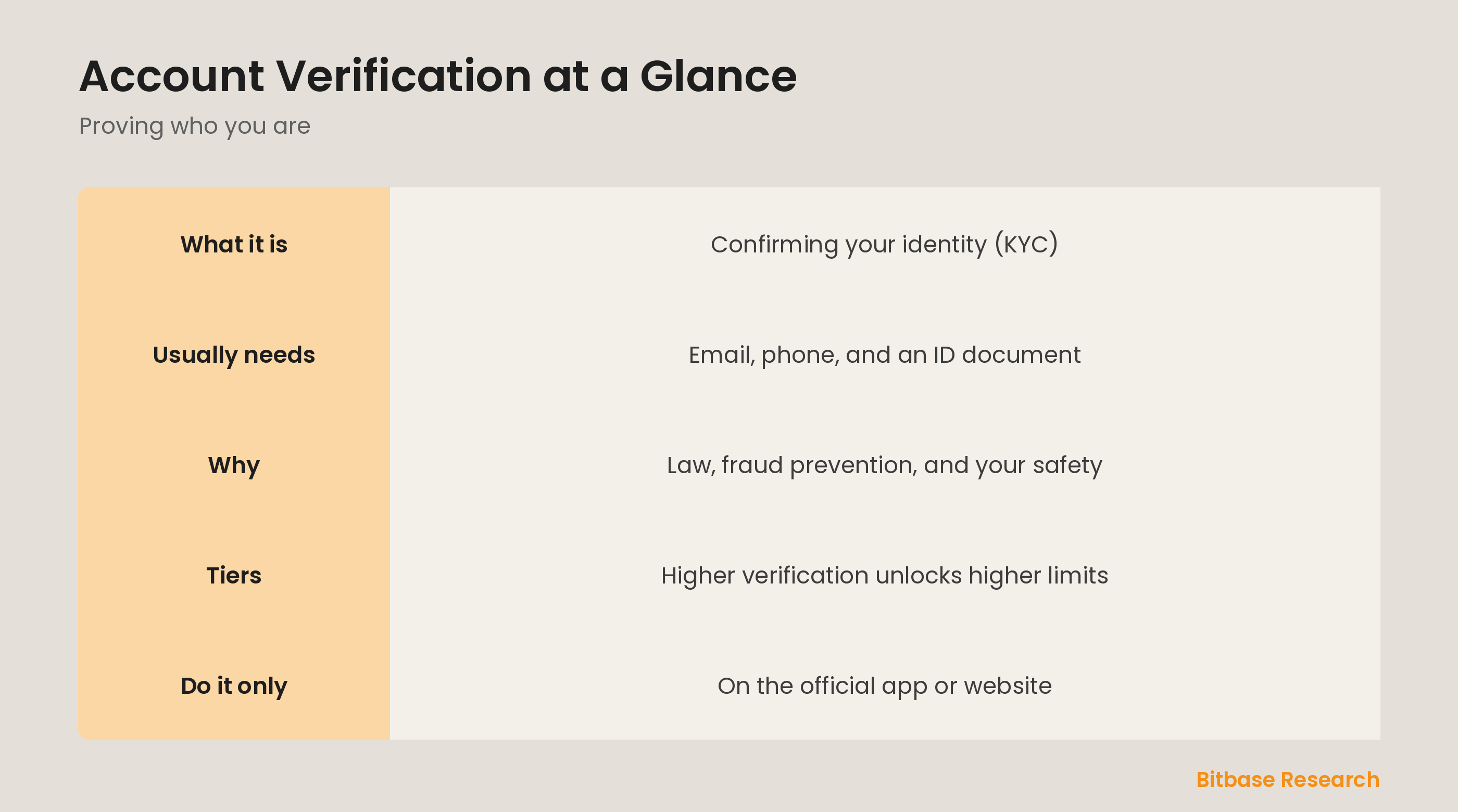
Verification is not just a formality. Regulated exchanges are legally required to know their customers under anti-money-laundering rules designed to keep crime out of the financial system. Beyond the law, it also helps prevent fraud and account theft — if someone tries to hijack your account, identity checks make that harder. In short, it exists to keep the platform lawful and its users safer.
How verification tiers work
Many exchanges use tiers. A basic level, often just a verified email, may let you explore the platform with low limits. Completing full identity verification unlocks higher deposit, trading, and withdrawal limits, and access to more features. The more you verify, the more the exchange trusts the account — so if your limits feel low, the fix is usually to complete the next verification tier.
What to expect and how to stay safe
Have a valid government ID ready, take clear well-lit photos, and make sure the name you register matches your document. Only ever go through verification inside the exchange's official app or website — never send ID photos to someone who contacts you by email, chat, or phone claiming to be support, since scammers use fake verification requests to steal documents. Real verification happens on the platform, not in your inbox.
The bottom line
Crypto account verification confirms your identity through a KYC process that usually needs your email, phone, and a government ID. Exchanges require it to follow the law, prevent fraud, and protect users, and higher verification tiers unlock higher limits and more features. Complete it only inside the official app or website, and treat any off-platform request for your documents as a scam. To keep learning the fundamentals, follow more from Bitbase Academy.
Disclaimer: This article is educational content from Bitbase Academy, provided for information only. It does not constitute investment, trading, tax, or financial advice. Crypto assets are volatile; assess your own risk. Written as of June 2026; refer to the latest official information.
References
[1] Investopedia, "Know Your Client (KYC): What It Means, Compliance Requirements" investopedia.com
[2] Investopedia, "Anti-Money Laundering (AML): What It Is and How It Works" investopedia.com
[3] CFTC, "Customer Advisory: Understand the Risks of Virtual Currency Trading" cftc.gov