A stablecoin depeg is when a coin that is supposed to be worth $1 trades meaningfully away from it — usually below. Because stablecoins are treated as digital dollars, even a small, brief depeg can trigger panic. Here is what a depeg is, why it happens, two very different real examples, and the question that tells you how worried to be.
What a depeg is
A stablecoin holds its value by targeting a fixed price, almost always $1. A depeg is when the market price drifts off that target — say to $0.95 or, in a crisis, far lower. Tiny wobbles of a fraction of a cent are normal and constant; a depeg that matters is a clear, sustained gap that signals traders no longer fully trust that the coin is worth a dollar. The direction is usually down, though a coin can briefly trade above $1 too.
Why depegs happen
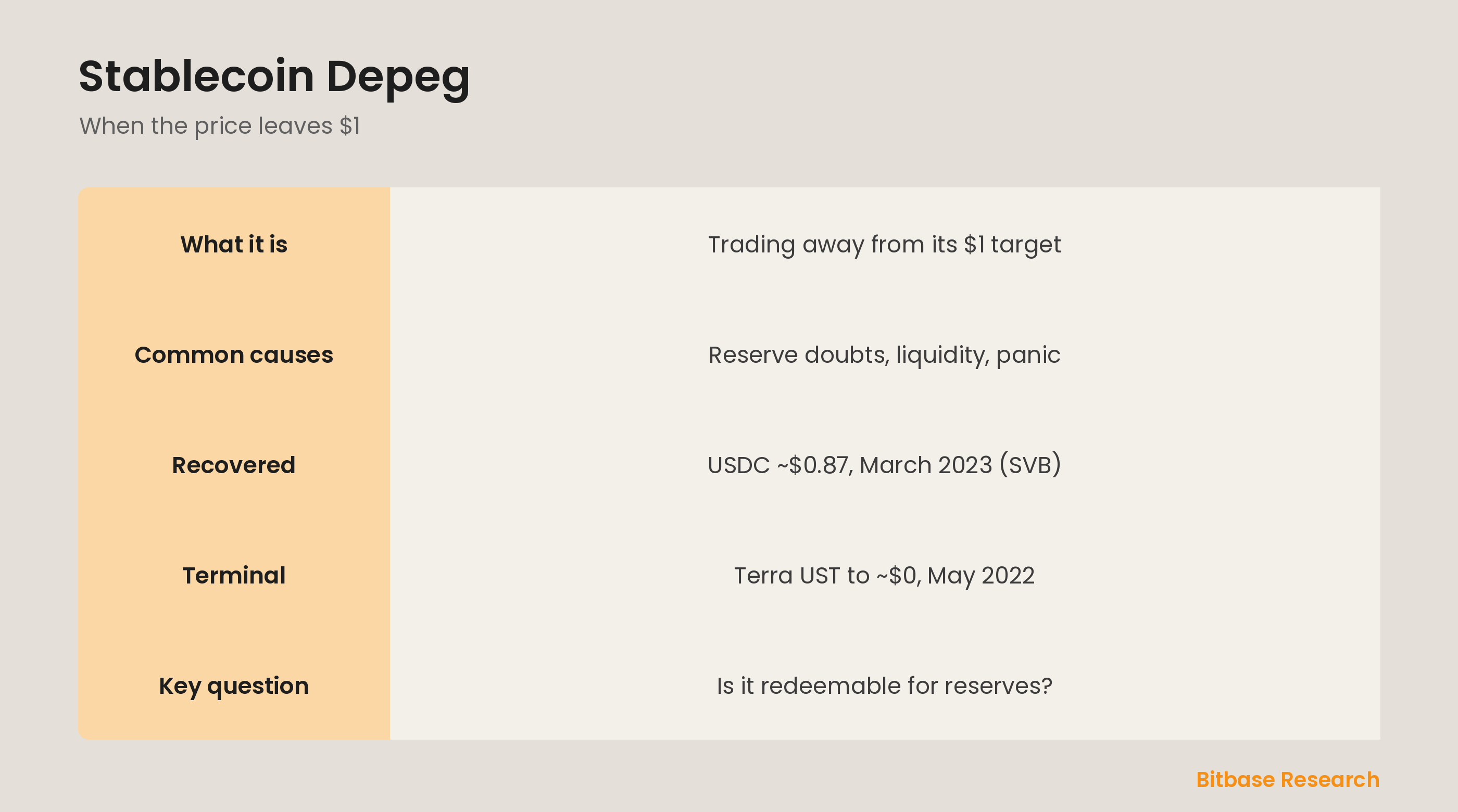
Depegs come from a loss of confidence in the coin's backing or its ability to pay out. Common triggers include doubts about whether the reserves are real and sufficient, a custodian or bank holding those reserves running into trouble, a sudden liquidity crunch where too many holders sell at once, or, for algorithmic coins, the stabilising mechanism failing. In every case the pattern is the same: people rush to exit faster than the coin can honour redemptions.
Two very different examples
Not all depegs mean the same thing. In March 2023, USDC fell to about $0.87 after its issuer disclosed that roughly $3.3 billion of reserves — around 8% — was stuck at the failed Silicon Valley Bank. Because USDC was fully collateralized, it recovered within days once redemptions resumed. Terra's UST, by contrast, depegged in May 2022 and went to near zero for good, because it was algorithmic and had no reserves to redeem against.
Temporary or terminal
The deciding factor is what stands behind the coin. A collateralized stablecoin can usually re-peg: as long as the reserves exist, traders buy the discounted coin and redeem it for a full dollar, and that arbitrage drags the price back. An algorithmic or thinly backed coin has no such floor, so a loss of confidence can be permanent. When a stablecoin wobbles, the useful question is not “how far did it fall?” but “can it still be redeemed for real assets?”
The bottom line
A depeg is the market saying it is not sure a stablecoin is really worth a dollar. Some are brief scares that redemption and arbitrage repair, as USDC showed; others are the end, as Terra showed. Judge a depeg by the backing, not the headline: a fully reserved coin trading at a discount is often a temporary dislocation, while an unbacked one at the same price may never come home. To keep learning the fundamentals, follow more from Bitbase Academy.
Disclaimer: This article is educational content from Bitbase Academy, provided for information only. It does not constitute investment, trading, tax, or financial advice. Crypto assets are volatile; assess your own risk. Written as of June 2026; refer to the latest official information.
References
[1] CNBC, "Stablecoin USDC breaks dollar peg after firm reveals $3.3 billion in SVB exposure" cnbc.com
[2] Federal Reserve, "In the Shadow of Bank Runs: Lessons from the Silicon Valley Bank Failure" federalreserve.gov
[3] Investopedia, "Stablecoin: Definition, How They Work, and Types" investopedia.com