
Thousands of different tokens live on blockchains like Ethereum, yet your wallet can handle almost all of them without special setup. That works because most tokens follow a shared token standard — a common rulebook that defines how a token behaves. Understanding token standards explains why tokens are interchangeable across apps, and why choosing the right network when you send one matters so much. Here is what a token standard is and why it is important.
What a token standard is
A token standard is an agreed set of rules, built into smart contracts on a blockchain, that defines how a token must behave — how it is transferred, how balances are tracked, and how other programs can interact with it. Any token that follows the standard exposes the same basic functions, so wallets, exchanges, and apps can support it without needing custom code for each new token. It is a shared interface, not the token itself.
Common token standards
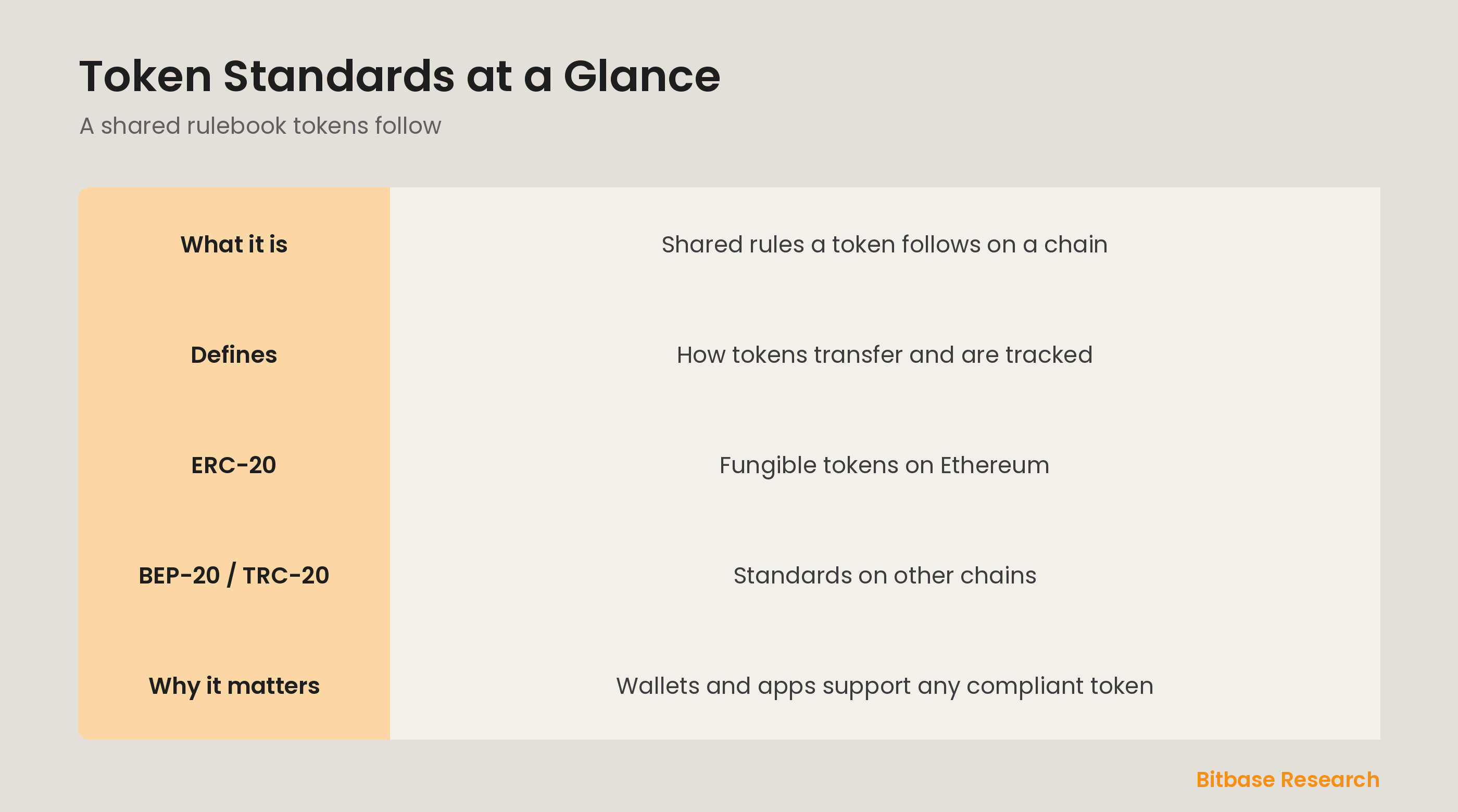
Different blockchains have their own standards. ERC-20 is the widely used standard for fungible tokens on Ethereum, where every unit is identical and interchangeable. ERC-721 defines non-fungible tokens, or NFTs, where each is unique. Other chains mirror the idea with their own versions: BEP-20 on the BNB Chain and TRC-20 on Tron, for example. Each standard is tied to the blockchain it lives on.
Why standards matter
Standards make the token ecosystem work. Because compliant tokens behave predictably, a single wallet can hold thousands of them, an exchange can list new ones easily, and DeFi apps can plug them in without custom integration. This interoperability lowers the barrier to launching a token and lets the whole ecosystem build on shared foundations rather than reinventing the basics every time.
What it means when you transfer
For everyday use, the standard tells you which blockchain and network a token lives on, and that is critical when depositing or withdrawing. The same ticker can exist as an ERC-20 token on Ethereum and a BEP-20 token on the BNB Chain, and they travel on different networks. Sending to an address on the wrong network can lose your funds, so always match the token standard and network on both ends before you send.
The bottom line
A crypto token standard is the shared rulebook a token follows on its blockchain, defining how it transfers and how apps interact with it. Standards like ERC-20, BEP-20, and TRC-20 make tokens interoperable, so wallets and exchanges can support any compliant token. In practice, the standard also tells you which network a token uses — always match it when you deposit or withdraw, or you risk losing the funds. To keep learning the fundamentals, follow more from Bitbase Academy.
Disclaimer: This article is educational content from Bitbase Academy, provided for information only. It does not constitute investment, trading, tax, or financial advice. Crypto assets are volatile; assess your own risk. Written as of June 2026; refer to the latest official information.
References
[1] ethereum.org, "Token standards" ethereum.org
[2] Investopedia, "What Is ERC-20? Understanding the Ethereum Token Standard" investopedia.com
[3] Investopedia, "Smart Contracts: Definition, How They Work, and Applications" investopedia.com