
A blockchain timestamp is the time recorded in each block's header saying, roughly, when that block was created. It sounds like a precise clock, but it is really an approximation set by whoever produced the block, kept honest by consensus rules. Here is what the timestamp is, who sets it, the limits on it, and what it is actually used for.
What the timestamp is
Every block includes a timestamp in its header — a single number recording when the block was made, in seconds. It becomes a permanent part of the block once added, so a blockchain doubles as a rough timeline of when things happened. But unlike a receipt printed by a trusted clock, this time is chosen by the block's own producer, which is why it can only ever be treated as approximate rather than exact.
Why it is approximate
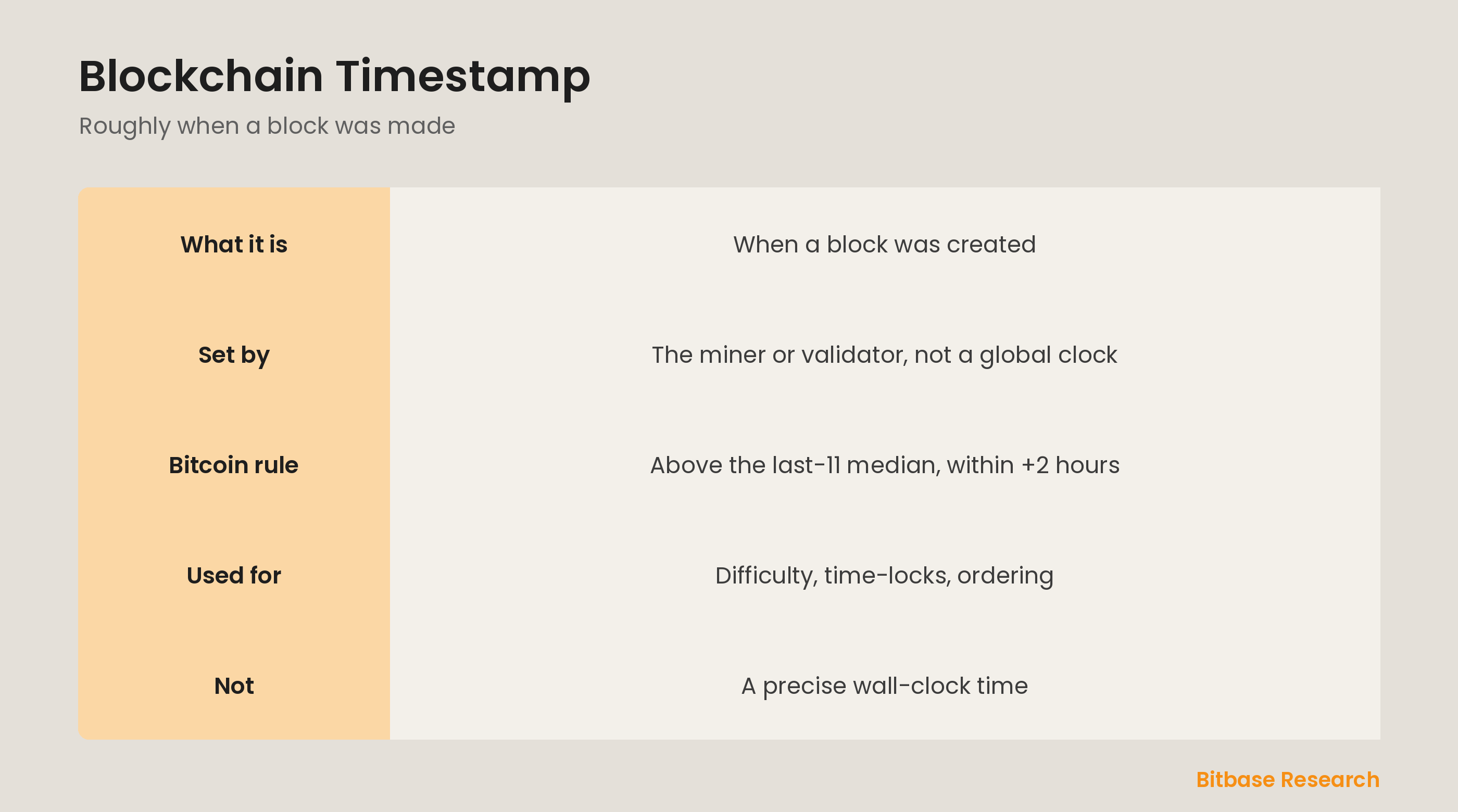
Because a miner or validator sets the timestamp itself, the network cannot simply trust it, so consensus rules fence it in. On Bitcoin, a new block's timestamp must be greater than the median of the previous eleven blocks and no more than about two hours ahead of the network's own time. Within that window the producer has leeway, so timestamps can even go slightly backwards between blocks. They are close to real time, but not a precise, strictly increasing clock.
What it is used for
Despite being loose, the timestamp does real work. Bitcoin uses the spread of timestamps to measure how fast blocks are coming and adjust mining difficulty so the ten-minute target holds. Timestamps also drive time-locks — transactions or contracts set to become valid only after a certain time — and they give the chain a broadly reliable ordering of history. For these jobs, approximate but bounded is good enough.
What it is not
The timestamp is not a certified, to-the-second record of when a transaction happened. Two blocks can carry times that are out of order by a little, and a producer could nudge the value within the allowed range. So while a block's timestamp tells you roughly when it was mined — accurate to minutes, not seconds — you should not lean on it for exact timing or treat it as tamper-proof proof of the precise moment.
The bottom line
A blockchain timestamp is an approximate record of when a block was created, set by its producer and constrained by consensus so it stays close to real time. It powers difficulty adjustment, time-locks, and the rough ordering of the chain's history, but it is not a precise clock. Read it as “about when,” and understand why a decentralized network can only agree on time loosely, not exactly. To keep learning the fundamentals, follow more from Bitbase Academy.
Disclaimer: This article is educational content from Bitbase Academy, provided for information only. It does not constitute investment, trading, tax, or financial advice. Crypto assets are volatile; assess your own risk. Written as of June 2026; refer to the latest official information.
References
[1] Bitcoin Wiki, "Block timestamp" en.bitcoin.it
[2] Investopedia, "Timestamp: What It Means and How It Works" investopedia.com
[3] Ethereum.org, "Blocks" ethereum.org