
Knowing whether a trade actually made money is less obvious than it sounds, because the answer depends on what you truly paid, not just the last price you clicked. Cost basis, average entry, and break-even are the tools that turn a messy pile of buys and sells into a clear picture of profit. Get them right and you always know where you stand. Here is how each works and how averaging changes them.
Cost basis and average entry
Your cost basis is the total amount you paid to acquire a position, including the trading fees. If you spent 1,000 to buy a coin and paid 2 in fees, your cost basis is 1,002. Average entry is simply that cost basis divided by the quantity you hold, giving the effective price you paid per unit. These two numbers, not the price on the screen, are the foundation for judging any trade.
Break-even and profit
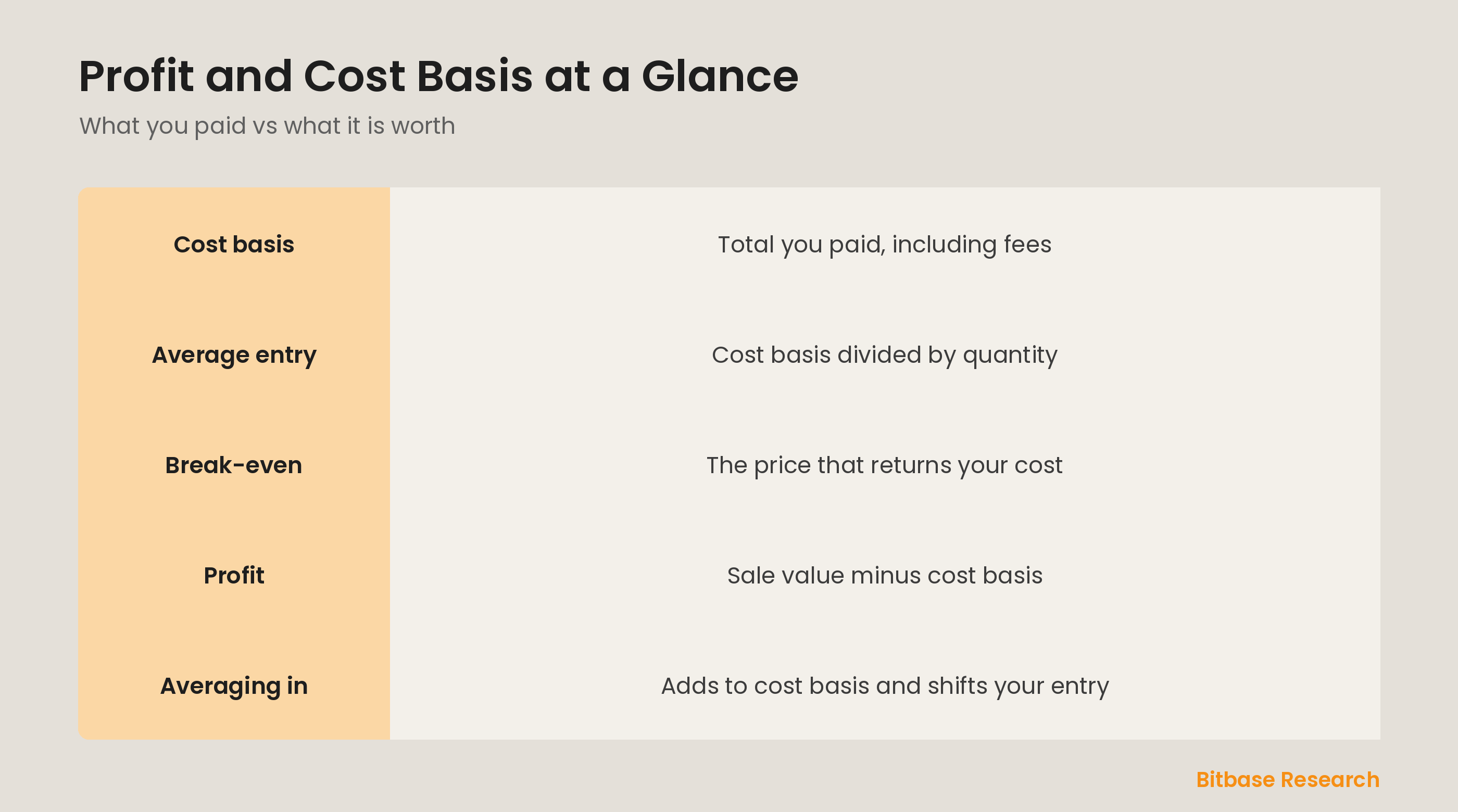
Your break-even price is the price at which selling returns exactly your cost basis, leaving you neither up nor down; because fees apply on the way out too, true break-even sits slightly above your average entry. Profit is what you get above that: the value you sell for, minus your cost basis. Framing every position around break-even keeps you honest about whether a rising price has actually put you in profit yet.
How averaging in changes it
Rarely do you buy a whole position at one price. When you buy more, your new cost basis is the sum of all your purchases plus fees, and your average entry moves to a blended figure. Buying more at a lower price pulls your average entry down, which is called averaging down; buying higher pulls it up. Each new purchase reshapes the single average entry that all your profit math depends on.
Selling in parts
Selling some of a position does not change the average entry of what remains, but it does realize profit or loss on the portion you sold, measured against that average entry. This is where trade history matters: to compute cost basis and realized profit accurately, you need the record of what you actually bought and sold and at what fees. Guessing from the current price alone will mislead you.
The bottom line
Cost basis is everything you paid including fees; average entry is that total per unit; break-even is the price that returns your cost, sitting a little above average entry once exit fees are counted; and profit is sale value minus cost basis. Averaging in reshapes your entry, and selling realizes gains against it. Track these from your real trades, and you will always know whether you are truly ahead. To keep learning the fundamentals, follow more from Bitbase Academy.
Disclaimer: This article is educational content from Bitbase Academy, provided for information only. It does not constitute investment, trading, tax, or financial advice. Crypto assets are volatile; assess your own risk. Written as of June 2026; refer to the latest official information.
References
[1] Investopedia, "Cost Basis: What It Is, How to Calculate, and Examples" investopedia.com
[2] Investopedia, "Break-Even Price: Definition, Examples, How to Calculate" investopedia.com
[3] Investopedia, "Spot Trade: What It Is, How It Works, and Types" investopedia.com