Once you know what a moving average is, the next question is which kind to use, and the two most common are the simple moving average and the exponential moving average. They pursue the same goal, smoothing price into a trend, but they weight the data differently, which changes how they behave. Understanding that one difference tells you when to reach for each. Here is how the SMA and EMA compare.
The simple moving average
A simple moving average, or SMA, treats every period in its window equally. To calculate a 20-period SMA, you add up the last twenty closing prices and divide by twenty, giving each of those prices the same weight. This equal treatment makes the SMA smooth and steady, but it also means a price from twenty candles ago counts just as much as the most recent one, so it can be slow to reflect a fresh change in direction.
The exponential moving average
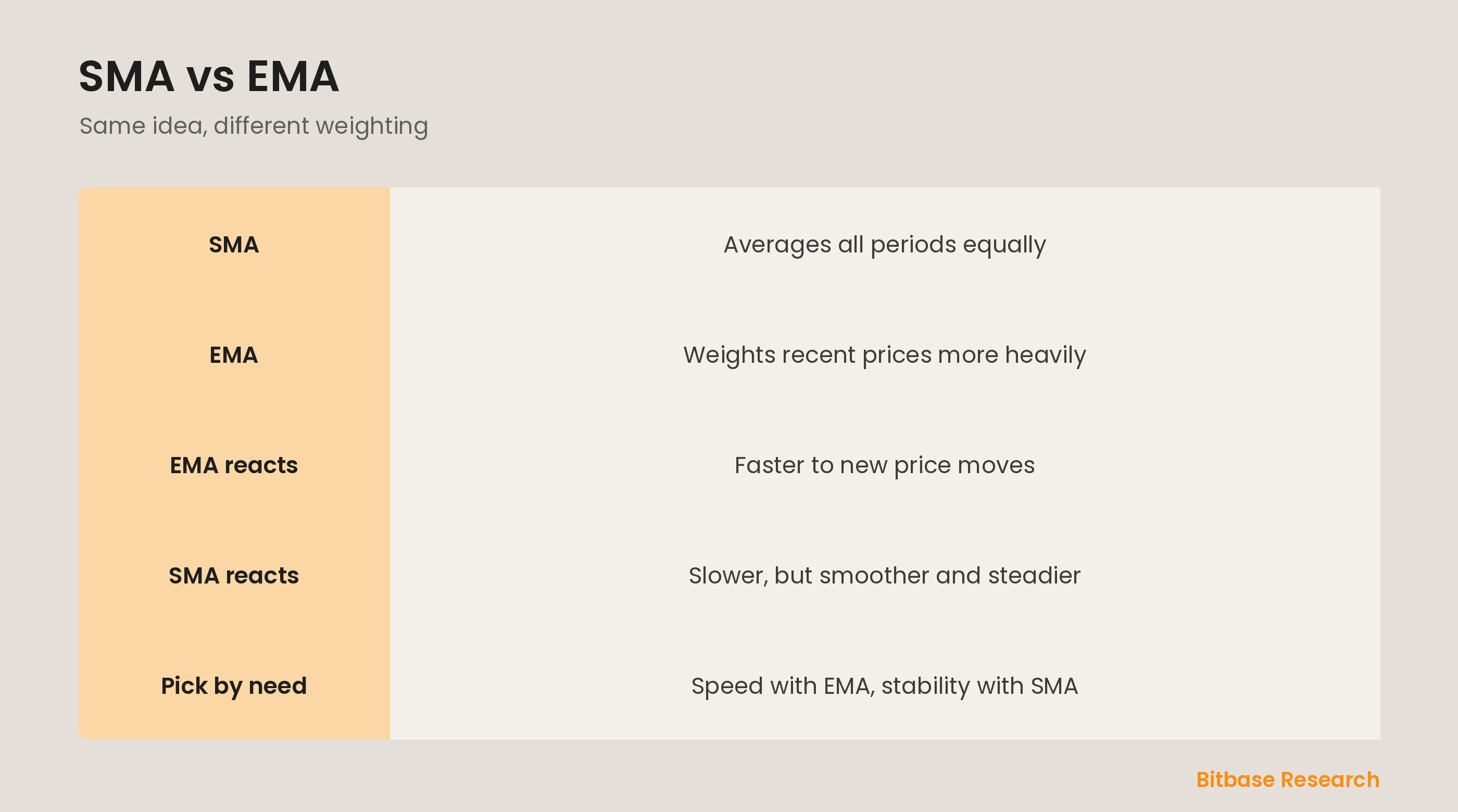
An exponential moving average, or EMA, weights recent prices more heavily than older ones. Instead of treating all periods equally, it puts extra emphasis on the latest candles, so newer information influences the line more. The result is an average that stays closer to current price and turns faster when the market changes direction. The EMA is the same length of history as an SMA, but it listens to the recent past more attentively.
How they behave differently
The weighting difference shows up directly on the chart. Because the EMA emphasizes recent prices, it reacts faster to new moves, hugging price more closely and signaling turns earlier. The SMA, weighting everything equally, lags a bit more but stays smoother and gives fewer false alarms. In short, the EMA is faster and more sensitive; the SMA is slower and more stable. Neither is better in the abstract; they simply trade speed against steadiness.
When to use each
Choose based on what you value. Traders who want to react quickly to changes, especially shorter-term traders, often prefer the EMA for its responsiveness. Those who want to filter out noise and follow the bigger trend without being whipped around often prefer the SMA for its stability. Many use both together, a faster EMA and a slower SMA, to balance responsiveness with reliability. There is no universally right choice, only the one that fits your style.
The bottom line
An SMA averages all periods in its window equally, making it smooth and steady but slower to react, while an EMA weights recent prices more heavily, making it faster and more sensitive to new moves. The EMA turns sooner and hugs price closer; the SMA lags a little but gives fewer false signals. Pick the EMA when you value speed and the SMA when you value stability, or combine them to get some of both. To keep learning the fundamentals, follow more from Bitbase Academy.
Disclaimer: This article is educational content from Bitbase Academy, provided for information only. It does not constitute investment, trading, tax, or financial advice. Crypto assets are volatile; assess your own risk. Written as of June 2026; refer to the latest official information.
References
[1] Investopedia, "Simple Moving Average (SMA): What It Is and How To Calculate It" investopedia.com
[2] Investopedia, "Exponential Moving Average (EMA): Definition and Formula" investopedia.com
[3] Investopedia, "Moving Average (MA): Purpose, Uses, Formula, and Examples" investopedia.com