Overbought and oversold are two of the most used, and most misused, words in trading. They sound like clear buy and sell signals: oversold means cheap, overbought means expensive, so buy low and sell high, right? Reality is trickier, and traders who take these terms too literally get burned. Understanding what overbought and oversold really mean, and what they do not, is essential. Here is the honest version.
What the terms mean
Overbought and oversold describe how stretched a price move has become. Overbought means price has risen quickly and far in a short time, so upward momentum is extended. Oversold means price has fallen quickly and far, so downward momentum is extended. The terms are about the speed and extent of a move, not a fixed valuation. A market can be overbought while still being fundamentally cheap, or oversold while still expensive; the words describe momentum, not worth.
How they are measured
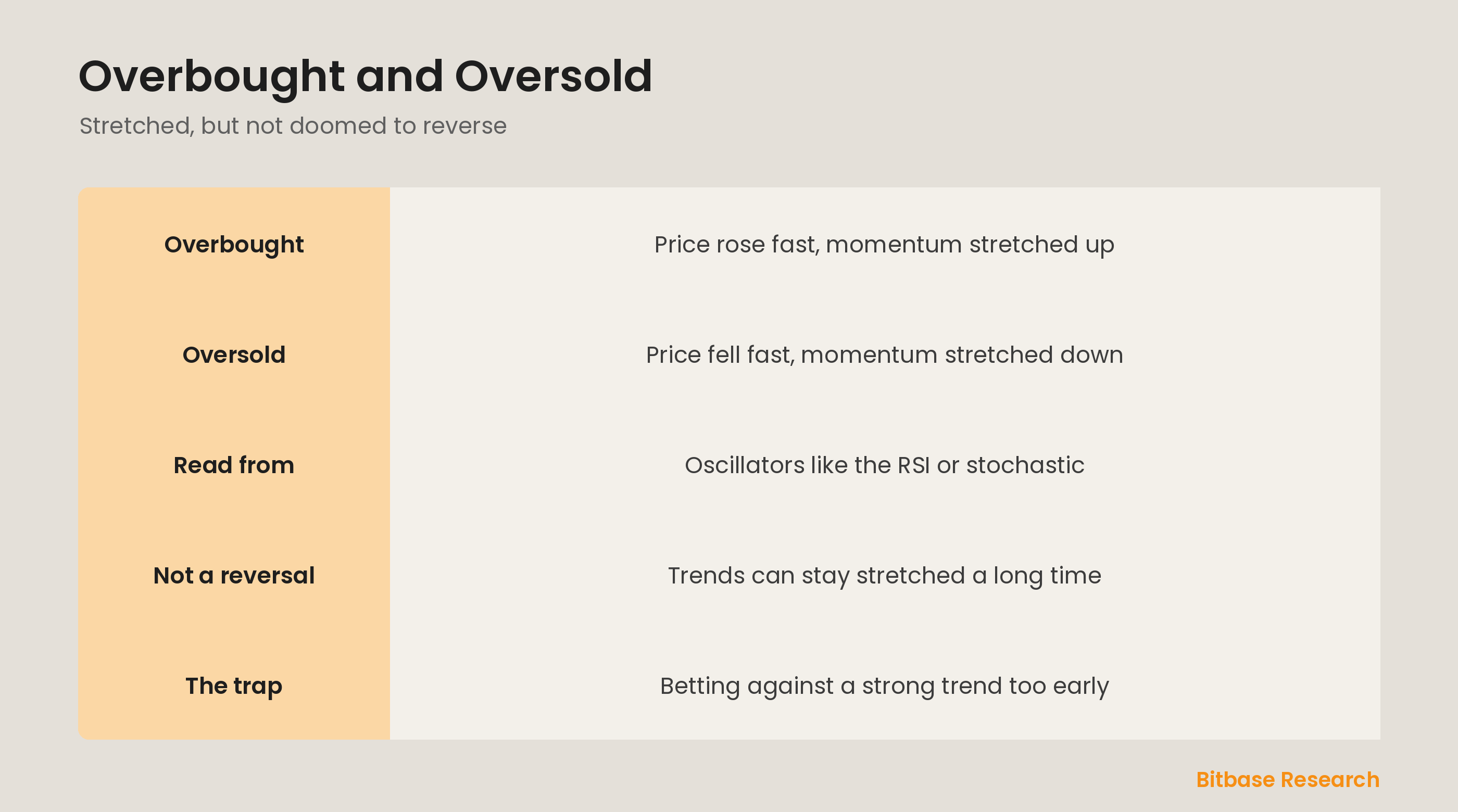
These conditions are usually read from momentum oscillators like the RSI or stochastic, which have zones for them. On the RSI, above 70 is commonly labeled overbought and below 30 oversold; on the stochastic, 80 and 20 do the same job. When an oscillator pushes into one of these zones, it is flagging that momentum has run hard in one direction. The specific number is a convention, but the underlying idea is always a stretched move.
Why they are not reversal signals
Here is the crucial point: overbought does not mean price must fall, and oversold does not mean it must rise. In a strong trend, an oscillator can stay overbought or oversold for a long time while price keeps trending, because powerful momentum simply pins the indicator at an extreme. Treating an overbought reading as an automatic sell, or oversold as an automatic buy, ignores that a stretched market can keep stretching further.
Avoiding the trap
The classic mistake is betting against a strong trend just because an oscillator is overbought or oversold, and getting run over as the trend continues. The safer approach is to treat these readings as context, not triggers: they tell you a move is extended and to be cautious, but you wait for actual evidence of a turn, like a reversal pattern or a break of trend, before acting. In a range, the signals work better; in a strong trend, respect the trend.
The bottom line
Overbought means price has risen fast and far, and oversold means it has fallen fast and far, both describing a stretched move rather than a fixed value, usually read from oscillators like the RSI or stochastic. Crucially, they are not reversal signals: in a strong trend, a market can stay overbought or oversold for a long time. The trap is betting against the trend too early, so treat these readings as caution flags and wait for real confirmation of a turn. To keep learning the fundamentals, follow more from Bitbase Academy.
Disclaimer: This article is educational content from Bitbase Academy, provided for information only. It does not constitute investment, trading, tax, or financial advice. Crypto assets are volatile; assess your own risk. Written as of June 2026; refer to the latest official information.
References
[1] Investopedia, "Overbought: What It Means and How To Identify It" investopedia.com
[2] Investopedia, "Oversold: Definition and How To Identify It" investopedia.com
[3] Investopedia, "Relative Strength Index (RSI) Indicator Explained" investopedia.com