
A market order promises a fill but not a price, and in a thin or crashing market that can mean an execution far worse than you ever intended. Exchanges guard against this with order protection: rules that reject an order rather than let it fill at a disastrous price. These guardrails have saved countless traders from a single catastrophic click. Here is how market order protection, fat-finger limits, and maximum deviation work.
Why market orders need protection
A pure market order fills against whatever is on the book, no matter how bad. If the book is thin or a flash crash empties it, your order can climb through terrible prices and fill far from where you expected. Without protection, a market buy could execute at an absurd price during a moment of chaos. Order protection exists to put a ceiling on that risk, so a market order stays fast without becoming reckless.
Price protection and maximum deviation
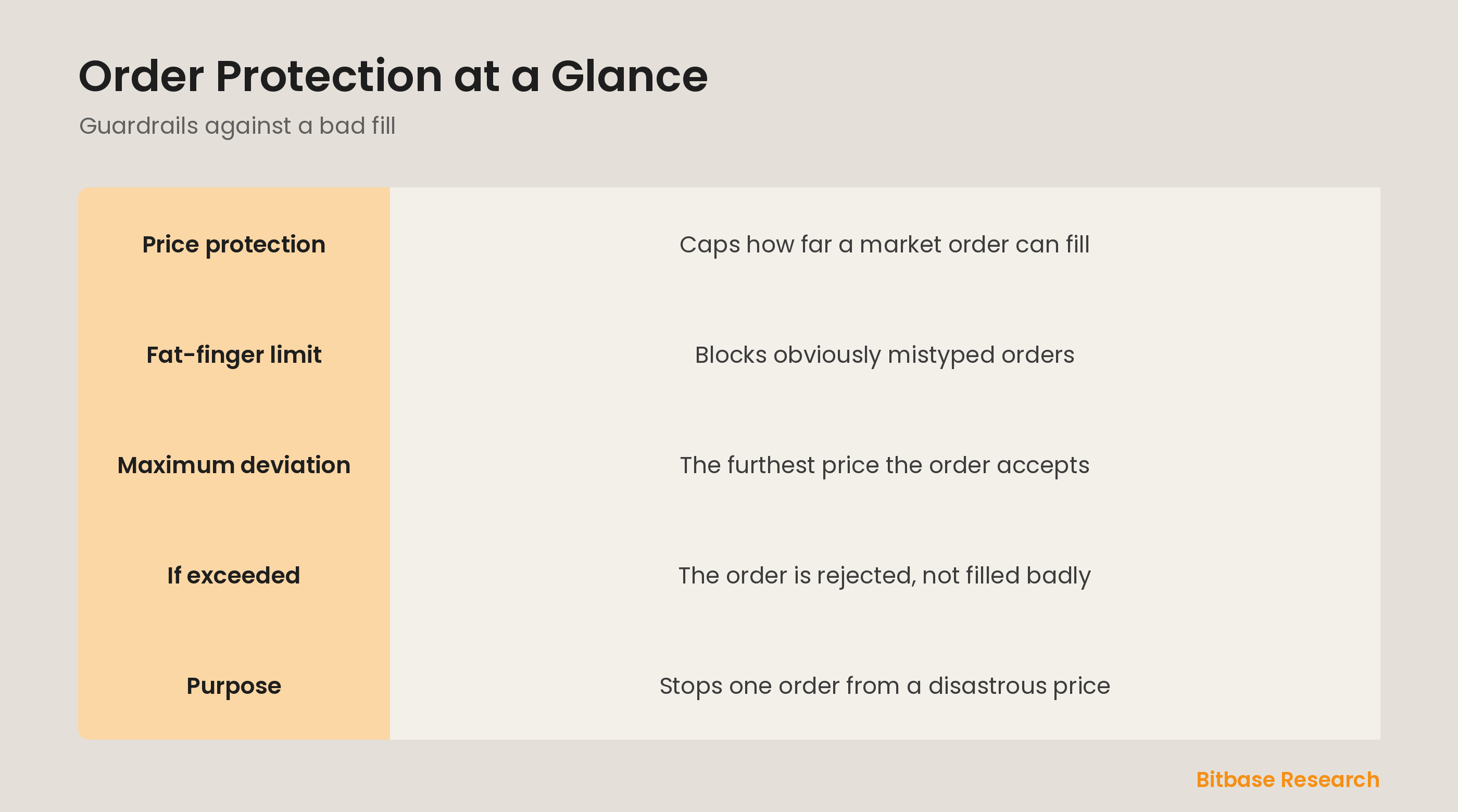
Price protection sets a limit on how far from the current price a market order is allowed to fill. This is often expressed as a maximum deviation: the furthest price the order will accept, such as a few percent from the last trade. The order fills normally up to that boundary, but the moment execution would require a worse price, it stops. In effect, the exchange converts a naked market order into one with a built-in guardrail.
Fat-finger protection
A fat-finger error is a mistyped order, an extra zero, a wrong decimal, a size far larger than intended. Fat-finger protection is a check that blocks or warns on orders that look like obvious mistakes, such as a price wildly away from the market or a size far beyond your balance. It cannot read your mind, but it catches the most dangerous slips before they become an expensive lesson, which is why it is worth leaving enabled.
Why an order gets rejected
When an order would breach these limits, the exchange rejects it instead of filling it. Seeing a rejection can be frustrating in the moment, but it usually means protection just saved you from a bad fill: the price had moved beyond your maximum deviation, or the order tripped a fat-finger check. Rather than fighting the rejection, treat it as a signal to reassess, then use a limit order or a wider tolerance if you genuinely want to trade at the new price.
The bottom line
Market order protection stops a market order from filling at a disastrous price by capping how far it can execute, usually via a maximum deviation from the current price. Fat-finger limits block obviously mistyped orders. When an order would exceed these, it is rejected rather than filled badly. These guardrails trade a little convenience for real safety, so leave them on and treat a rejection as protection doing its job, not an obstacle. To keep learning the fundamentals, follow more from Bitbase Academy.
Disclaimer: This article is educational content from Bitbase Academy, provided for information only. It does not constitute investment, trading, tax, or financial advice. Crypto assets are volatile; assess your own risk. Written as of June 2026; refer to the latest official information.
References
[1] Investopedia, "Market Order: Definition, Example, Vs. Limit Order" investopedia.com
[2] Investopedia, "Slippage: What It Means in Finance, With Examples" investopedia.com
[3] CFTC, "Customer Advisory: Understand the Risks of Virtual Currency Trading" cftc.gov