A market order is the simplest way to trade: tap buy or sell, and it fills right now. But right now at what price? Many beginners assume they get the price on the screen, then are surprised the fill differs. Understanding how a market order actually executes, and why the price you get is not always the price you saw, is the foundation of controlling your trading costs. Here is how it works.
What a market order does
A market order tells the exchange to trade immediately at the best prices currently available, prioritizing speed over price. When you send a market buy, it does not wait; it trades against the sell orders resting on the book, starting with the cheapest and working up until it is filled. Because it consumes existing liquidity, a market order takes whatever the book offers, which guarantees you a fill but not a specific price.
Expected price vs execution price
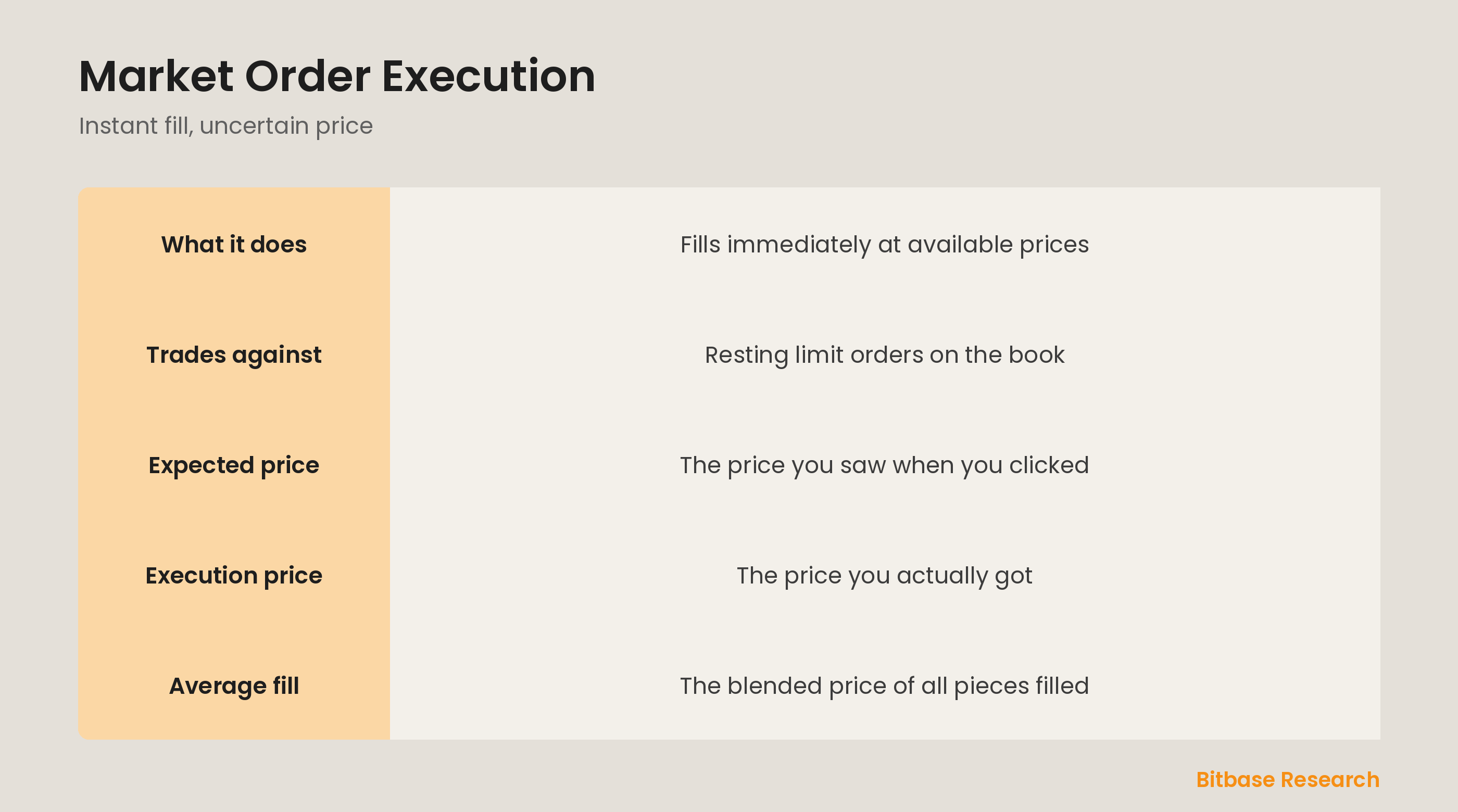
The price shown when you click is the expected price, usually the best available at that instant. The execution price is what you actually pay or receive. They can differ for two reasons: the market moves in the split second between your click and the fill, and your order may be larger than the amount available at the best price. The gap between expected and execution price is slippage, and it is a normal feature of market orders, not a glitch.
How the average fill forms
A market order large enough to exhaust the best price keeps filling at the next-best prices until it is complete, so it does not fill at one price but at several. Your average fill is the blended price of all those pieces. On a deep book with tight prices, that average is very close to where you started. On a thin book, the order climbs through worse prices, and the average ends up meaningfully away from the top of book.
When to use a market order
A market order is the right tool when getting the trade done matters more than the exact price, such as exiting quickly or entering a fast-moving market you do not want to miss. It is the wrong tool when price precision matters and you can afford to wait, where a limit order protects you. For anything large or in a thin market, a market order risks meaningful slippage, so consider splitting it or using a limit.
The bottom line
A market order fills immediately by trading against the resting orders on the book, guaranteeing execution but not a specific price. The expected price you see can differ from the execution price you get, and a large order fills across several prices to form an average. Use market orders when speed matters most, be aware of slippage in thin or fast markets, and reach for a limit order when price control is the priority. To keep learning the fundamentals, follow more from Bitbase Academy.
Disclaimer: This article is educational content from Bitbase Academy, provided for information only. It does not constitute investment, trading, tax, or financial advice. Crypto assets are volatile; assess your own risk. Written as of June 2026; refer to the latest official information.
References
[1] Investopedia, "Market Order: Definition, Example, Vs. Limit Order" investopedia.com
[2] Investopedia, "Fill: What It Means, How It Works, Types, and Example" investopedia.com
[3] Investopedia, "Slippage: What It Means in Finance, With Examples" investopedia.com