When a project buys back its own token or burns supply, it is sending a message: we are returning value to holders. But do these moves actually support the price, or are they just marketing? Learning to read buybacks, burns, and the on-chain flows around them separates real signals from theater.
What buybacks and burns signal
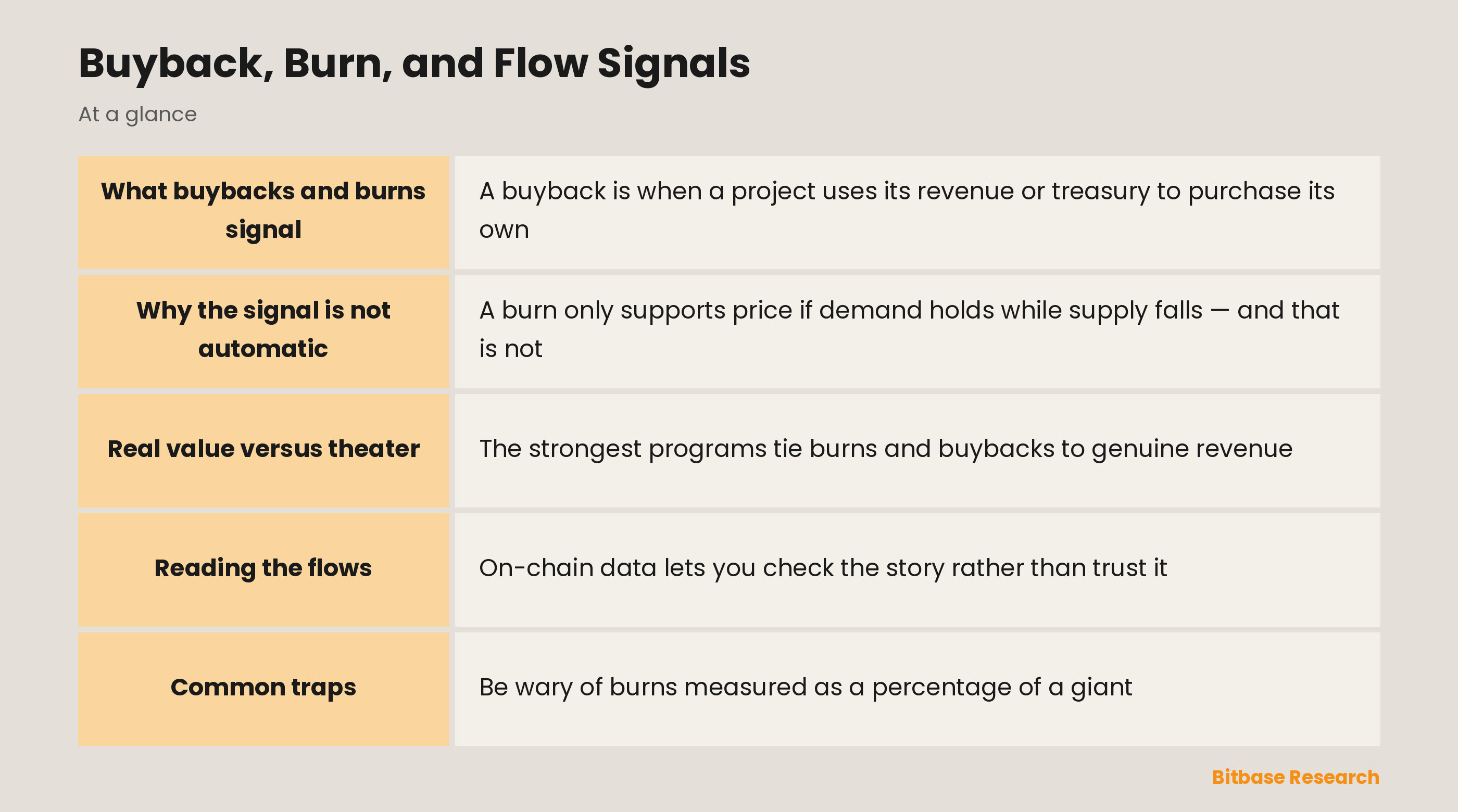
A buyback is when a project uses its revenue or treasury to purchase its own token on the open market; a burn permanently destroys tokens, shrinking supply. Both are meant to signal confidence and return value to holders, much like a company buying back its shares. The intended message is simple: demand is real and supply is getting scarcer.
Why the signal is not automatic
A burn only supports price if demand holds while supply falls — and that is not guaranteed. If a token is highly inflationary, a small burn can be swamped by new emissions. If a buyback is funded by selling something else, or by a treasury that is running dry, the "value return" may be an illusion. The mechanism matters more than the headline.
Real value versus theater
The strongest programs tie burns and buybacks to genuine revenue, so they scale with real usage. Ethereum's fee mechanism burns a portion of every transaction, and large exchange tokens run recurring buy-back-and-burn programs funded by platform activity — for example, BNB's quarterly auto-burn steadily removes coins on the way to a hard supply target. Weaker projects announce one-off burns of tokens they were never going to sell, which changes little.
Reading the flows
On-chain data lets you check the story rather than trust it. You can watch whether a project's treasury is actually buying, whether burned tokens came from real revenue, and whether team or insider wallets are quietly selling into the buyback. Exchange inflows and outflows add context: coins moving onto exchanges hint at selling, while steady removal hints at conviction.
Common traps
Be wary of burns measured as a percentage of a giant, mostly-locked supply — they can look dramatic while barely denting the float that actually trades. Watch for buybacks announced but never verifiable on-chain, and for "deflationary" branding on tokens whose emissions still swamp the burn. A signal you cannot verify is just a press release.
The bottom line
Buybacks and burns can be real value returns or pure theater, and the difference lives in the details: the funding source, the emission backdrop, and the on-chain flows you can check yourself. Treat every burn announcement as a claim to be verified, not a reason to buy. The projects worth trusting are the ones whose numbers hold up when you look.
Disclaimer: This article is educational content from Bitbase Academy, provided for informational purposes only. It is not investment, trading, tax, or financial advice. Written as of July 2026; rely on the latest official information.
References
[1] CoinMarketCap, "BNB Chain Completes $1.28B Token Burn" coinmarketcap.com
[2] AMBCrypto, "BNB burn strengthens tokenomics" ambcrypto.com