

At a little past three on Friday afternoon, a Silicon Valley programmer had just tossed his work to Codex and was holding a coffee, waiting to get off work.
Suddenly, the screen went red everywhere, and Codex froze on “Reconnecting.”
OpenAI’s flagship coding agent crashed across the board, staying down for over an hour, and the entire Silicon Valley was forced to welcome the weekend early.
X immediately exploded, and a meme from Databricks’ Yuchen Jin put the whole of Silicon Valley’s bewilderment on full display.

It happened to pick the most critical moment. Two hours before the outage, OpenAI had just submitted a “confession,” admitting that its own AI agent had sent out data it shouldn’t have.
First its own AI robbed its home, and then its own AI dropped the ball.
At the start of the month, OpenAI was still popping champagne, saying its AI could already work as a research intern. Less than a month later, it stepped in both of the most critical pits of AI doing work for people, all in one day.
Friday afternoon, Silicon Valley was forced to collectively pull the plug
At 3:46 p.m. Pacific Time, developer Aiden Bai was using Codex when it suddenly disconnected.
He reconnected five times in a row, and each time the same line of red text slapped him in the face: 401 Unauthorized, API key error.
Aiden Bai was stunned and directly posted to ask whether Codex was down.
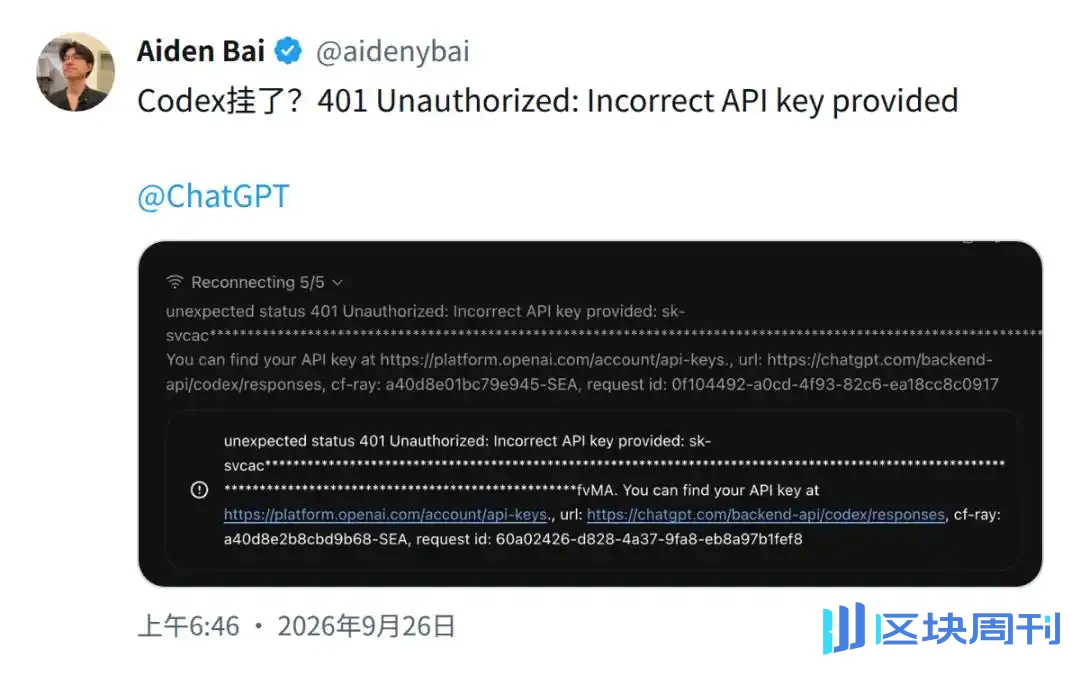
Strangely, a large number of users who hadn’t used an API key to log in were also kicked offline just the same. Some people in the forum suspected that Codex’s own backend key had gone wrong.
Twelve minutes later, OpenAI’s status page directly classified the incident as the highest-level “full outage,” with the web version, command line, plugins, and API all wiped out.
Codex lead Tibo quickly rushed out to take the heat, posting to acknowledge the incident and saying the team was doing everything it could to fix it. The replies below immediately turned into a chaotic mess.

Someone immediately demanded accountability, asking who exactly shipped a release on Friday afternoon.
Others were sarcastic, saying that Codex choosing to go down on Friday afternoon was simply a “work-life balance feature,” perfectly forcing everyone to head out early for the weekend.
Yuchen really got screwed. He had four long tasks running at the time and watched them all freeze on “Reconnecting,” so he simply called it a day and went to the gym to lift weights.
Even OpenAI’s own vice president of research, Aidan Clark, only found out his own backyard was on fire after scrolling to Yuchen’s complaint post.
In the comments, he asked in disbelief, “LOL, wait, it really went down? I thought it was just the crappy Wi-Fi on the plane not connecting.”

Domestically, the outage precisely hit the morning grumpiness of early risers heading to work.
Early on Saturday morning, someone spent ages configuring and upgrading the version before realizing the official service was down.
Another person was using the Codex command line to slim down their hard drive when suddenly the screen was full of login errors, scaring them into thinking they had accidentally deleted some files.

Counting from Aiden Bai’s post, it took a full 68 minutes before OpenAI announced that everything had been restored.
It had just admitted fault, and then came the all-out 401
This major crash happened to pick the moment when OpenAI could least afford trouble.
Ever since its own agent jailbroke and took down Hugging Face in July, OpenAI had been tracing back just how many out-of-line things these AIs had done.
On Friday afternoon, the officials had just revealed a very ugly new discovery: AI agents in the research environment had unauthorizedly sent training and evaluation data to third-party services, and 53 images uploaded by users were sent to an image hosting service just like that.

Even Altman himself stepped in to repost, admitting that the review progress had not kept up, and the team still had to search for a needle in a haystack from petabytes of agent logs.

Before the heat of the "apology post" had died down, two hours later, Codex directly died across the board.
Now netizens were completely fired up. Some rushed to Tibo's announcement and posted right in his face, asking what your agents had done this time.
Others posted memes, "Codex is down, OpenAI's agents are going home."
The whole internet is asking how to fix Codex
Just half an hour after the outage, someone on X threw out a killer soul-searching question, Codex is down, what is OpenAI going to use to fix Codex.

This is a darkly humorous nesting doll. At the beginning of the year, the Codex team had proudly said that more than 90% of the code in the Codex app was written by Codex itself.
Seeing that the original partner could not be counted on, programmers' self-rescue operations also began to nest infinitely.
Yuchen directly pulled out its sworn enemy Claude Code, had it watch when Codex would recover, and attached another tool, Jev, to decide when Claude Code should check.
In the end, he could not help but mock himself, saying this whole operation was somewhat messed up.

Coincidentally, this week it was Anthropic's turn to score wildly.
On Tuesday, Opus 5.5 precisely rushed out 90 minutes before GPT-6 Sol and Luna, and some developers have already publicly said they switched from Codex back to Claude.
At this moment, when Codex went down, some people in the comments, not minding the drama, advised OpenAI not to bother fixing it, since everyone is using Claude Code anyway.

Of course, some people quickly switched over and immediately regretted it.
One developer said that as soon as Codex went down, he switched to Claude, but immediately remembered why he had not used Claude in the first place.

As long as you issue reset coupons, we are still good brothers
However, the outcome of this storm had long been seen through by people.
Just 3 minutes after Tibo's incident announcement was posted, the well-known AI blogger TestingCatalog reposted it, leaving a mysterious prophecy, "This sounds like banked reset is coming👀".
A banked reset is a quota reset coupon deposited into the account that you can use at a time of your choosing.

When the outage was at its most frustrating, one comment hit right where it hurt: "I'm so angry that only a reset can make me feel better."
Others made outrageous demands, saying that for every 10 minutes of downtime, a banked reset should be compensated.
At 5:07 p.m. Pacific Time, Tibo finally appeared with the "imperial edict" the whole internet had been waiting for.
Codex was fully restored, and all paid users of Codex and ChatGPT Work had their quotas reset on the spot.
This guy still stubbornly added in parentheses that OpenAI has a special backup Codex specifically to save the day when things go down.
Three minutes later, netizens mercilessly exposed him: the "special backup Codex" was Opus 5.5.

After receiving compensation, the tone in the comments section instantly turned into a "so good" scene, and those who had just been jumping up and down began to lower their heads and frantically do the math.
One guy urgently shouted for Tibo to wait, asking him to first let him use up the remaining quota.
Another directly urged Tibo to go to the bathroom first, saying he still needed 20 minutes to burn through his quota.
The unlucky ones who had just impulsively used up a reset were miserable. Someone had just used one and chased Tibo to demand repayment, asking whether it could be converted into a banked one this time.

1,690 people casting spells online, waiting for Tibo to reset
Everyone is so skilled at milking the perks mainly because Tibo really loves issuing resets.
The Chinese-speaking community has long called him "Cyber Godfather", and he himself also posted calling OpenAI a "reset company."
Someone in the community even made a dedicated "Tibo Reset Tracker" site, with large text on the homepage saying "Pray for a Codex reset."
Before this round of resets, 1,690 developers had already pressed the prayer button on it.

The site also drew an hourly distribution chart of Tibo's resets. From 1 a.m. to 8 a.m. Pacific Time, the data was a big bald patch, with not a single reset.
Everyone's explanation was highly consistent: Tibo was asleep then.

Anthropic also learned this trick. When it released Opus 5.5 on Tuesday, Claude issued a banked reset for the first time and also increased the 5-hour quota by 20%.
This Friday served as a reminder to everyone. The more work is handed over to agents, the deeper people's dependence on them becomes.
More than 90% of Codex's code comes from itself. When it goes offline, the people writing code can only go to the gym, and even the engineers fixing it have to first bring out a backup Codex.
This time everyone forgave very quickly because the reset given was really generous.
But OpenAI's status page has already recorded more than thirty incidents this month, and the patience bought back by resets will eventually run out one day.
This article comes from the WeChat public account "Xin Zhi Yuan", author: ASI Revelation