At ten o'clock on the evening of August 13, the carriage of Metro Line 10 still carried the lingering crowding from the evening rush hour. Lin Wei gripped the hanging strap, lowered her head, and scrolled through her phone. A push notification from the tech world caught her attention.
The headline read: "
DeepSeek
V4-Pro official version released, Agent capabilities greatly enhanced, priced at three times the Flash version." She slid her fingertip down a bit. Also releasing updates the same day were Grok 4.6 and
Tongyi Qianwen
Qwen3.8-Max.
"Parameters, Agent, weights... I know every single word, but when they're strung together I have no idea what they're saying." Lin Wei told the Phoenix AI Research Institute.
Her phone has
Doubao
and
DeepSeek
installed, usually used for writing weekly reports and meeting minutes. "But what exactly these new versions upgraded, and what impact they have on me, I can't tell at all."
What confused her even more was another piece of news. On August 17,
DeepSeek
API price adjustments officially took effect, introducing "peak-valley pricing" for the first time, with some interfaces seeing increases of up to 1100% during peak hours. The official announcement specifically added a sentence: This adjustment only applies to API interface calls; daily use by ordinary web and App users remains free.
"Why does the API charge, but the App is still free?" Lin Wei said. She asked a few friends around her, and not a single one could answer.
If we turn the clock back thirty years, we find that almost the exact same script is being replayed, except that the puzzling terms back then were TCP/IP, modems, and bandwidth.
01 Thirty-six years ago, the Internet was also a "book of heaven"
The Internet of the early 1990s was a world belonging to geeks, scholars, and engineers.
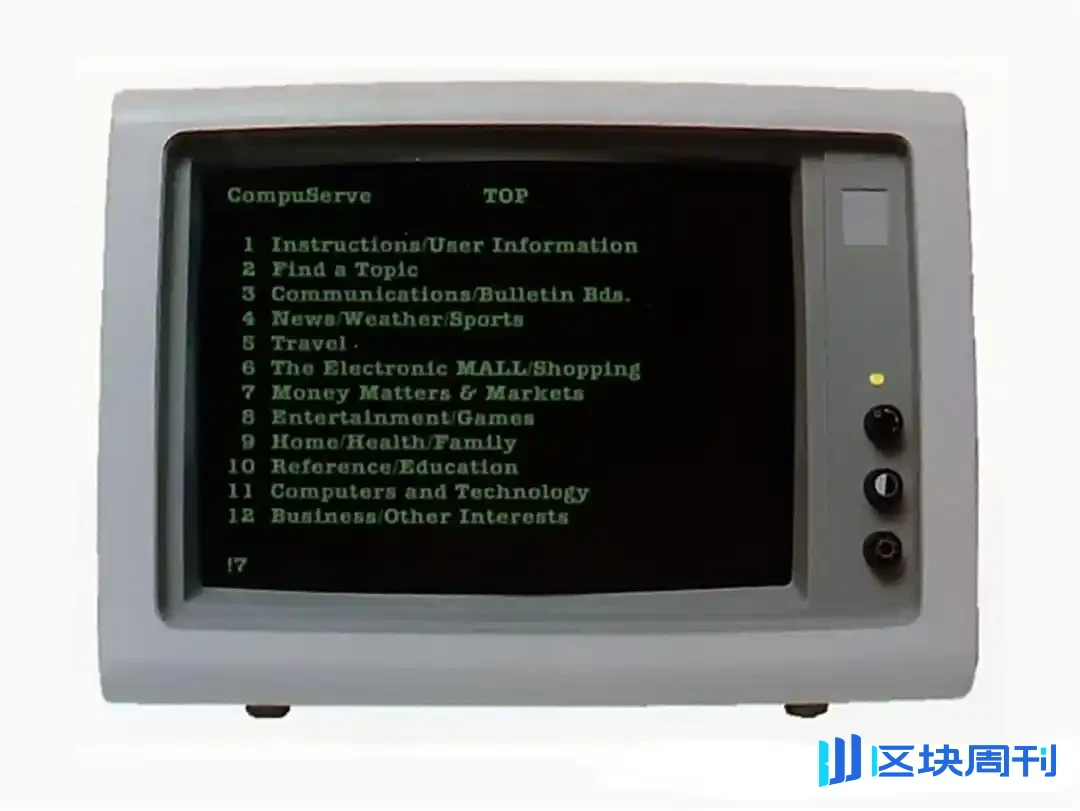
For ordinary people to get online, they first had to figure out what the TCP/IP protocol was, know how to dial up through a telephone line, and face a command-line interface with green characters on a black background.
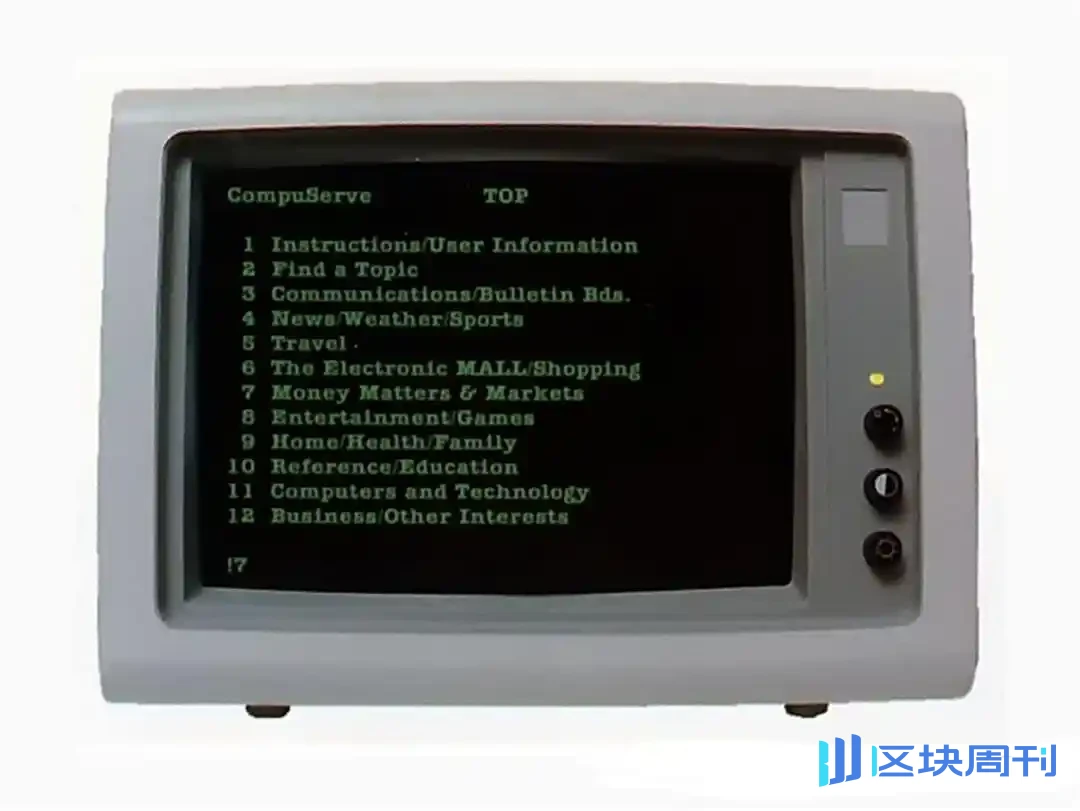
The image shows the CompuServe character-based main menu interface. Source: CompuServe official historical materials
At that time, the most mainstream online services were CompuServe and Prodigy. The interfaces were crude and the operations cumbersome. Users needed to remember a long string of commands to send and receive an email.
Even more discouraging was the vocabulary. The words we take for granted today were all a book of heaven to ordinary people back then.
Bandwidth was originally a meteorological term from 1885, used to measure rain belts; Firewall existed as early as 1578, referring to a literal wall that blocks fire; Online was originally a railway term, meaning "along the railway line."
These words were stripped from their respective native fields and forcibly given technical meanings, which to ordinary people was no different from another language.
Just at this time, a young man born in Hawaii appeared.
Steve Case, who was impatient with his school's computer classes in middle school. In his eyes, "components, circuits, assembly language—what do these things have to do with me?" So in 1985, he and a partner founded an online service company, which was officially renamed "America Online" (AOL) in 1989.
Case did not invent any underlying Internet technology. He did only one thing: package the Internet into a product that ordinary people could use.

The image shows Steve Case. Source: AOL official website
His approach seemed almost crazy at the time. Former chief marketing officer Jan Brandt later recalled that this "carpet bombing" went through two stages.

The image shows a 3.5-inch floppy disk distributed by AOL. Source: AOL official website
In the 1993 trial period, AOL still used 3.5-inch floppy disks, and the first batch alone sent out more than 200,000 copies, with a unit cost as high as $1.19.
As optical drives became standard on personal computers, AOL quickly switched to lower-cost, higher-capacity CDs, and the distribution scale began to expand exponentially. From Super Bowl audience seats to frozen steak packaging, every corner of North American life could see that CD printed with the AOL logo: "Insert it into your computer and try the real America Online."
Later, Brandt estimated that AOL had cumulatively sent out over 1 billion discs, and at its peak, half of all discs produced globally bore the AOL logo.
In terms of cost, AOL spent an average of $35 to acquire each registered user. But this proved to be an extremely good deal: the average lifetime value of an AOL user reached $350, exactly ten times the customer acquisition cost.
The discs were only the entry point; what truly retained people was Case's obsession with a foolproof experience. AOL replaced the command line with a graphical interface, and replaced abstract protocol configurations with concrete channels like "chat rooms, email, newsgroups." Users didn't need to know what SMTP was—one click on [Write] and they could send an email; they didn't need to understand what IRC was—one click on [Chat] and they could enter a chat room.
This model, later called the "walled garden," essentially hid all the complex internet technology in the background, leaving users with only a world they could enter with a double-click.
The commercialization effect was immediate. When AOL went public in 1992, it had only 200,000 users; by 1997, it crossed the 10 million mark. By its peak in 1999, AOL had over 35 million paying users, meaning nearly half of all U.S. internet users accessed the internet through AOL.

The image shows the brand sign outside the headquarters of America Online. Source: social media screenshot
AOL's revenue in 1999 reached $4.8 billion, with a net profit of $762 million, and its market value once soared to $164 billion, more than twice IBM's market value at the time. In the same year, AOL entered the Fortune 500 for the first time, ranking 337th, and was the only internet company on the list.
Looking back at this history, AOL's most core contribution was never inventing a particular internet technology, but completing a "cognitive dimension reduction."
AOL did not try to teach ordinary people what TCP/IP was or what a modem was; it simply let people first chat, send emails, and play games, and in the process of using them, they naturally built an understanding of the internet. Users gradually learned what "slow internet speed, disconnection, viruses" meant.
02
The summer after China's AI "user acquisition frenzy"
More than thirty years later, Chinese internet giants did something similar to AOL's disc bombardment: they used real money to smash the entry barrier flat, pulling users in the door first and worrying about the rest later.
The 2026 Spring Festival can be called the most "money-burning" AI enlightenment campaign in Chinese internet history.

The image shows
Tencent Yuanbao
Spring Festival activity page. Source: social media screenshot
On January 25,
Tencent Yuanbao
was the first to announce it would splash out 1 billion yuan in cash red envelopes, with a single one worth up to ten thousand yuan; Baidu Wenxin followed closely with a 500 million yuan red envelope campaign lasting a month and a half; on February 2, Alibaba
Qwen
directly threw out a 3 billion yuan "Spring Festival treat plan," with 2 billion yuan in free-order coupons plus 1 billion yuan in cash, the largest investment in a Spring Festival campaign in Alibaba's history; ByteDance's
Doubao
simply embedded AI into the Spring Festival Gala.
Four giants, nearly 5 billion yuan in real money, with only one goal: to get more people to open AI and use AI.
The user acquisition data was impressive enough. During the Spring Festival,
Qwen
's "Help Me" function was called over 5 billion times in total, and Yuanbao's nationwide lottery participation reached 3.6 billion times. Ma Huateng said bluntly at an internal employee meeting: he hoped this move could recreate the WeChat red envelope moment from 11 years ago.
A large number of users who had never used AI before spoke with AI on their phones for the first time.
But after the excitement faded, an awkward reality surfaced: many people, after grabbing red envelopes and using an AI conversation once, turned around to face words like "API, GLM, Token, RAG, Agent" and were still completely confused.
This sense of fragmentation—"easy to get started, hard to advance"—was magnified to the extreme in the global large model version competition in August 2026.
On August 13,
DeepSeek
V4-Pro official version launched, kicking off this wave of密集 updates. In the official announcement, the core upgrade points were also full of various terms: Agent intelligent agent capabilities greatly enhanced, far surpassing the preview version on tool-calling benchmarks such as Terminal Bench and Cybergym; reasoning depth improved, supporting longer-chain complex problem decomposition; API pricing also increased, with the Pro version's input price 3 times that of the Flash version and output 2.5 times, and during peak hours a peak-valley pricing with a maximum increase of 1100% would be implemented.
Almost on the same day, Musk's Grok 4.6 and Alibaba's
Tongyi Qianwen
Qwen3.8Max were released and updated one after another. In the following twenty days, 11 frontier large models worldwide, including Anthropic's ClaudeSonnet5, Zhipu GLM-5.3, and Meta's Llama4Scout, were密集 officially announced, with new versions flooding the screen almost every one or two days.
In the headlines of industry media, expressions like "new benchmark high," "capability leap," and "paradigm innovation" appeared one after another, and the entire track was immersed in the excitement of rapid technological advancement.
But from the perspective of an ordinary user, this vigorous version competition feels more like a "carnival behind glass."

The image shows
DeepSeek
-V4-Pro official version launch announcement. Image source:
DeepSeek
official account
The core capabilities of these upgrades are almost all concentrated in dimensions that ordinary users cannot perceive.
DeepSeek
V4-Pro's main features—Agent tool invocation, code execution, and multi-step reasoning—are mainly released to developers and enterprise customers through API interfaces. On the App side for ordinary users, there is only limited experience improvement in "deep thinking" mode, and the perceived difference in daily chatting or writing weekly reports is minimal.
Even the "Computer Use" capability enhanced in ClaudeSonnet5, which allows AI to directly operate computer software and execute cross-application tasks, is also prioritized for API callers. The entry point on the individual user side is hidden in a third-level menu, and the vast majority of people do not even know it exists.
In other words, the core capabilities that the industry is striving to iterate are mostly sunk "below the dialog box," hidden in API interfaces, developer tools, and enterprise-level solutions.

The image shows netizen comments. Image source: social media screenshot
On social platforms, this anxiety of "technology running forward while people chase behind" is everywhere. Some netizens commented with emotion, "New AI tool models come out every day, and I'm so anxious that I can't learn them in time"; a 35-year-old netizen even said bluntly, "Era, please run slower and take me with you."

The image shows popular science content related to "AI jargon." Image source: social media screenshot
When searching for "AI jargon" on social platforms, hundreds or thousands of targeted popular science posts pop up: "Quickly master AI jargon in five minutes," "Explain Agent, Skill, Token in plain language," "Understand 15 AI concepts in one image." From LLM, MCP, Harness to RAG, Workflow, behind almost every industry buzzword stands an entire group of creators doing "terminology translation."
The existence of the "AI jargon popular science" niche reflects that the threshold of terminology has not been eliminated by products, but shifted onto users.

The image shows the "Practical Manual for Computer Internet Operations" published in 2004. Image source: Baidu Baike
Just as in the 1990s, if everyone could easily access the internet, bookstalls would not be filled with "Introduction to Dial-up Internet" and "Practical Internet Manuals." When a technical field needs a large amount of third-party popular science to bridge the cognitive gap, it precisely shows that its productized encapsulation is still far from the passing line for ordinary people.
03 The thick terminology booklet has already begun to let light through
But in September 2026, when OpenAI released GPT-6Astra, it played a promotional video that let many people see another possibility.

The image shows a scene from the GPT-6 Astra promotional video. Image source: OpenAI official website
In the video, a person says to the computer: "Turn this yellow circle into a rocket, and then make it into a 3D game." A few minutes later, a 3D game that can be moved with the arrow keys, accelerated with the space bar, and dodges asteroids appears on the screen.
Then he says: "I'm a bit hungry. Can you help me order the beef rice from that place from last week?" The AI directly opens the food delivery app and completes the order.
The reason this video sparked heated discussion across the internet is not primarily that AI can write code, but that it demonstrates a completely new interaction paradigm: you do not need to know what a game engine is, what an API call is, what frontend and backend are, or even the term "Agent." You only need to describe what you want in natural language, and AI completes everything else in the background.
The wall of terminology that once stood between ordinary people and advanced capabilities has been completely leveled here.
This is not an exploration unique to overseas markets. Domestically, the same productization attempts have already quietly started beyond the chat box, and the cracks are slowly extending along the edges of "capability encapsulation."

The image shows
Kimi
Global Ambassador Program Image source:
Kimi
official website
In July 2026, Moonshot launched the "
Kimi
Global Ambassador Program," going against the industry convention of "first opening APIs and testing with developers," and instead recruiting experience officers from ordinary users worldwide, prioritizing validation of end-to-end task experiences.
Tongyi Qianwen
The "Help Me" smart entry upgraded in 2026 encapsulates multi-plugin scheduling and cross-application operations entirely behind the conversation. Users can complete email organization, schedule synchronization, and weekly report writing with a single instruction, while the underlying workflow orchestration and API authentication remain completely invisible to users.
ByteDance
Doubao
The programming assistant iterated in 2026 encapsulates code generation, Excel batch processing, and simple web page creation—which originally required a development environment—into tools that can be invoked in natural language, allowing ordinary office workers to get started without any programming background.
These attempts are still limited to specific scenarios and are far from achieving foolproof encapsulation of all capabilities, but the signal is already clear enough: true mass adoption is not just about making the chat box layer friendly, but also about encapsulating the thick terminology book beyond the chat box, layer by layer.
This path has long been repeatedly verified in the history of technology.

The image shows Apple Macintosh icons Image source: Susan Kare Exhibition
In 1984, Apple Macintosh encapsulated the DOS command line into a desktop and icons. The pixel icons designed by designer Susan Kare—such as folders, trash cans, and watches—allowed non-technical users to guess functions visually: click a folder to open a file, drag it to the trash can to delete it.
In 1998, Google encapsulated complex information retrieval theory into a blank search box. Users did not need to understand Boolean query syntax or know what the PageRank algorithm was; entering keywords would yield sorted answers. Crawlers, indexing, ranking, and server clusters were all hidden behind that box.
In 2007, iPhone encapsulated the entire operating system into a piece of glass screen. Users did not need to know what a file system or process management was; by tapping, swiping, and pinching with a finger, they could use all functions. Keyboards, styluses, and menu hierarchies all disappeared.
Each time, it was a company proactively making technology simple, rather than waiting for users to become smarter.
Three to five years from now, when we look back at today, the phrase "calling an API" may be replaced by "connecting a port," as natural as saying "connect to Wi-Fi, charge up" today.
Terms like "Agent, RAG, Token" may join "dial-up internet, modem" as archaic vocabulary that appears only in nostalgic posts.
By then, no one will ask "What should I do if I can't understand AI?" because AI will already be like electricity—you do not need to understand how a generator works; press the switch and the light comes on.
This article comes from the WeChat public account "Phoenix Finance," author: Phoenix AI Research Institute