



Written by: Hans
Compiled by: AididiaoJP, Foresight News
The center of gravity for U.S. crypto market rulemaking is shifting from Congress to regulators. This article places three things under the same framework: where legislation has stalled, what that means for HYPE, and how the licensed HIP-3 brings U.S. clients onto Hyperliquid. To understand this path, one point must first be clear: Hyperliquid does not necessarily need to register itself; licensed institutions can open their own markets on top of its underlying layer.
Legislative Stalemate: Congress Only Passed a Stablecoin Law
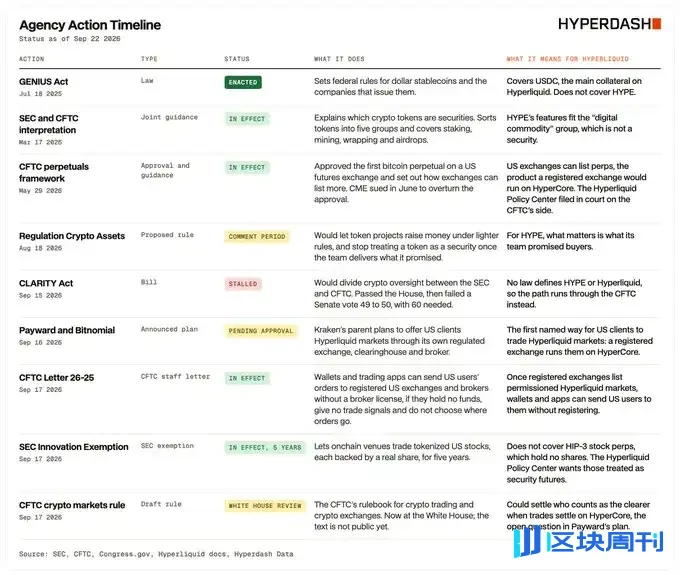
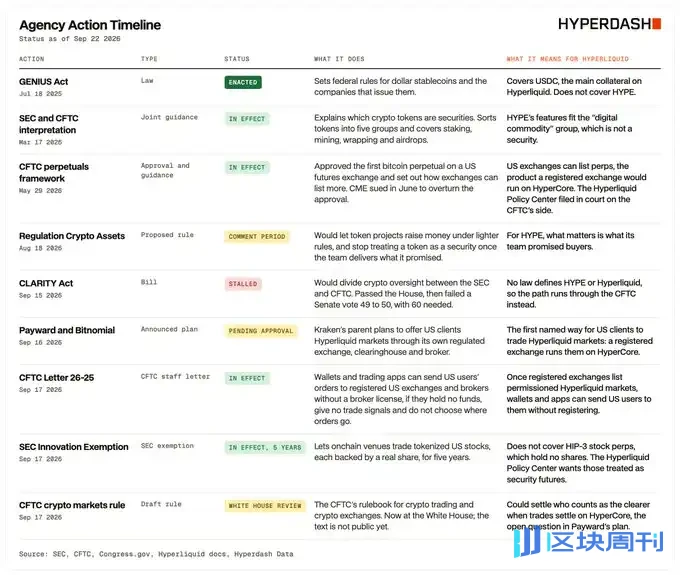
The only federal crypto legislation that has actually landed so far is the July 2025 GENIUS Act, aimed at payment stablecoins. The market structure bill, the CLARITY Act, originally sought to draw regulatory boundaries between the SEC and CFTC. It passed the House in July 2025, but on September 15, 2026, the Senate ended debate by a vote of 49 to 50, and it failed to pass. By one vote, the bill did not become law.
Jake Chervinsky of the Hyperliquid Policy Center said: "We didn't get Clarity this week, but we got certainty on the path forward." The author interprets this as: next, watch the CFTC, not the next round of congressional votes.
Regulators Take Over: SEC and CFTC Pave the Way Within the Year
On March 17, the SEC and CFTC jointly explained how securities laws apply to crypto assets, replacing the SEC staff framework from 2019. Digital securities, digital commodities, collectibles, and tools were defined separately: on-chain stocks, bonds, and fund shares are directly regulated as securities; digital commodities are not regulated as securities; stablecoins ultimately depend on their terms.
On May 29, the CFTC approved the first Bitcoin perpetual contract on a U.S. futures exchange. On June 6, the Chicago Mercantile Exchange (CME) sued to overturn the approval. Whether perpetuals can be traded on U.S. venues remains unresolved in court.
On August 18, the SEC proposed the Crypto Asset Regulations: token projects could use an issuance exemption; the safe harbor states that after the issuer completes or abandons the work originally promised, the token is no longer treated as an investment contract.
Three things happened on September 17. CFTC Letter No. 26-25 allows front ends to route users to registered U.S. brokers and exchanges without having to register as introducing brokers themselves, provided they do not custody funds, provide trading signals, or determine order routing. This effectively extends the exemption granted separately to the wallet Phantom in March of this year to all qualifying applications. In July, the Hyperliquid Policy Center and Phantom had asked for this exemption to be written into a formal rule applicable to all wallets. On the same day, the SEC approved an innovation exemption allowing on-chain venues to trade U.S. stocks backed one-to-one by real shares. Also on the same day, the CFTC sent crypto trading and market rules to the White House; they remain at the pre-rule stage, with no public text. Whether on-chain order books can be recognized as clearing engines, the author believes, is written in this yet-to-appear draft.
On August 19, Trump said that CFTC Chairman Selig is pushing to bring Hyperliquid ashore "in a fully compliant and legal manner." Letter No. 26-25 covers applications that route to registered U.S. venues, and Hyperliquid itself is not yet such a venue. The approach taking shape does not require it to register: a registered company deploys its own market on HyperCore, and that company takes on the clients.
HYPE Positioning: Digital Commodity Logic and Futures Listing
Under the March joint interpretation, the value of a digital commodity comes from the usable network and supply and demand, not from the team's management and operation; holders have no claim to income, profits, or assets. The author assesses HYPE by utility: it pays gas on HyperEVM; it is staked to validators to provide security for HyperBFT consensus; HIP-3/4 deployers must lock 500,000 HYPE as slashable margin; holders have no claim on exchange revenue.

The document names 16 digital commodities, including BTC, ETH, SOL, and XRP. Footnote 51 gives the screening criterion: each is "the underlying of a futures contract listed for trading on a designated contract market already regulated by the CFTC." HYPE had no such contract at the time, so it was not named. This does not mean it is excluded; it only means the named list follows already-listed futures.
On May 18, Coinbase Derivatives self-certified HYPE perpetual-style futures under CFTC Rule 40.2, and trading opened on June 8 without being halted. Self-certification means the exchange lists after notifying the CFTC itself; it is not a qualitative ruling by the Commission. But this contract was listed as a commodity future. On this basis, the author believes HYPE is already traded on U.S. venues as a commodity future.
U.S. Entry Template: Payward Assembles Three Licenses
On September 16, Payward, the parent company of Kraken, announced its intention to pursue licensed HIP-3. The structure breaks down into three licensed entities:
- Bitnomial Exchange, a designated contract market, creates, owns, and manages the licensed HIP-3 market;
- Bitnomial Clearinghouse, a derivatives clearing organization, handles clearing and settlement;
- NinjaTrader Clearing, a futures commission merchant, handles account opening and custody.
Only accounts opened through NinjaTrader and whitelisted by both NinjaTrader and Bitnomial can trade these contracts. This is not an open global order book, but a U.S. client book within a permissioned list. Payward acquired Bitnomial on May 1 of this year, aiming to obtain the three licenses: exchange, clearinghouse, and futures brokerage. The launch date, fees, and underlying assets have not been announced, and the plan still awaits regulatory approval.
Clearing Division of Labor: HyperCore Matches, Licensed Clearinghouse Backstops
How clearing is divided is the most technical and most critical part of the article. HyperCore already uses code to mark to market, freeze margin, and execute liquidations. A registered clearinghouse is more likely to serve as a backstop: through the modifyBackstopLiquidatorApproval parameter, the deployer designates who takes over positions that remain unliquidated after forced liquidation. Bitnomial Clearinghouse is the natural bearer of that seat and the corresponding losses. The author states clearly: this is the outcome he considers most likely, provided the CFTC recognizes that protocol code can serve as a clearing engine.
Payward is the first company to publicly disclose this structure. Other registered exchanges and brokers can follow suit. In each case, the broker's own app is the most natural front end; wallets and other trading applications, as long as they comply with the three restrictions in Letter No. 26-25, can also route U.S. users there without having to become brokers themselves.
Follow-up Observations: Three Things Determine the Pace of Implementation
- When HIP-3 will go to mainnet;
- Whether Bitnomial will self-certify the listing under Section 40.2, or go through the approval process;
- Whether the crypto market rules can pass the White House—whether an on-chain order book can serve as a clearinghouse is written right there in that text.
The author's conclusion is rather optimistic: most of the pieces for connecting Hyperliquid to the United States in a compliant manner are already on the table; HYPE fits the institutional definition of a digital commodity and is already traded as commodity futures on a U.S. exchange; licensed institutions also have a template—a registered exchange deploys the market, a registered broker-dealer onboards clients, and HyperCore handles matching, margin, and liquidations. Payward was the first to speak up, and he does not think it will be the last.
Three pieces have yet to fall into place: whether the CFTC recognizes that protocol code is the clearing engine; whether CME's challenge to perpetual contracts on U.S. exchanges will fail; and whether HIP-3 will go to mainnet. Under the current administration, with the SEC and CFTC already in the driver's seat, the author expects things to accelerate going forward.
These are the roadmaps of people within the ecosystem, not regulatory approvals. Even if a permissioned market opens, that does not mean the globally permissionless Hyperliquid automatically becomes legal for U.S. retail. What really needs to be verified is still that as-yet-unpublished rules text from the White House, and whether Bitnomial has actually listed the contracts.