Author: Zhao Ying
The standoff between the AI Agent wave and rising US Treasury yields is tearing the US stock market into two completely different worlds.
This week, Meta released its Agentic AI model Muse, and its market value surged by $220 billion in a single week, driving the Nasdaq 100 Index to become the strongest-performing major stock index. But at the same time, US Treasury yields continued to climb, pushing rate-sensitive assets into a trough — the Russell 2000 Index lagged significantly, and the S&P 500 repeatedly seesawed around the 7,700 level, unable to achieve an effective breakout.
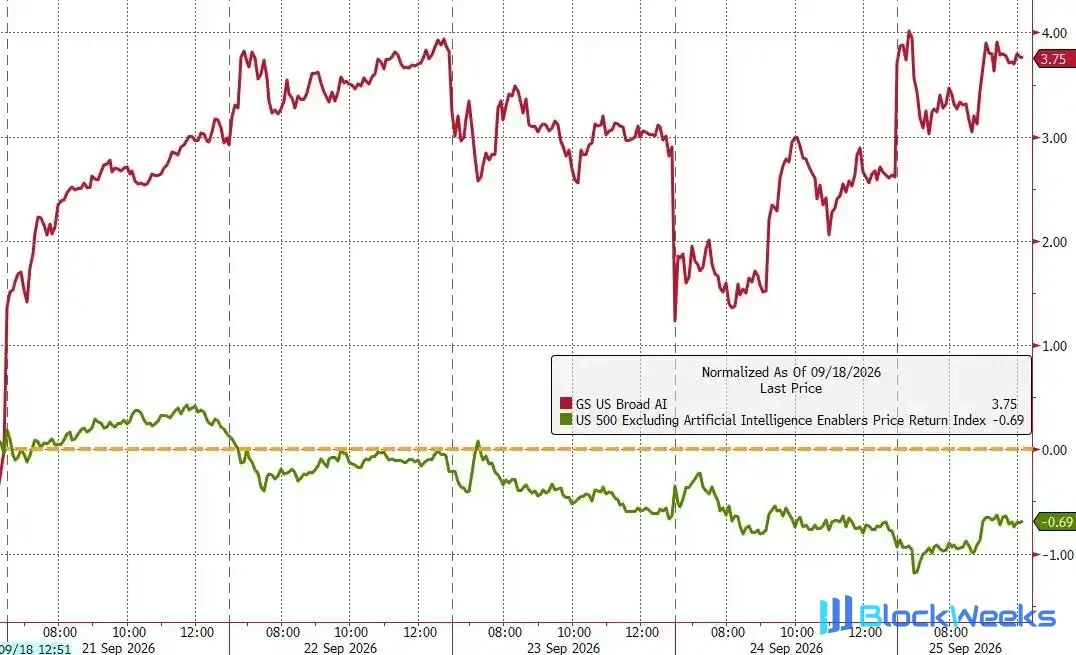
The internal divergence in the market has reached an extreme level. If AI-related names are excluded, the S&P 500 actually fell about 1% this week; the number of stocks hitting new lows on the NYSE exceeded the number hitting new highs for 9 consecutive trading days, the longest losing streak since October 2023.
Tony Pasquariello, head of global hedge fund business at Goldman Sachs, characterized the current situation as a "frustrating game of cat and mouse" between the stock market and the rates market, and gave clear advice: if you insist on holding long equity exposure, you need to simultaneously short US Treasuries to hedge interest rate risk.
AI Agents Ignite a Structural Rally, Market Cap Concentration Hits a Record High
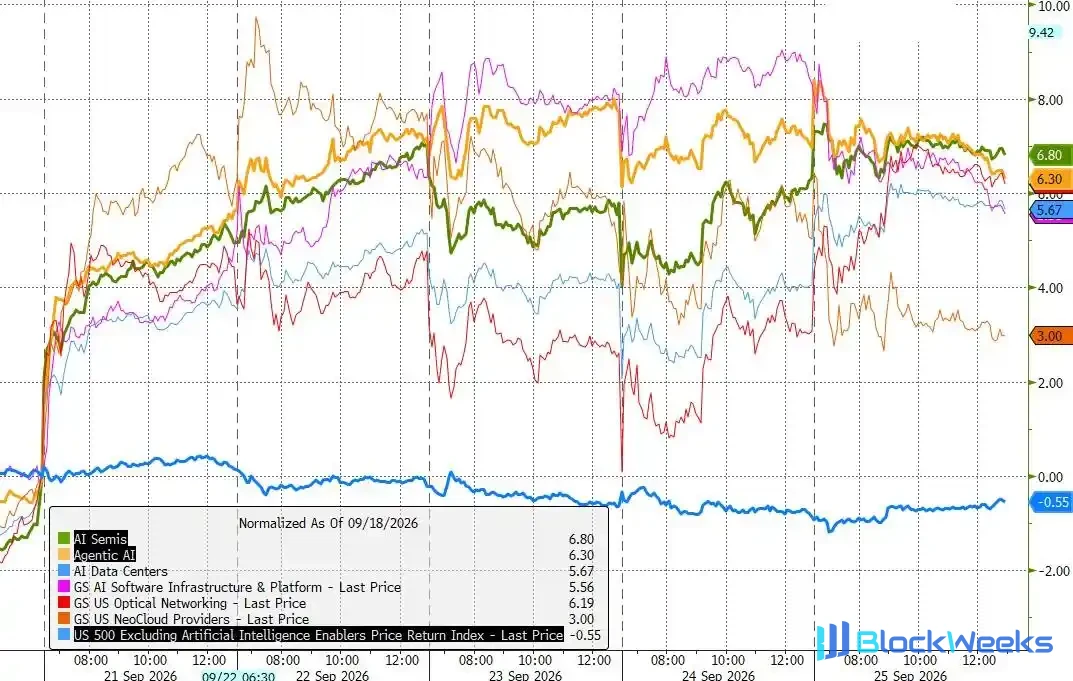
Meta's Muse model became the biggest catalyst for the market this week. The release of this Agentic AI product increased Meta's market value by $220 billion in a single week, bringing its total market value back to the $2 trillion mark, and drove the entire AI industry chain higher across the board — the semiconductor sector led gains due to the "inference economy's" pull on hardware demand, and Agentic AI-related names benefited collectively. Goldman Sachs' Agentic AI basket index (ticker GSXUAGNT) rose accordingly, and the high-beta momentum basket even recorded 9 consecutive trading days of gains.
Rich Privorotsky, a senior trader at Goldman Sachs, pointed out that Muse is only the first among many entrants, and in the coming weeks and months, competing products from Google and OpenAI will appear one after another. He believes that as large enterprises take on security, infrastructure, and distribution functions, a great deal of economic friction and intermediary links will be eliminated, which is itself a productivity improvement and structurally has an inflation-suppressing effect, with an overall positive impact on the broader stock market.
It is worth noting that US stock market cap concentration has climbed to a historic extreme. Pete Callahan, chief technology analyst at Goldman Sachs, pointed out that there are now 10 US TMT companies in the S&P 500 with market values exceeding $1 trillion, whereas just three years ago, at the start of the AI cycle, that number was only 3.
Severe Internal Divergence in the Market, the "Diffusion Trade" Is Declared Dead
Behind the AI rally's revelry is a sharp deterioration in market breadth. This week the technology sector stood out alone, while both the energy and financial sectors lagged; the Mag7 (the seven tech giants) rose nearly three times as much as the other 493 S&P constituents. ZeroHedge, citing data, pointed out that the "diffusion trade" exists in name only — the number of stocks hitting new lows on the NYSE exceeded new highs for 9 consecutive days, the longest streak in nearly three years.
At the same time, divergence has also appeared within the AI trade. AI power-related stocks were weak this week, and their performance was almost perfectly negatively correlated with the probability of Democrats winning the House in the US midterm elections — the market worries that once Democrats control the House, existing and future data center construction projects may be shelved indefinitely, posing a potential drag on US AI infrastructure investment.
In addition, credit spreads of hyperscalers widened noticeably this week, while their equity valuations remained elevated. Goldman Sachs noted that the divergence between hyperscaler credit risk and Nasdaq implied volatility has widened to abnormal levels, and the gap between the two is worth watching.

US Treasury Yields Become the Biggest Obstacle, S&P 500 Repeatedly Blocked at the 7,700 Mark
The continued rise in US Treasury yields is the core variable suppressing a market breakout this week. After consolidating around the 7,700 level for two full months, the S&P 500 showed signs of an upward breakout on Tuesday, but was immediately dealt a "head-on blow" by the bond market and fell back to its starting point that same evening.
Pasquariello described this situation as a "frustrating game of cat and mouse" between the stock market and the rates market: every time stocks try to break out, rates jump accordingly, suppressing risk appetite; and the rise in rates, by tightening financial conditions, directly weighs on rate-sensitive assets. The Russell 2000 Index has underperformed the S&P 500 for six consecutive weeks, and Goldman Sachs frankly acknowledged that small caps have been continuously sold off by long-only funds and wealth management channels, with technicals also breaking down.
On the valuation front, research by Goldman Sachs' US equity strategy team shows that the market has already priced in a certain degree of discount regarding the sustainability of AI infrastructure earnings growth — the median forward P/E of AI infrastructure stocks has fallen from 32x in April 2026 to 22x currently, with some pessimistic expectations already digested.
Goldman Sachs: Holding Stocks Requires Hedging, Breakout Still Needs a Catalyst
Faced with the above fractured landscape, Pasquariello gave a clear operational framework: if you want to hold significant long equity exposure, you need to simultaneously establish a simple short US Treasury position as a hedge. He rated the current market's speculative long positioning at +3 on a standard scale of -10 to +10, believing that overall positioning is not crowded.
He also pointed out that buyback intensity is slowing, new equity issuance is rising, US retail investors are tending to stand on the sidelines, and the current market structure is not perfect. But he also admitted that, given how fierce the recent move in rates has been, the stock market's ability to hold on to most of its gains is itself no small feat.
Pasquariello's conclusion is: if a catalyst for an upward breakout appears in the market, fast money will have to chase the rally and enter quickly; but before that, the tug-of-war between stocks and rates will continue, and ZeroHedge added one final word to this — "yet."