Author: Xiaoxiang, Cailian Press
As U.S. Treasury yields suffered their worst Waterloo in nearly 18 months on Wednesday, the "second phase" of this round of the U.S. Treasury crisis seems to be emerging, with yields gradually evolving from "rising high" to "rising fast"...
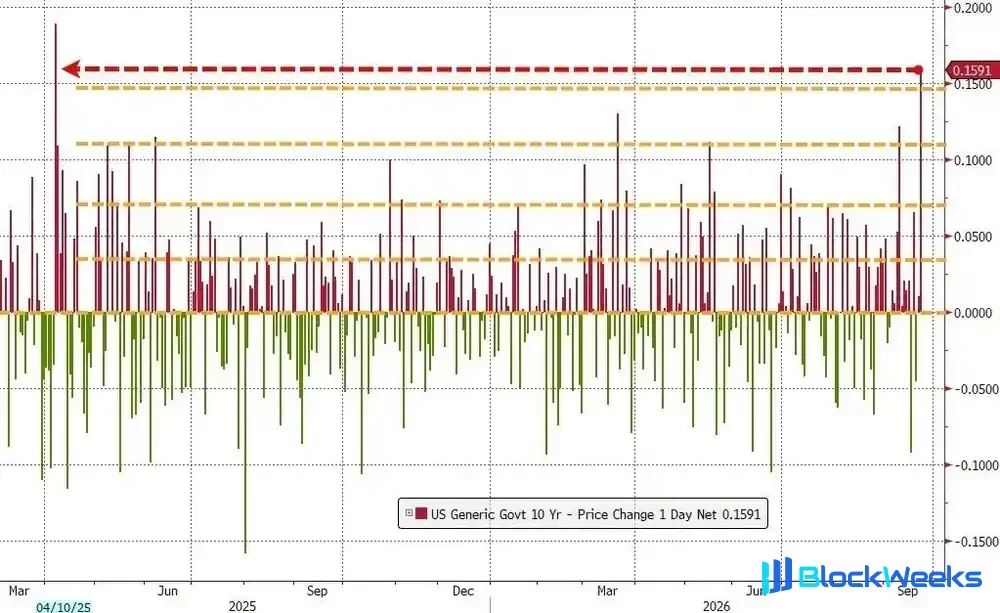
Cailian Press introduced earlier in the day that, with the superposition of the "five consecutive whips" of bearish news, the U.S. Treasury market on Wednesday formed a "perfect storm," driving the single-day increase in the 10-year U.S. Treasury yield to the largest record since April 2025, when Trump announced "Liberation Day" tariff measures that triggered market turmoil. According to industry statistics, this was a rare extreme fluctuation of 4 standard deviations.
Many industry insiders had previously warned that rising yields alone do not necessarily lead to a stock market crash. The greater risk actually lies in market volatility being too rapid and disorderly. For stocks, the speed of interest rate changes is more important than the direction, at least in the short to medium term.
With the violent sell-off in the bond market on Wednesday, people undoubtedly need to be nervous now...
Goldman Sachs previously warned in a research report that when the 10-year U.S. Treasury yield fluctuates by about 50 basis points within a month, or 30 basis points within two weeks, the stock market will begin to pay close attention.
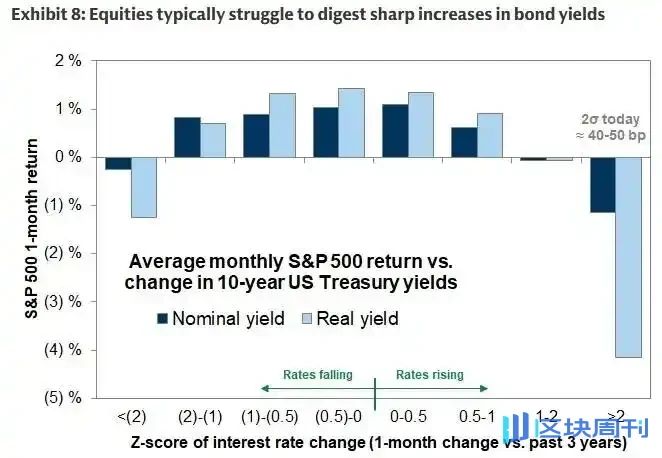
Interestingly, as of Wednesday, the 10-year U.S. Treasury yield has cumulatively risen by 51 basis points since August 26; since September 8, it has cumulatively risen by 35 basis points—although this slightly exceeds Goldman Sachs' statistical period in terms of time, if the U.S. Treasury sell-off continues unabated, then breaking through the warning line set by Goldman Sachs is clearly no longer difficult.

Yields "Sitting at 5, Eyeing 6"
For years, the U.S. 10-year Treasury yield reaching the benchmark level of 5% has been regarded as the tipping point for global financial markets to begin experiencing turmoil. Now, this threshold no longer seems like a ceiling, but more like a midway stop.
This month, the 10-year U.S. Treasury yield broke through 5% in one go—extremely rare in recent decades, and even when it occurs, it is often fleeting. But this breakthrough has forced some investors to confront an unsettling question: what if 6% is the new number that truly keeps them awake at night?
The duration of this yield breakthrough above 5% is still short, not enough to fully validate this theory. But according to Mike Bell, head of market strategy at BlueBay Asset Management, this level has historically been just a psychological threshold, not an automatically triggered warning line.
"People always think there is a 'magic number' for U.S. Treasury yields, and once touched, it becomes a problem, but it is actually a relative concept, not an absolute value," Bell explained.
What truly matters is the comparison between Treasury yields and other key investment indicators, especially the earnings yield ratio with stocks. Bell pointed out that the balance between the two is approaching a critical inflection point, which is likely to set the stage for a new round of stock market sell-offs.
Historical patterns offer some insight. The last time the 10-year U.S. Treasury yield broke through 5% was on the eve of the global financial crisis, when the MSCI All Country World Index halved directly; and less than a decade earlier, the yield soared to nearly 6.8%, also becoming one of the drivers that burst the dot-com bubble.

JPMorgan analysts pointed out that the reason why the current market pressure point may once again rise above 5% is fundamentally due to a "major structural change" in the global economy—the significantly increased weight of artificial intelligence, healthcare, and the service sector. Leading companies in these fields continue to invest and expand aggressively regardless of borrowing costs.
JPMorgan, citing the views of some major investors at its recent conference, said this means that "the traditional interest rate transmission mechanism seems to have significantly weakened," and the stock market's "crash threshold" may rise—or fall in the 5.5% to 6.0% range.
A Profound Repricing
In any case, in the $29 trillion U.S. Treasury market, which serves as the pricing benchmark for almost all financial assets, a move in yields from 5% to 6% would mean a profound reshaping of global capital costs.
A 6% U.S. Treasury yield implies three signals: a significant rise in inflation expectations, heightened concerns about U.S. fiscal sustainability, or the market's firm belief that high interest rates will be maintained for a long time—or possibly a combination of all three.
Federal Reserve policymaker Goolsbee admitted this week that if yields remain at the 5% level for a long time, it is currently unknown whether the market will react differently than before.
Paul Jackson, head of global asset allocation research at Invesco, said the logic behind investors' close watch on US Treasury yields is very straightforward: US Treasuries represent the benchmark for the global risk-free rate, and a yield breaking above 5% means investors can lock in the highest risk-free US Treasury return since 2007.
Jackson's model calculations show that once the 12-month average yield on the 10-year US Treasury reaches 4.72% and continues to rise, global stock markets will turn downward.
At present, the market still has some buffer space before this critical threshold—the current 12-month average is about 4.34%—but Jackson revealed that he has already begun to moderately reduce equity positions and shift into government bonds to lock in this rare and generous yield. "If Treasury yields continue to climb, the risk of the stock market coming under pressure and declining over the next 12 months cannot be ignored," he pointed out.
Hidden dangers emerge in emerging markets
Looking at past experience, emerging markets, which have performed strongly in recent years, are often the first victims to bear the impact when US Treasury yields surge.
Rising US Treasury yields usually drive the dollar stronger, greatly increasing the appeal of dollar assets. This not only siphons off cross-border capital from emerging economies, but once the cost of repaying dollar-denominated debt rises sharply, it may even push fiscally fragile countries to the brink of a default crisis.
Capital flow data show that last week emerging market bond funds recorded their largest weekly net outflow in months, while equity funds also saw billions of dollars withdrawn; at the same time, the pace of emerging market sovereign debt issuance this month has also slowed noticeably compared with usual.
"For emerging markets, the current situation is hardly ideal," said Alison Shimada, head of emerging market equities at Allspring Global Investments, though she also stressed that there has not yet been a "sharp deterioration" or collapse, and the team as a whole still maintains a "constructive wait-and-see" attitude.
However, the biggest hidden danger may come from the level of psychological expectations.
Once investors begin to seriously discuss "the possibility of yields reaching 6%," the focus of debate will no longer be a temporary spike in yields. The market will have to undertake a deeper collective reckoning: the era of abundant liquidity and ultra-low-cost funding may have completely ended, and global asset prices must painfully adapt to a new normal of permanently elevated capital costs.
Neil Birrell, chief investment officer at Premier Miton, pointed out that although there has not yet been a panic-driven crash in the stock market, it is likely because most investors have not yet truly incorporated high interest rates above 5% into their long-term earnings forecast models.
"Before everyone reruns their valuation models, everything looks calm," Birrell said bluntly. "But data is ultimately data, and reality will surface sooner or later."