Written by: Rita
Goldman Sachs Group raised its forecast for the Fed's terminal rate to two rate hikes, while emphasizing that this tightening cycle is nearing its end. In a global outlook report released on September 22, 2026, Goldman Sachs pointed out that the Federal Open Market Committee (FOMC) raised rates by 25 basis points in September, and 16 of the 18 committee members expected at least one more rate hike within the year. Goldman Sachs expects the second rate hike at the October 27-28 meeting, after which rates will remain stable.
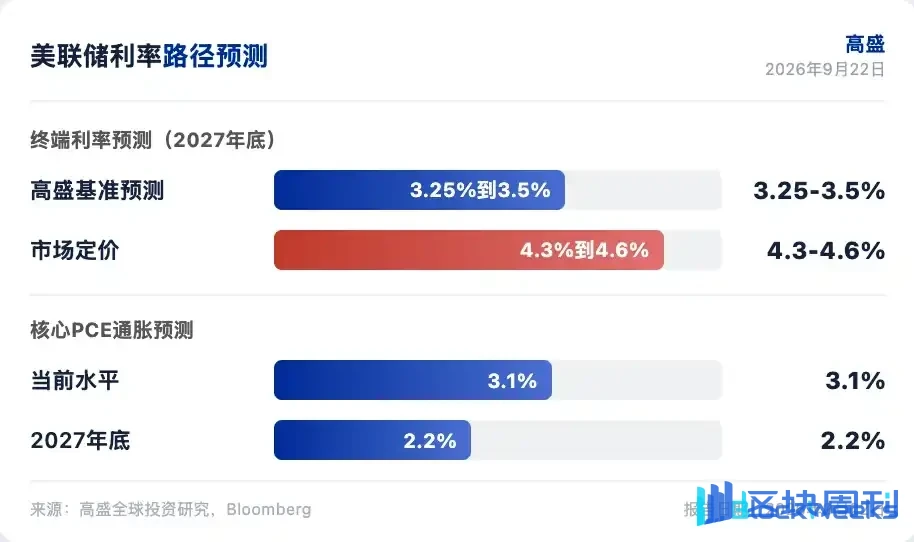
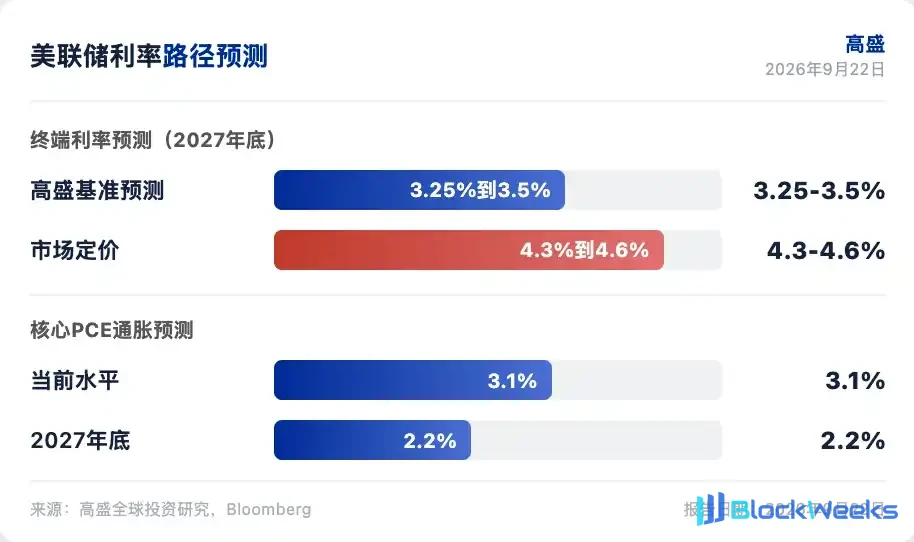
Goldman Sachs Chief Economist Jan Hatzius pointed out that market pricing is more hawkish than Goldman Sachs. Goldman Sachs' probability-weighted path shows the federal funds rate falling to the neutral rate of 3.25% to 3.5% by the end of 2027. The market is pricing in a smaller magnitude of rate cuts. Goldman Sachs believes core Personal Consumption Expenditures (PCE) inflation will decline faster than the committee expects.
The report's judgment framework is built on three changes. The Middle East situation has pushed up refined oil product prices, with diesel and jet fuel returning to 2022 highs. Third-quarter real GDP growth is tracking at 3.3%, and August nonfarm payrolls added 162,000. August core PCE rose 0.27% month-on-month, slightly above expectations. Goldman Sachs believes these hawkish factors will weaken in the coming months.
The case for rate hikes is fading
Oil prices are the first driver of the hawkish shift. Middle East crude oil exports have recovered to nearly 80% of pre-war levels, and the impact of the partial closure of the Strait of Hormuz and disruptions in the Red Sea has been absorbed. China has again cut imports since early August due to higher prices, helping stabilize the global oil supply-demand balance. Goldman Sachs commodity strategists expect Brent crude to gradually fall to $85 per barrel by December.
Refined product prices may remain elevated. A shortage of refining capacity constrains supply, and Goldman Sachs remains concerned that an escalation in the Middle East could damage more energy infrastructure. Diesel and jet fuel prices have returned to 2022 highs, with limited pass-through to core inflation, but they will weigh on consumer spending.
The divergence in economic data supports Goldman Sachs' judgment. U.S. GDP growth is close to its potential level of 2.3%, and the job market is stable. Economic growth is concentrated among high-income consumers and AI-related industries, residential investment is contracting, and demographics and mortgage rates are suppressing demand. August retail sales beat expectations, but Goldman Sachs still expects consumer spending to weaken, with slow nominal wage growth, higher gasoline prices, and the fading boost from tax refunds.
Core inflation is falling faster than expected
Core PCE annualized growth over the past three months slowed to 2.5%. Goldman Sachs pointed out that the effects of tariff pass-through, energy pass-through, software and accessory price increases, and portfolio management fees are fading. Temporary inflation drivers began to weaken from mid-2025 and will largely disappear by 2027.
Goldman Sachs forecasts core PCE year-on-year growth to fall from the current 3.1% to around 2.2% by the end of 2027. The committee's median forecast for 2027 core PCE is higher than Goldman Sachs'. Goldman Sachs believes this gap is the core of the disagreement over the rate path.
The internal stance of the FOMC is more unified than Goldman Sachs expected. The September 25 basis point rate hike had no dissenting votes, and 16 committee members expect at least one more rate hike within the year. Goldman Sachs believes the political sensitivity of an October rate hike is lower than in September, and in the history of the modern FOMC there is almost no precedent for skipping a meeting before a general election. Six days before the 2022 midterm elections, the committee raised rates by 75 basis points.
ECB and BoE each hike once
Goldman Sachs raised its forecast for the European Central Bank's terminal rate to 2.75%, expecting a third rate hike in December. Euro area growth is resilient, headline inflation will rise again, and the neutral deposit rate has entered positive territory in real terms. Goldman Sachs' forecast for the European Central Bank in 2027 is below market pricing, with core Harmonized Index of Consumer Prices (HICP) at 2.4% year-on-year in August, and underlying inflation data favorable.
The Bank of England is expected to raise rates by 25 basis points in November to 4%, in a "one and done" move. Goldman Sachs expects three rate cuts starting in late 2027 to 3.25%. UK inflation is close to the 2% target, with no significant overshoot.
The Bank of Japan is expected to raise rates by 25 basis points each in January and July 2027 to 1.75%. The Bank of Canada is expected to raise rates by 50 basis points in the second half of 2027 to 2.75%. Australia is expected to raise rates by another 25 basis points this month to 4.6%, with a risk of another hike in November, and then cut rates by 100 basis points in 2027 to 2028 to 3.6%. Goldman Sachs' forecasts in these markets are all more dovish than market pricing.
S&P earnings face a slowdown
S&P 500 earnings per share are expected to grow 36% in 2026, and Goldman Sachs U.S. equity strategists believe this growth rate is unsustainable. Companies are "over-earning" due to gains from private investment holdings and the AI investment dividend. Gains from private investment holdings come from AI model companies and others, and AI investment is driving margin expansion in semiconductors and memory chips.
Goldman Sachs expects gains from private investment holdings to end, AI investment to approach its peak, and S&P 500 earnings per share growth to slow to 11% in 2027. If AI investment declines directly, the slowdown would be larger, but Goldman Sachs believes this will not happen until 2028 or later.
In the bond market, the repricing of monetary policy expectations explains most of the rise in government bond yields. Goldman Sachs rate strategists expect some of the repricing to reverse, with long-term yields declining modestly. Rising term premiums and AI-related issuance pose constraints. Goldman Sachs credit strategists expect $420 billion in AI-related issuance in 2027.
In the foreign exchange market, major currencies are expected to remain in narrow ranges, with significant room for appreciation in the renminbi. In commodities, Goldman Sachs is bullish on long positions in refined products in 2027 as a hedge, maintains a bullish view on gold, and expects continued central bank gold purchases.
Goldman Sachs' core judgment is that falling inflation will force the Fed to stop raising rates earlier than the market expects. The risks are another escalation in the Middle East pushing oil prices higher, core inflation stickiness exceeding expectations, and an extended AI investment cycle pushing up term premiums. The market is pricing in a more hawkish rate path than Goldman Sachs, and this divergence is the main opportunity for rates trading in the coming months.

This article is a compilation and interpretation by Chaoxiang Research of a third-party brokerage research report (Goldman Sachs Group, September 22, 2026), combined with publicly available market information. The ratings, target prices, earnings forecasts, and related judgments cited in the article are all the views of the brokerage's analysts and represent only the position of their institution, not the views of Chaoxiang Research, and do not constitute any investment advice.
Markets carry risk, and decisions must be made independently. This article should not be used as a basis for buying or selling any securities.