Issue 20 closed on a conditional sentence that the market read as a commitment, and said the other branch would get its data in this window. It did. August CPI reaccelerated, the two-year added 24 basis points across four sessions, and bitcoin gave back 4.35% [1][2][3].
The single most useful fact in this issue is a date. The August CPI release carries USDL number 26-1496 and an embargo of 8:30 a.m. Eastern on Friday, September 11 [1]. The largest single-session repricing in the window happened on Thursday, September 10 — the day before. The two-year rose 13 basis points, the ten-year 12, the thirty-year 9, and bitcoin fell 2.21%, its worst session of the window [2][3]. On the print itself the front end added 7 basis points, the long end fell 2, and bitcoin rose 0.86% on the heaviest volume of the week [2][3]. The market moved ahead of the data and faded it on arrival.
The print itself was split, and the split is the reason a single headline number misleads here. All items rose 0.4% on the month against 0.1% in July; all items less food and energy rose 0.3%. Over twelve months the headline was 3.4% and core was 2.4% [1]. The gasoline index rose 3.9% and BLS attributes over one third of the entire monthly increase to it [1]. On this series' own arithmetic from the published index levels, core year-on-year has now fallen for a fourth consecutive month: 2.85%, 2.59%, 2.48%, 2.45% [1].
And the buyer stopped. Strategy's 8-K filed September 8, covering August 31 to September 7, discloses that the company did not purchase or sell any bitcoin and sold no shares under its at-the-market programme [4]. In the same period it repurchased 1,810,885 shares of its STRC preferred for $176.3m, and its board doubled the authorisation for that programme from $1.0bn to $2.0bn [4]. The week it stopped buying coin is the week the window's low printed at 76,000.30, which is 0.78% above the company's own disclosed average cost of $75,412 [3][4].
Week of September 7 to September 13, 2026
Bitbase Research · September 14, 2026
The one chart that matters
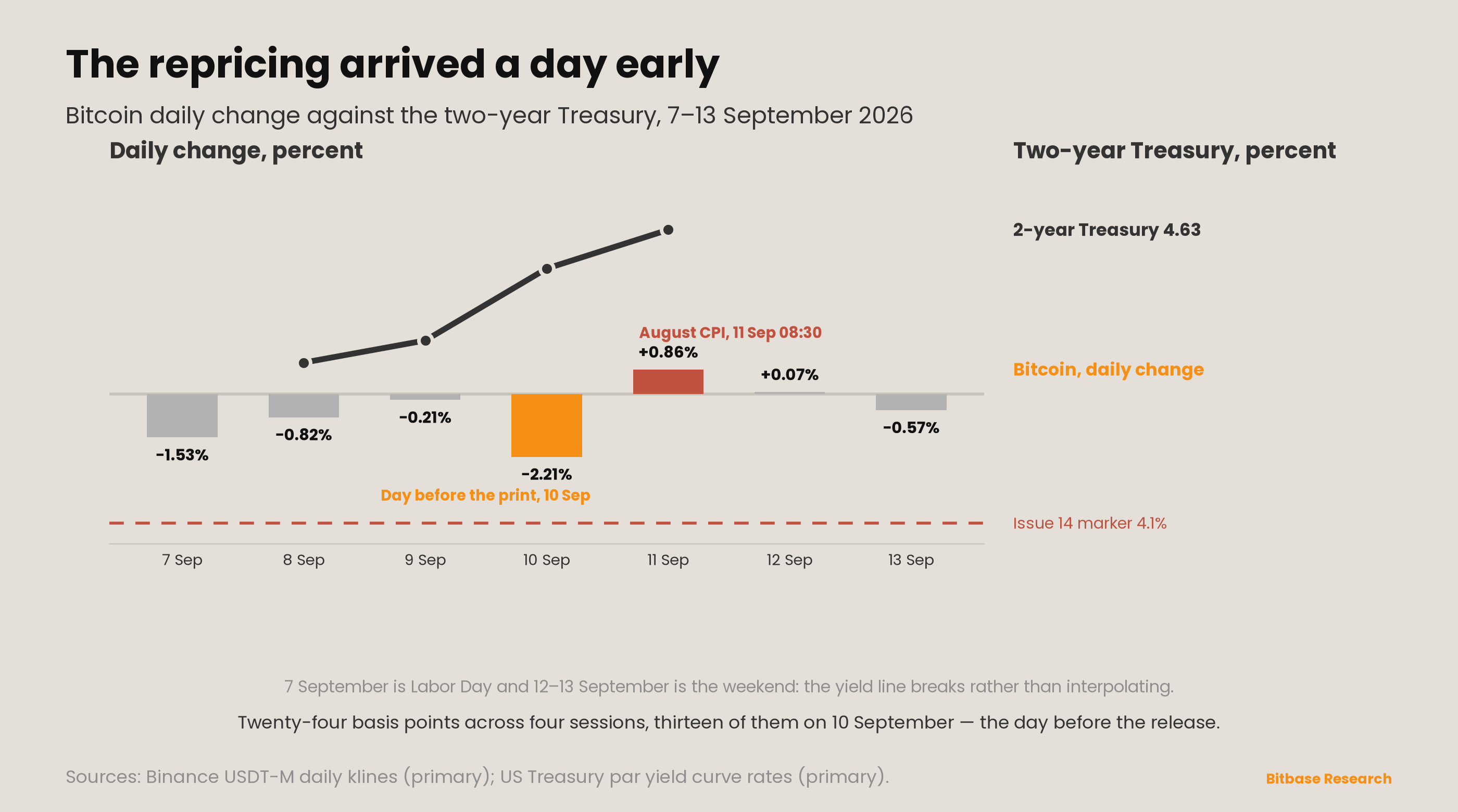
Bitcoin entered the window at 80,301.10 and left it at 76,805.00, down 4.35%, with five of seven sessions negative [3].
| Session | Close | Change | Volume (BTC) |
|---|---|---|---|
| September 7 | 79,075.90 | −1.53% | 94,686 |
| September 8 | 78,425.60 | −0.82% | 129,863 |
| September 9 | 78,264.10 | −0.21% | 152,629 |
| September 10 | 76,535.70 | −2.21% | 142,695 |
| September 11 | 77,191.10 | +0.86% | 207,305 |
| September 12 | 77,242.80 | +0.07% | 40,727 |
| September 13 | 76,805.00 | −0.57% | 67,943 |
The Treasury curve tells it in smaller units. September 7 was Labor Day and there is no observation; the four sessions that exist read 4.39, 4.43, 4.56 and 4.63 at the two-year [2]. Twenty-four basis points across four sessions, of which thirteen land on September 10.
| Session | 2Y | 10Y | 30Y |
|---|---|---|---|
| September 4 (prior close) | 4.37 | 4.78 | 5.24 |
| September 8 | 4.39 | 4.80 | 5.25 |
| September 9 | 4.43 | 4.83 | 5.28 |
| September 10 | 4.56 | 4.95 | 5.37 |
| September 11 | 4.63 | 4.96 | 5.35 |
The asymmetry between the two sessions is the finding. September 10 moved the whole curve up together — 13, 12 and 9 basis points — which is what a market positioning for an inflation surprise looks like. September 11, the session that actually contained the surprise, moved the two-year 7 basis points, the ten-year 1, and the thirty-year down 2 [2]. The curve flattened on the data it had steepened into. Bitcoin traded the same shape: worst session on the tenth, positive on the eleventh, and the eleventh carried 207,305 BTC of volume, 1.74 times the window's daily average [3].
Two readings are available and this issue takes the narrower one. The unsupportable reading is that the market knew the number. The supportable one is that whatever was priced on September 10 was more than the number delivered on September 11, and the long end said so first by refusing to extend.
Issue 14's two-year marker at 4.1% fails for a third consecutive window and by the widest margin yet. The lowest reading here is 4.39%, 29 basis points above the marker [2]. Issue 20 recorded a closest approach of 4.34%. The marker has not been touched on any session since it was set, and the distance is now growing rather than oscillating.
This week's structural signal
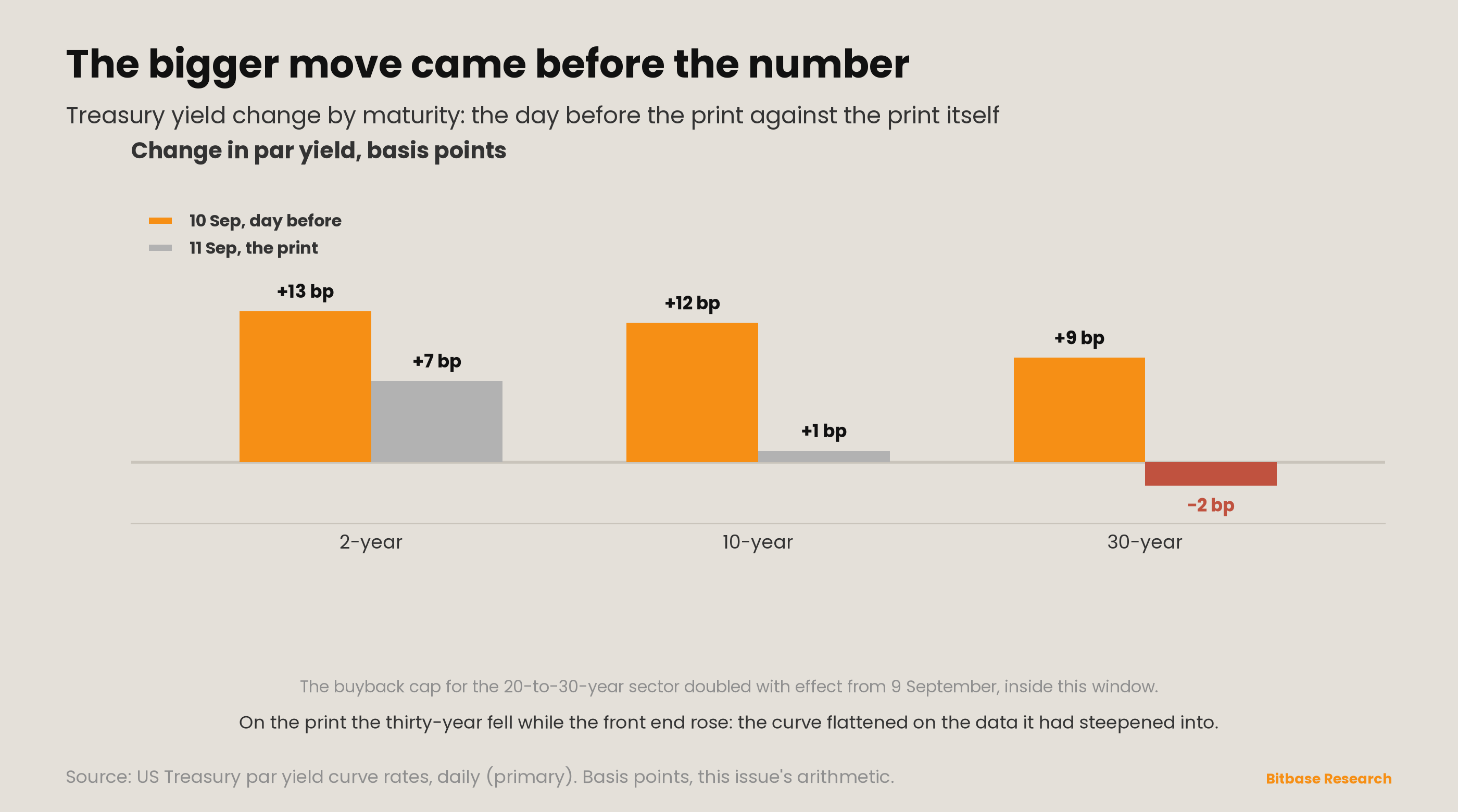
Treasury's buyback programme changed size in this window. A press release dated August 19, 2026 announced that the maximum size of liquidity-support buyback operations in the 10-year-to-20-year and 20-year-to-30-year nominal sectors would increase from $2bn per operation to at least $4bn, effective September 9, 2026 and running through the end of the refunding quarter on November 4 [5]. Treasury's stated reason is "consistent strong sponsorship from market participants, as evidenced by the significant volume of high-quality offers Treasury routinely receives in longer-dated buyback operations" [5].
Issue 20 asked whether Treasury would post an updated schedule or run a second unscheduled operation, and said one of the two would resolve the question. Neither happened. A third thing did, and it was already on the record when the question was asked. The August 19 release predates Issue 20's window entirely. Issue 20's statement that the August 5 document remained the only published schedule is still literally correct — a size change is not a schedule — but a primary Treasury document bearing directly on the thread this series was tracking was in the public record and this series did not carry it. That is recorded here rather than reconciled away.
What the doubling did not do is hold the long end. The effective date was September 9. Over the three sessions from September 9 to September 11 the thirty-year went 5.28, 5.37, 5.35 — net up 7 basis points with the new cap live [2]. The twenty-year-to-thirty-year sector that Treasury identified as having "consistent strong sponsorship" sold off through the week it received a larger official bid. This issue does not claim the buyback caused the selloff or failed to prevent it. What is claimed is narrower: an official bid doubling in size and a 10-basis-point rise at the thirty-year are compatible, and anyone treating buyback capacity as a yield ceiling has now watched one week where it was not.
The operation-level detail that would sharpen this is not in this issue, and the reason is stated rather than hidden. Treasury's buyback results for September 7 to September 13 — per-operation maximum, par offered, par accepted — could not be retrieved from a primary source. The TreasuryDirect results table and the buyback press-release index both render their data through client-side scripting and returned empty tables [12]; the TreasuryDirect JSON service could not complete a TLS handshake from this environment. No operation figures for this window appear anywhere in this issue. Whether an operation ran at the new $4bn cap is therefore an open question, not a negative finding.
Dual-track scoreboard
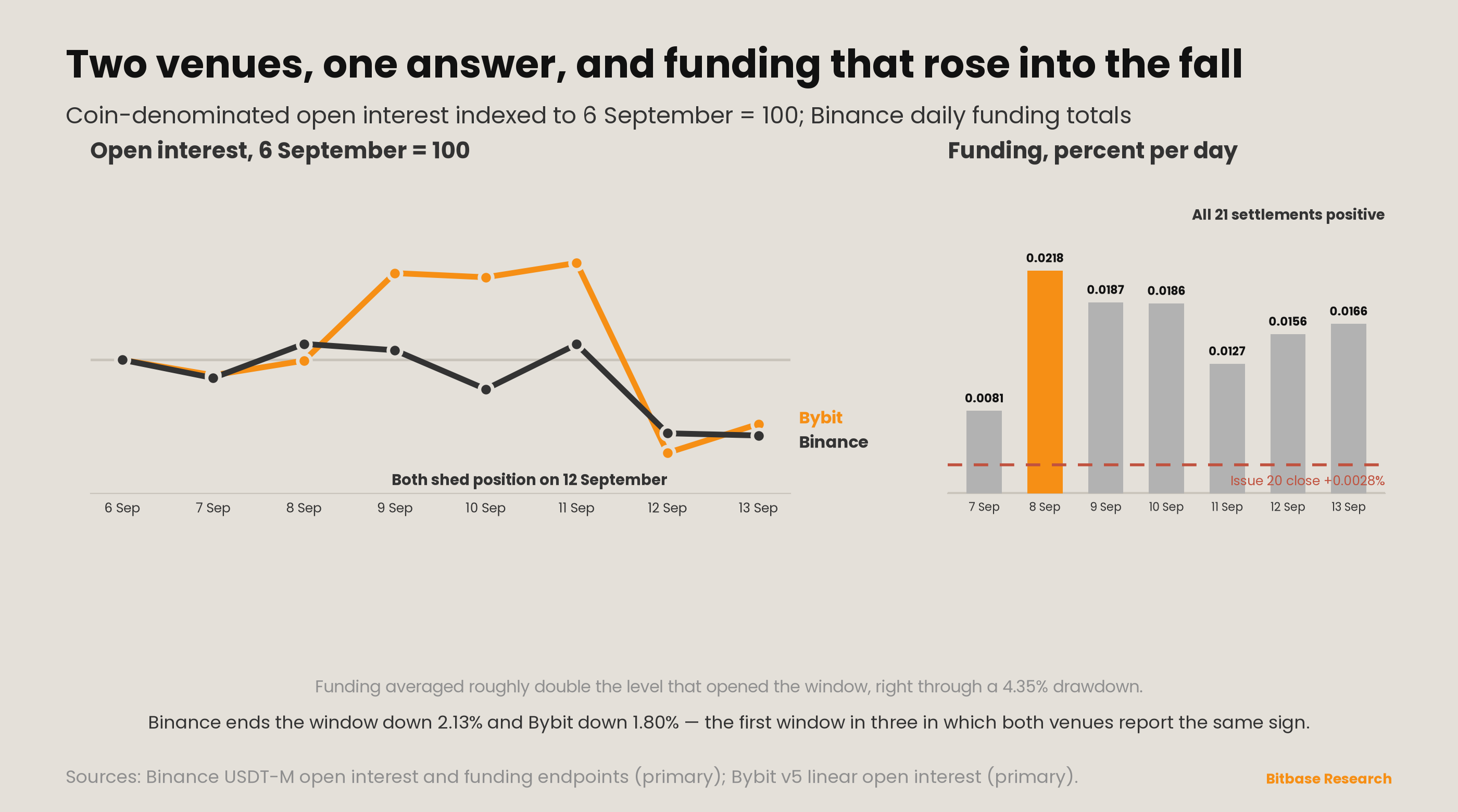
Coin-denominated open interest in BTCUSDT perpetuals, daily snapshots [6]:
| Date | Binance (BTC) | Bybit (BTC) |
|---|---|---|
| September 6 (prior close) | 106,255.01 | 54,566.44 |
| September 7 | 105,543.71 | 54,256.40 |
| September 8 | 106,876.11 | 54,549.15 |
| September 9 | 106,627.35 | 56,304.52 |
| September 10 | 105,105.97 | 56,220.82 |
| September 11 | 106,858.93 | 56,508.44 |
| September 12 | 103,385.13 | 52,700.14 |
| September 13 | 103,299.61 | 53,279.30 |
Binance ends the window down 2.13%; Bybit down 1.80% [6]. Issue 19 recorded the two venues moving in opposite directions across the August 28 crash, and Issue 20 recorded the divergence widening to −0.06% against +11.55%. This is the first window in three in which both venues report the same sign, and the magnitudes are within 33 basis points of each other. The convergence is itself the observation: this series reports open interest per venue and in coin terms precisely because the aggregate had been hiding a disagreement, and this week there is no disagreement to hide.
The September 12 step deserves naming. Both venues shed position on the same calendar day — Binance −3.25%, Bybit −6.74% on this issue's arithmetic — on the window's lightest futures volume, 40,727 BTC [3][6]. Position left on a quiet Saturday rather than on either of the two sessions that moved price.
Funding went the other way, and that is the part worth carrying forward. Daily funding totals on Binance BTCUSDT ran +0.0081%, +0.0218%, +0.0187%, +0.0186%, +0.0127%, +0.0156% and +0.0166% across the seven sessions [7]. All twenty-one settlements in the window are positive, and the window average is roughly double the +0.0081% that opened it. Issue 20 reported a compression to +0.0028% and the series' first negative settlement at −0.0002%. That floor was touched and left behind inside one week. Longs paid more to stay long through a 4.35% drawdown — not the configuration that precedes a capitulation, and not one this issue reads as bullish either.
Spot ETF flows are secondary in this series and are omitted entirely from this issue rather than carried at a lower grade. No daily creation-and-redemption figures for September 7 to September 13 were obtained from a source this issue is willing to cite. That is a gap in sourcing, not a zero.
On the radar—week of September 14 to September 20
First, the FOMC decides on September 15 and 16. This is the meeting Waller's September 3 conditional pointed at [10], and the inflation half of his condition has now arrived hot on the headline and soft on the core [1]. Both branches of his sentence have a number to stand on.
Second, does the two-year hold above 4.60% through the decision? It closed the window at 4.63% after four consecutive higher sessions [2]. A hold through an FOMC is a different test from a hold through a data release, and the last three windows have all ended with the two-year higher than they began.
Third, does Strategy resume? The filing covering September 7 to September 14 is expected in the days after this window closes. Issue 19 asked whether the June-to-August pause was over, Issue 20 said one purchase does not answer it, and this window answers with a zero. Two consecutive filings now bracket the question: one purchase, then none.
Fourth, does a long-end buyback operation run at the new cap, and does this series retrieve the result? The cap took effect September 9. Section 2 states why no operation figures appear here. The question is both whether Treasury used the new size and whether the number is obtainable at all.
Fifth, does the SRO channel keep producing while Congress does not? Section 6 counts what each venue emitted in this window. The count only means something if it is repeated.
Signal tracking update
Issue 20's radar asked five questions. Four settle cleanly. The fifth settles, but against the framing that produced it.
First, would August CPI arrive, and what would it say? It arrived on September 11 and it said two things at once [1]. Headline 0.4% on the month and 3.4% on the year; core 0.3% and 2.4%. Gasoline rose 3.9% and BLS attributes over a third of the monthly headline increase to that one index [1]. A print that is hot on the headline and cooling on the core does not settle a hold-or-hike question; it hands each branch a number. Tier-1, settled as an event, unsettled as a conclusion.
Second, did the two-year hold 4.30% through an inflation print? Yes, and not narrowly [2]. Readings 4.39, 4.43, 4.56, 4.63. The closest approach was 9 basis points above the level. The question was framed as a test of whether the level would hold and it has been answered by the level becoming irrelevant — the two-year spent the window moving away from it, not defending it. Tier-1, passed, and this series retires the 4.30% test as no longer informative.
Third, did Strategy's next 8-K answer the pause question? Yes, and the answer is that the pause continued [4]. Zero bitcoin purchased, zero ATM shares sold, holdings unchanged at 845,050 BTC against an aggregate $63.73bn and an average cost of $75,412. The prior filing had disclosed 4,603 BTC at $80,318 [11]. One purchase followed by none is not a resumption. Section 6 takes the observation further.
Fourth, did Treasury post an updated schedule or run a second unscheduled operation? Neither. Section 2 has the detail, including the August 19 size-increase release that this series should have carried in Issue 20 and did not.
Fifth, did the market-structure bill get floor time? No, and the framing of the question has to be withdrawn [8]. Two issues of the Congressional Record fall inside this window — September 8 and September 10, 47 pages, 410,497 characters. Market structure, CLARITY Act, GENIUS Act, stablecoin, blockchain, bitcoin and Securities and Exchange Commission all return zero. Digital asset returns one: H.R. 10317, introduced by Mr. Issa for himself and Mr. Gooden, "to establish requirements and oversight for digital assets in the custody of Federal agencies," referred to the Committee on the Judiciary [8][17].
The withdrawal is this. Issue 20 wrote that its window "establishes that the absence of legislative attention is no longer explained by the absence of legislative days," on the strength of five Congressional Record issues across 334 pages. This window has two issues and 47 pages. The chamber sat roughly a seventh as much. The absence-of-days explanation is available again, and Issue 20's conclusion does not extend to this window. The zero is real; the inference Issue 20 drew from a busier week is not transferable to a quiet one, and this issue will not borrow it.
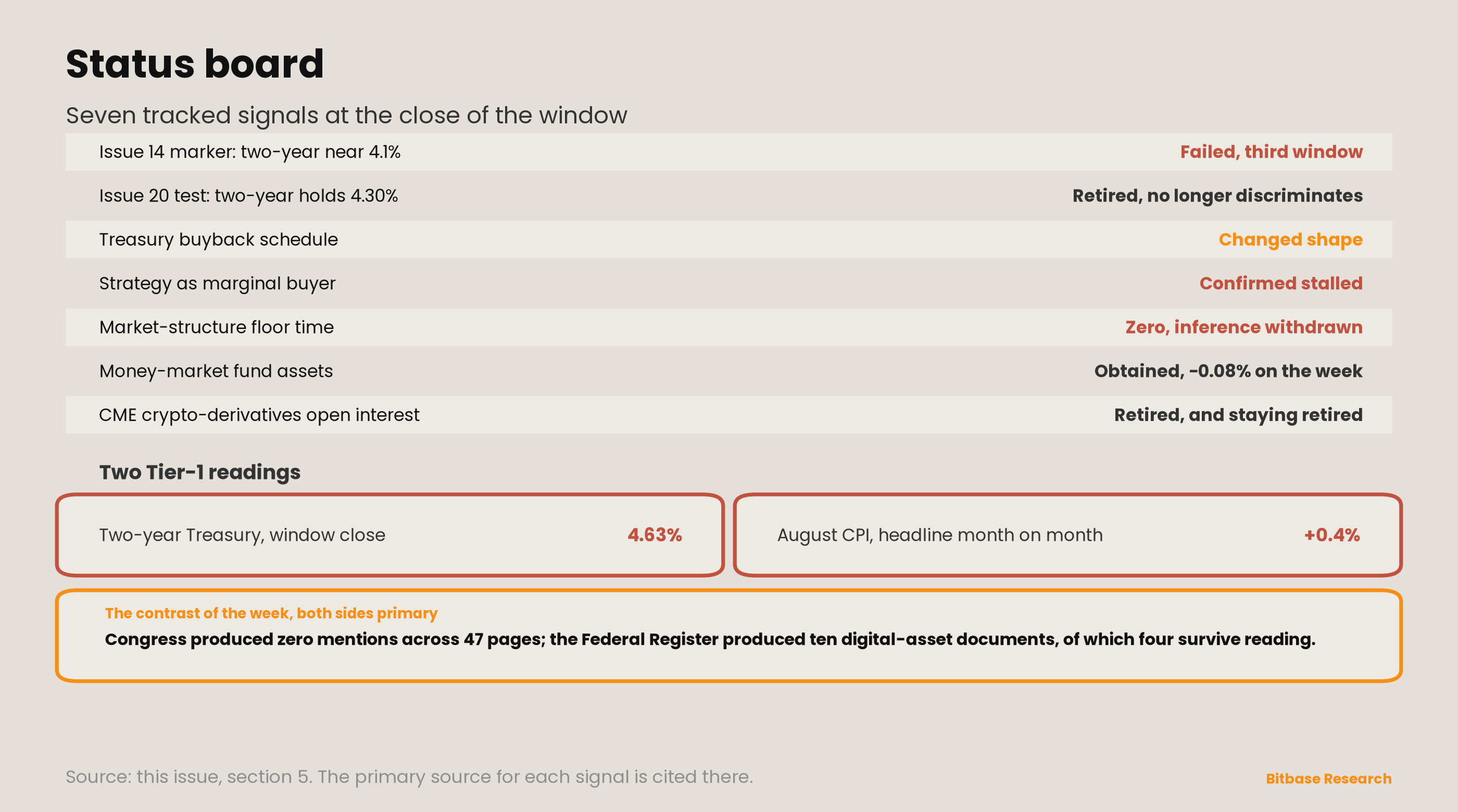
SIGNAL — Issue 14 two-year marker at 4.1%. STATUS: FAILED for a third window, Tier-1, widest margin yet. Closest approach 4.39%, 29 basis points above.
SIGNAL — Issue 20's 4.30% two-year test. STATUS: RETIRED. Passed so comfortably that it no longer discriminates.
SIGNAL — Treasury buyback schedule publication. STATUS: CHANGED SHAPE. The tracked object was a schedule; what moved was an operation-size cap, announced August 19 and effective September 9.
SIGNAL — Strategy as marginal buyer. STATUS: CONFIRMED STALLED. One purchase in three months, then zero.
SIGNAL — Market-structure floor time. STATUS: ZERO, inference withdrawn. 47 pages against Issue 20's 334.
SIGNAL — Money-market fund assets. STATUS: OBTAINED, and it discriminates nothing. The publisher's release is dated September 10, inside this window: total assets 7.97 trillion dollars for the week ended September 9, down 6.10 billion on the week, government funds down 7.99 billion and prime funds up 3.47 billion [13]. That is 0.08% against the base. Recorded, not read.
SIGNAL — Deep Dive 1 Part 6, "CME crypto-derivatives open interest." STATUS: RETIRED, and staying retired.
New dimension—the marginal buyer stopped at its own cost line
This series has tracked Strategy since Issue 14 as the cleanest available proxy for discretionary, non-flow-driven demand: a single disclosed buyer, filing weekly, with a published average cost. This window produces the sharpest observation that proxy has yet offered, and it is a coincidence of two numbers that is worth stating precisely before it is interpreted.
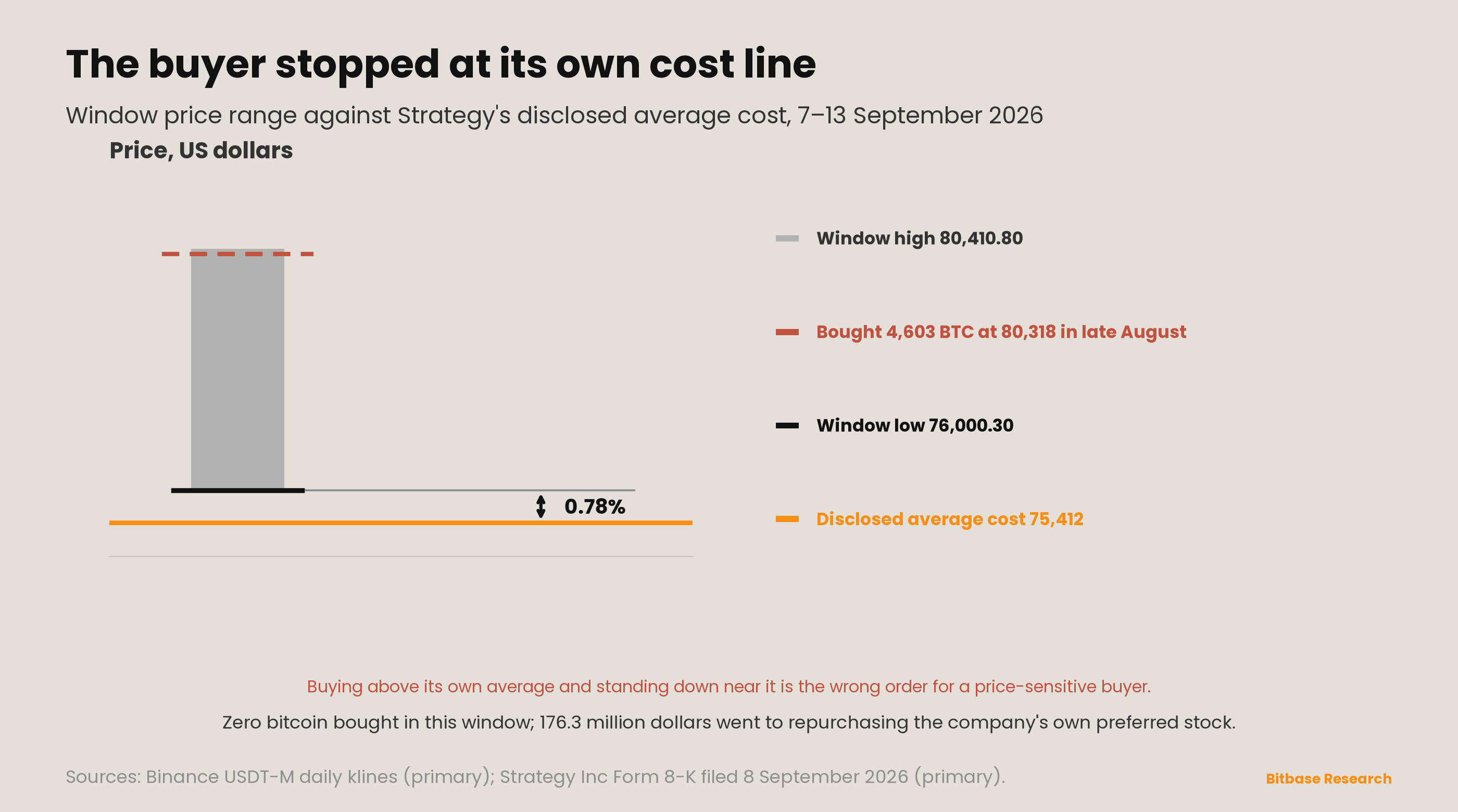
The company's disclosed average purchase price across 845,050 bitcoin is $75,412 [4]. The lowest price printed in this window is 76,000.30, on September 11 [3]. The difference is 0.78%. In the same window the company bought no bitcoin at all, and directed $176.3m to repurchasing its own preferred stock while doubling that programme's authorisation to $2.0bn [4].
The naive reading is that the company defends its cost basis and this is a floor. That reading is not supported and this issue rejects it. A floor would require the company to have been buying near that level, and it bought nothing. The disclosure describes the opposite behaviour: it was buying at $80,318 in late August, above its own average, and it stopped when price came down toward that average [11].
What the pair does support is narrower and more interesting. The purchase decision is not tracking price the way an accumulation strategy would. Buying at $80,318 and not buying at $76,000 is the wrong order for a price-sensitive buyer. It is the right order for a buyer whose constraint is the cost of capital rather than the price of the asset — one that issues equity when the equity is well bid and stands down when it is not, irrespective of where the coin trades. The 8-K supports that reading directly: no ATM shares were sold in the period either [4]. The equity tap and the bitcoin purchase stopped together.
And the capital that did move went to the capital structure rather than the asset. $176.3m of preferred repurchased, authorisation doubled, $1.19bn of capacity remaining [4]. Issue 20 recorded that in the prior period 61.3% of at-the-market proceeds bought coin and the remainder serviced and repurchased the securities issued to buy it. This period, that ratio is zero to all.
The implication for the framework is specific. If the marginal disclosed buyer is capital-structure-constrained rather than price-constrained, then its absence carries no information about price and its presence carries information mainly about its own financing conditions. This series has been reading the filings as a demand signal. On this window's evidence that reading needs qualifying, and the qualification is being made here rather than after it becomes expensive.
Caveats
The September 10 versus September 11 asymmetry is an observation, not an explanation. This issue establishes that the larger curve move preceded the release and that the release itself produced a smaller, flatter move. It does not establish what was priced on the tenth. Position-squaring, supply, and unrelated macro are all available and none is separable from the data here.
The two Strategy numbers in section 6 are a coincidence until shown otherwise, and are labelled as one. A window low 0.78% above a disclosed average cost has no mechanism attached to it in this issue. The behavioural reading in section 6 rests on the purchase and issuance record, not on the proximity of those two prices.
Two quantities are absent rather than zero, and each is named where it belongs. Treasury buyback operation results for the window, section 2. Spot ETF daily flows, section 3. In both cases the retrieval attempt and its failure mode are stated.
One arithmetic difference is recorded rather than resolved. Core CPI year-on-year is published by BLS as 2.4% [1]; this series computes 2.45% from the published unadjusted index levels. BLS computes from unrounded internal series. The published figure governs; the computed one is shown because the four-month sequence in the lead is built from index levels throughout and should not silently mix methods.
One count needs its false positives stated, because the raw number is misleading by roughly a factor of two. A Federal Register term search for digital asset over this window returns ten documents [9]. Reading them, the substantively digital-asset items are the SEC notice on Nasdaq Texas Rule 5711(d) for Commodity-Based Trust Shares [14], the SEC notice on an Options Clearing Corporation filing [15], and two OFAC Venezuela sanctions general-licence publications [16]. The remainder — Department of Energy bulk-power security, three Federal Communications Commission proceedings, an IRS opportunity-zone proposal and a Federal Trade Commission horseracing budget — contain the phrase incidentally. Section 6 of Issue 20 counted zero over 513 documents; this issue counts ten over 430 and then says how many of the ten survive reading.
Related reading
Other Bitbase articles on this topic:
Disclaimer: This article is market commentary from Bitbase Research, provided for information only. The views are those of Bitbase Research as of the date of writing and do not constitute investment, trading, tax, or financial advice, nor an offer or solicitation to trade. Data in this issue is current as of September 13, 2026; markets and disclosures may change, so refer to the latest information from authoritative sources. Trading crypto assets and leveraged products carries significant risk, including the possible loss of your capital.
References
[1] US Bureau of Labor Statistics, Consumer Price Index — August 2026, USDL-26-1496, embargoed until 8:30 a.m. ET September 11, 2026; index levels from the BLS public API, series CUSR0000SA0, CUUR0000SA0, CUSR0000SA0L1E, CUUR0000SA0L1E. bls.gov
[2] US Treasury, Daily Treasury Par Yield Curve Rates, 2026 CSV download. home.treasury.gov
[3] Binance USDT-M futures, BTCUSDT daily klines, UTC. fapi.binance.com
[4] Strategy Inc, Form 8-K filed September 8, 2026, accession 0001193125-26-384402, Item 8.01, covering August 31 – September 7, 2026. sec.gov
[5] US Treasury, "Treasury Announces Increased Sizes of Nominal Long-End Liquidity Support Buybacks Beginning September 9," August 19, 2026. home.treasury.gov
[6] Binance USDT-M open interest history endpoint and Bybit v5 linear open interest endpoint, daily snapshots. fapi.binance.com · api.bybit.com
[7] Binance USDT-M funding rate endpoint, BTCUSDT perpetual, eight-hour settlements. fapi.binance.com
[8] Congressional Record, Volume 172, Issues 142 and 143, September 8 and September 10, 2026; full-issue PDFs retrieved from GPO govinfo and scanned locally. govinfo.gov
[9] Federal Register API, full enumeration of documents published September 7–13, 2026, and term queries over the same range. federalregister.gov
[10] Governor Christopher J. Waller, "The Economic Outlook and Some Comments on My Policy Communication," Reuters NEXT Newsmaker Interview, Washington, D.C., September 3, 2026. federalreserve.gov
[11] Strategy Inc, Form 8-K filed August 31, 2026, accession 0001193125-26-375463, covering August 24–30, 2026. sec.gov
[12] TreasuryDirect, Buyback Announcements & Results, and the buyback announcement and results press-release index; both queried for September 7–13, 2026 and both returned empty client-rendered tables. treasurydirect.gov
[13] Investment Company Institute, "Money Market Fund Assets," release dated September 10, 2026, covering the week ended September 9, 2026. ici.org
[14] Securities and Exchange Commission, "Self-Regulatory Organizations; Nasdaq Texas, LLC; Notice of Filing, and Order Granting Accelerated Approval of, a Proposed Rule Change To Amend Rule 5711(d) (Commodity-Based Trust Shares)," published September 9, 2026. federalregister.gov
[15] Securities and Exchange Commission, "Self-Regulatory Organizations; The Options Clearing Corporation; Notice of Filing of Proposed Rule Change," published September 8, 2026. federalregister.gov
[16] Office of Foreign Assets Control, "Publication of Venezuela Sanctions Regulations Web General Licenses 50A and 51A" and "… 30B and 51," both published September 11, 2026. federalregister.gov
[17] H.R. 10317, 172nd Congress, introduced September 8, 2026, referred to the Committee on the Judiciary. congress.gov