
In November 2022, FTX collapsed overnight. On the most devastating day, the crypto market evaporated hundreds of billions of dollars in market value in a single day, coin holders were panicked, and industry practitioners were wailing in despair.
Yet outside this storm, a Wall Street veteran who had managed a 150-person global risk team was staring at on-chain data, remarkably calm.
"Not panicked at all," CK Zheng recalled of that night. "Because architecturally, we are very far from counterparty risk."
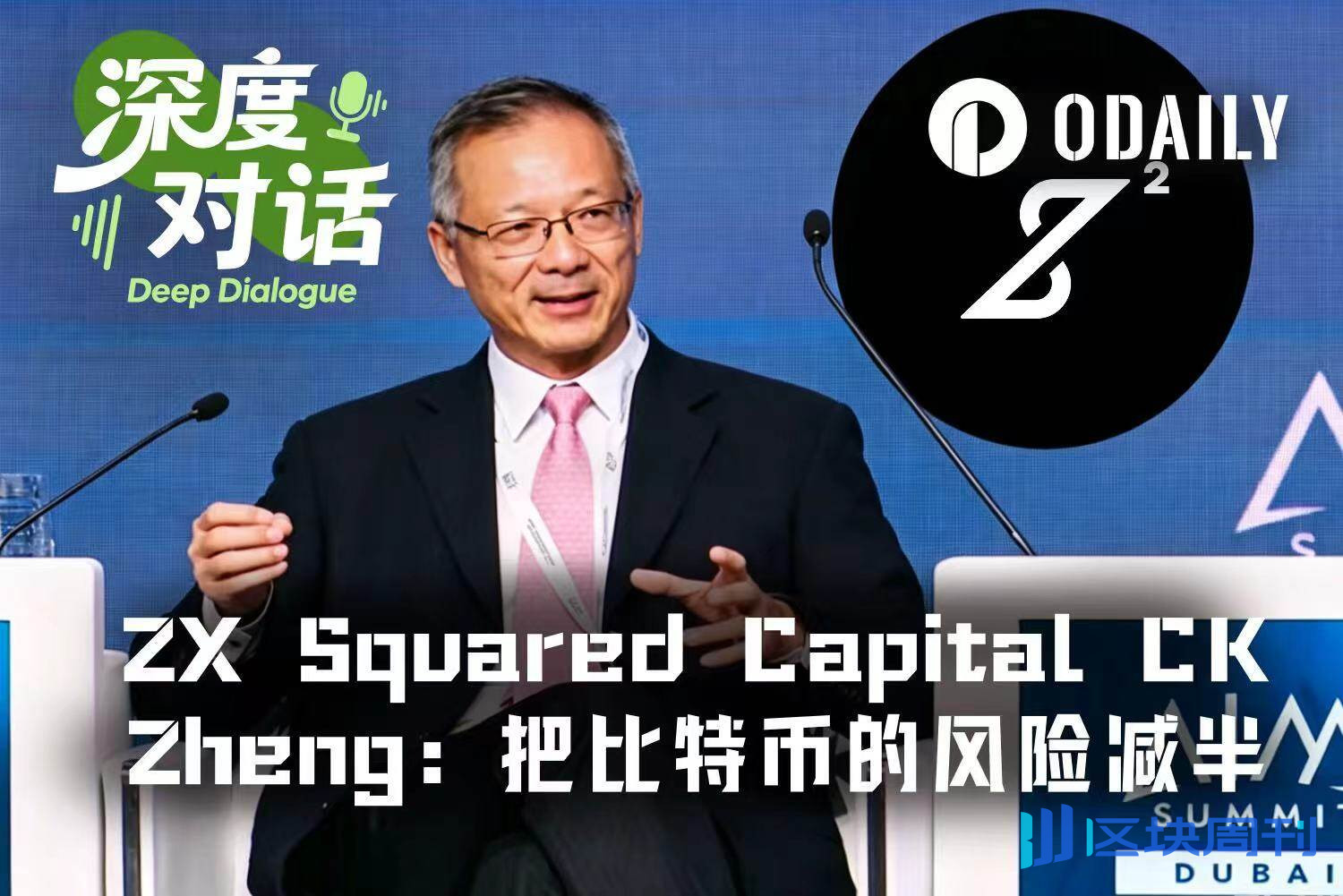
CK Zheng is now co-founder and Chief Investment Officer of crypto hedge fund ZX Squared Capital (hereafter ZXSQ). Before that, he spent 17 years at Credit Suisse, with the title of Global Head of Valuation Risk (Managing Director); before that, he was an Executive Director of Valuation Risk Management at Morgan Stanley, and even earlier at SIG and Bank of America's interest rate derivatives trading desk. For thirty years, he has been dealing with the word "risk" almost exclusively.
In 2021, he left TradFi, and with the idea of bringing options hedging into the Bitcoin market and rich practical experience, he founded ZXSQ. Five years later, the fund's report card is: cumulative return of 229.18% since inception, compared to Bitcoin's 136.94% over the same period, with an average annualized return of about 30%.
He summarized this strategy in one plain sentence: "What we want to do is halve Bitcoin's risk. At the same time, over a four-year cycle, the net return after fees far exceeds Bitcoin."
1. Chicago, New York, Credit Suisse: Thirty Years of a "Risk Expert"
CK Zheng's story begins with a taxi license.
In 1988, he came to the United States to pursue a PhD at the University of Chicago Booth School of Business, writing his doctoral thesis on pricing and risk management in the options market. In his first summer in Chicago, he drove a taxi; not just to earn money, but more to "understand American local culture." Years later, he still remembered some details: downtown Chicago was beautiful, but there were some neighborhoods around it one should not go to; at that time, taxi drivers were murdered every year.
That was an era when "theory surged vigorously and its practical impact shaped reality." The economic genes of the Chicago School gave birth to a group of quantitative funds like AQR and Dimensional Fund that calculated risk and return to the extreme; it was also during that time that he laid the foundation for a lifetime of options pricing. "Since graduating with my PhD, my deepest desire has been to truly apply the profound theories from books to actual investment markets."
After leaving Chicago, he first worked as a trader at SIG for a few years. This company had a culture that outsiders found rather unconventional: the founder encouraged employees to play poker. "Texas Hold'em thinking" later became part of his trading decisions: calculate probabilities, look at odds, manage chips, and always keep something in reserve.
In 1999, he joined Morgan Stanley and stayed for five years. In 2004, he followed the then-CEO to Credit Suisse, and for the next 17 years, he led a global team of more than 100 people, responsible for one of the most difficult tasks after the financial crisis: figuring out exactly how much those "illiquid, hard-to-price" complex assets were really worth.
At Credit Suisse, he saw too many cases where "the model calculated beautifully, but reality shattered it on impact." This also explains his underlying preference when later running a fund: don't chase the excitement, ask about risk first.
From 2011 to 2012, academia and the financial world were still debating whether Bitcoin was a bubble; a Nobel laureate and founder of market efficiency theory predicted it would go to zero ten years earlier, and ten years later was still bearish. "Academia may not keep up with the pace of the times." CK's judgment was that rather than listening to conclusions, it's better to look at data: "More and more people are using it, grassroots culture and young people are embracing it, and such an adoption process cannot be stopped."
In July 2021, he felt the time had come. That year, Bitcoin had already entered the视野 of mainstream American media, and the options market was beginning to take off. Thus ZXSQ was founded.
2. "Halving" Bitcoin's Risk: A Mathematics of Compounding
If CK Zheng had to explain what ZXSQ does to an LP who knows nothing about derivatives in one sentence, he would first give an arithmetic problem.
"Imagine two assets: one first falls 50%, then rises 100%, and the final return is 0%; the other, through hedging, limits the decline to 25%, then rises 50%, and the final return is 12.5%. What ZXSQ does is eliminate the large tail declines, letting the asset slowly compound."
Behind this problem is his old trade for thirty years—options. In the 1970s, options became prevalent in the stock market, and later became the standard tool for hedging interest rates, commodities, aviation, and industrial oil prices; one of Wall Street's most profitable businesses is concentrated in this area. CK's intuition was: Bitcoin is so volatile, why not use options to "buy insurance" for it?
Thus ZXSQ does four things: hold Bitcoin spot for the long term, use options hedging to reduce volatility, cautious custody, and 0 leverage.
The actual effect can be measured by two numbers. Bitcoin's actual volatility is about 55% to 70%, and ZXSQ presses it down to around 37%. This level is already close to high-tech blue-chip stocks. In the 2022 bear market, Bitcoin's maximum drawdown was about 65%, while ZXSQ controlled the drawdown to around 35%. This is what is called "halving the risk."
But CK repeatedly emphasized that the hardest part of this strategy is not "what to buy," but "when to buy and with what structure."
"The framework of the strategy can be copied, but the precision of execution cannot be plagiarized," he said. "Knowing to buy options is easy, but when to buy and with what structure, so that it doesn't erode returns in normal times and precisely defends during big drops—this requires decades of practical experience."
In other words, what ZXSQ sells is not a formula that can be copied and used, but a continuous control of cycles and costs. This is also what makes it most attractive to institutional capital: "designing" Bitcoin's price into a greatly flattened volatility curve.
3. That Night of FTX, and a Mistake Almost Made
2022 was the crypto market's "Lehman moment." Luna's collapse, Three Arrows Capital's blowup, FTX's fall—the ensuing chain reactions dragged the industry into an abyss. In mid-2022, some investors ZXSQ approached thought it was "too conservative." Meanwhile, many peers who used leverage did not survive.
"The Luna event was equivalent to the crypto world's Lehman Brothers," CK said. "At the time it was actually hard to predict, but we did foresee the subsequent chain reactions."
On July 14, 2022, when Bitcoin was priced at $20,000, CK Zheng predicted on CNBC: "The deleveraging process is not yet complete; the market is still in the stage of clearing out weak participants; Bitcoin price is very likely to fall to $15,000." As it turned out, Bitcoin bottomed in November 2022, touching a low of $15,500.
And on the night of FTX's collapse, the ZXSQ team appeared very calm. Because architecturally, their assets were not on centralized exchanges. "After ensuring the safety of funds, we closely monitored on-chain and market indicators, patiently waited for deleveraging to end, and looked for deterministic signals of a bear market bottom."
After FTX's collapse, on November 17, 2022, CK Zheng predicted on CoinTelegraph: "The collapse of FTX will be the last wave of negative news in this crypto bear market."
As a result, Bitcoin's price rebounded from the cycle bottom of $15,500. CK also became one of the earliest investors in the last cycle to predict Bitcoin's bottom.
In public news such as Coindesk, we found that CK and the ZXSQ team, through increasingly rich on-chain data analysis + macro trend research, predicted BTC price peaks and correction lows at multiple time points from 2023 to 2025, and led the fund to successfully avoid risks.
But in an interview with Odaily, he proactively talked about a mistake he almost made.
"At the end of 2025, we once reasoned: a large-scale influx of traditional institutional capital might break the crypto market's traditional 'four-year halving cycle' and produce an ultra-long rally." He said, "But by the first quarter of 2026, based on deeper data tracking and macro liquidity reasoning, we quickly corrected course and returned to the cycle's defensive rhythm."
He takes this matter very seriously: "Staying humble in the market and daring to quickly correct mistakes is the core of risk control."
How was this judgment made? CK said that five or six people in the team collect intelligence together and form judgments jointly, with a data-oriented method: "Data provides objective facts, while human fear and greed within market cycles must be penetrated through experience." He looks at three types of signals: crypto's own risks (internal perspective), the scale and speed of institutional capital and macro policy (where the money comes from), and Bitcoin's process of "becoming digital gold."
For this reason, he remains cautious about whether the "four-year cycle" has already failed: currently institutional capital accounts for only 10%, retail investors are still the dominant force, and the cycle has been weakened but not yet broken. "It may take until institutions account for 30% to 50% before the rules are truly rewritten."
IV. The Game Between Traditional Financial Institutions and BTC
"Where is the dimensional wall between BTC and traditional financial institutions now?" He explained, "Bitcoin is still in the early stage of adoption, and very few risk committee members have actually read the Bitcoin whitepaper word for word." More realistically, at a time when the AI wave is exploding, risk committee members are more likely to vote for visible, tangible AI infrastructure; a pure spot exposure with no defense exceeds the psychological tolerance of most traditional institutions.
CK's proposal to family office CIOs is a 5% allocation, plus precise downside hedging.
"From a risk-return perspective, this is the optimal balance point for a family office portfolio." He said, "It can capture the asymmetric upside benefits of digital assets without affecting the safety of the overall assets during extreme drawdowns, or your sleep."
From a compliance perspective, Bitcoin's drawdowns of 70% to 80% make large allocations almost impossible under the framework of fiduciary duty; while ZXSQ, whose volatility has been compressed to a level close to blue-chip stocks, can be placed in the "Alternatives" basket.
Furthermore, according to the "denominator effect," dollar-cost averaging into spot may appear to dilute costs, but it still bears full Beta risk; during a macro downturn, the total portfolio will shrink sharply along with it; while hedge funds use options to build a protective cushion, preserving the safety cushion for the entire portfolio.
In the interview, CK also rarely talked about "what not to do." ZXSQ does not invest in Meme coins, its core allocation is Bitcoin and mainstream assets, with strict asset custody and 0 leverage.
"As firm BTC believers, we take a positive view of BTC's long-term returns and remain cautious about short-term volatility. We give up short-term windfall profits and high-leverage arbitrage." He made the boundaries very clear.
V. There Is No Free Lunch
Any story that sounds too good should be questioned for its cost.
My first question was very direct: options hedging has a cost. If Bitcoin triples again over the next two years, will ZXSQ significantly underperform pure spot?
"No." CK's answer was crisp. "Our strategy is dynamically adjusted. In a confirmed bull market, we will significantly reduce hedging intensity and reduce premium losses; at the same time, we will allocate a small proportion to high-quality mainstream coins with more asymmetric elasticity. This allows us to still keep pace with the broader market in a bull market, and even outperform it."
The second question was about the return ceiling of "0 leverage"—is this an active abandonment?
"In the market, there is always There is no free lunch." He said, "Adding leverage appears to raise the return ceiling, but the cost is that it is extremely easy to be liquidated to zero in extreme market conditions. What we want is to achieve a 30% to 40% annualized net return without leverage. Giving up inflated and fragile leverage buys certainty across cycles."
The third question was about when this hedging approach would fail.
CK said that the biggest black swan in the crypto market is large-scale systemic bankruptcies and counterparty defaults in the industry. This is exactly what he wants to avoid from the underlying architecture. "We do not rely on a Prime Broker and resolutely do not take on counterparty risk." Custody is placed with Copper in Switzerland, also to isolate settlement risks "outside the model."
The last question is one almost every actively managed fund gets asked: "Crypto hedge funds are fake demand, buying ETFs is enough, what do you think?"
CK believes: "For many ordinary investors, buying stock and bond ETFs is indeed enough. But this does not prevent global traditional hedge funds from managing more than $5 trillion in assets. The logic is the same." He gave a comparison: ETFs can only passively bear 100% of volatility and major declines, while funds like ZXSQ have halved Bitcoin's maximum drawdown over the past five years, and their net returns after management fees still exceed pure Bitcoin spot by 100%.
"This is the value of active management."
VI. The Next Bull Market: Legislation, Stablecoins, and a Wealth Paradigm Shift
When talking about the industry stage, CK Zheng believes that the influx of traditional capital into crypto is one of the most important wealth paradigm shifts of the next decade, and the path is already clear.
"The three main lines are: crypto ETFs and Crypto Treasury Companies, the infrastructuralization of stablecoins, and RWA integrating into traditional finance's clearing and liquidity layers."
In his view, stablecoins are the most underestimated part. "It looks simple, but in the future it will have a huge impact on the payments and credit card industries. The United States is pushing it hard, and behind it is dollar hegemony." And for Wall Street's truly large capital, what they are waiting for is not narrative, but legislation.
"All financial activities require compliance. The Genius Act is effective, and the Clarity Act may be the final threshold—once the legislation is clear, Wall Street will feel safe doing crypto."
When I asked for advice for small and medium-sized investors, CK said: "Crypto is not easy to time, and it is hard to say whether now is the best short-term allocation point. Ordinary people find it even harder to grasp the rhythm, so what they need is the discipline to hold on, a strategy to reduce risk, and long-term thinking."
He also talked about the ongoing competition for capital between AI and crypto. "AI is good technology, but not necessarily a good investment." He said, "The market's attention to AI even exceeds its attention to economic risks. Whether finance has already overdrawn its imagination of AI, and how revenue will be recouped, are still unknown." His judgment is that as some capital rotates from AI back to crypto, it will prepay for a new bull market; and right now may be the "last window" for Bitcoin at $80,000.
I repeatedly pressed him for predictions on price levels, and the coordinates he gave were: when Bitcoin fell to around $58,000 this summer, he judged that the cycle bottom had already appeared. He said this bear market is somewhat different from the last one: the last one was a chain of explosions, while this round has "fewer mines," the risks of major leveraged players are controllable, and the market structure is healthier.
VII. Epilogue: The "Crypto Ivy League" Worth Remembering
As the interview was nearing its end, I asked one last question: If you look back five years from now, how would you like people to remember ZXSQ and CK Zheng?
He barely thought about it: "I hope people remember that ZXSQ is a crypto Ivy League fund that takes the 'risk and return' of digital assets to the extreme. Bitcoin still needs one to two decades to truly become the global digital gold."
Thirty years ago, he studied option pricing in a Chicago classroom; thirty years later, he brought that methodology into a market whose volatility is several times that of blue-chip stocks. While others surf the waves, he repairs the boat beneath them—a boat that can sail through bull and bear markets and also let a family office CIO sleep well.
This is probably the expertise of a "risk expert": "No matter how treacherous the storms in the Crypto market, our boat can always withstand the relentless impact of the waves."