
Overview
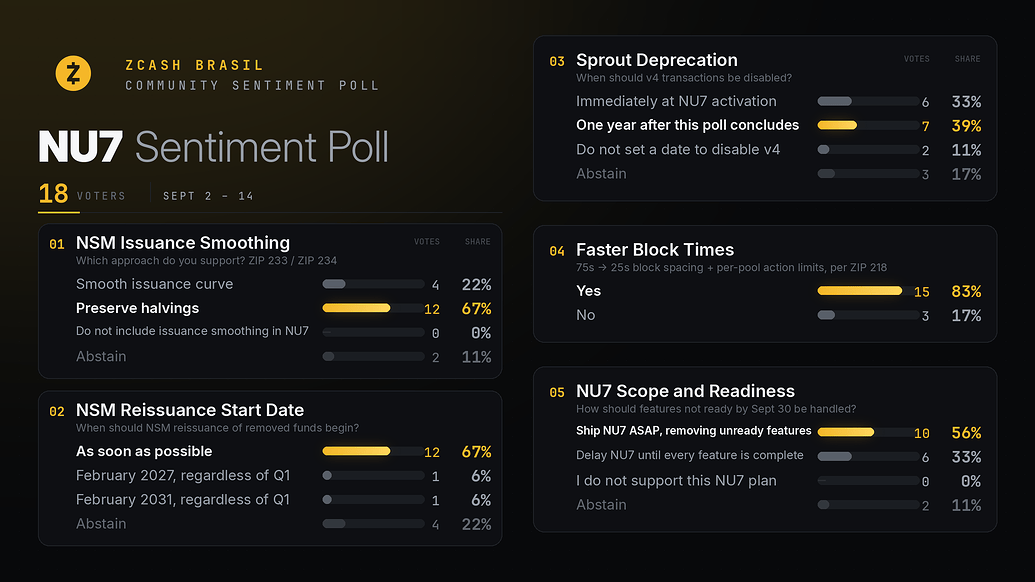
Zcash holders have overwhelmingly voted to preserve the network’s Bitcoin-style halving schedule as part of the upcoming NU7 upgrade. Nearly 2.4 million ZEC participated in the privacy-preserving vote, representing roughly two-thirds of the approximately 3.6 million ZEC eligible at the snapshot. Of the participating ZEC, 98.9% supported keeping scheduled halvings rather than replacing them with a smoother issuance model, while 99.9% backed reducing block time from 75 seconds to 25 seconds.
The result matters because the Zcash halving debate was not simply about whether miners should receive fewer coins. It was fundamentally a decision about monetary-policy credibility, supply predictability, and the trade-off between a fixed issuance schedule and a smoother miner-revenue profile. By keeping periodic halvings, Zcash preserves one of the clearest similarities between its monetary architecture and Bitcoin’s.
ZEC also rose sharply around the vote and subsequently reached approximately $1,388 during the broader market rally. However, the governance result should not be treated as the sole explanation for the price move. Privacy-coin demand, market liquidity, derivatives positioning, broader crypto sentiment, and expectations around NU7 can all influence ZEC independently.
Key Takeaways
- Nearly 2.4 million ZEC participated in the NU7 governance vote.
- 98.9% of participating ZEC supported retaining Bitcoin-style halvings.
- 99.9% supported cutting block time from 75 seconds to 25 seconds.
- Keeping halvings preserves a predictable supply schedule but does not guarantee higher ZEC prices.
- The longer-term issue is whether falling issuance can coexist with sustainable miner economics and network security.
Why Did Zcash Keep Its Bitcoin-Style Halving?
Predictable Supply Matters More Than a Smooth Issuance Curve
A Zcash halving reduces the amount of newly issued ZEC paid to miners at predetermined intervals. The structure resembles Bitcoin’s supply schedule, where block subsidies are periodically cut in half rather than declining gradually.
The main argument for keeping this model is predictability.
Investors, miners, developers, and users can estimate the future issuance path years in advance. That reduces the extent to which monetary policy depends on repeated discretionary governance decisions. A network that frequently changes its issuance formula could create uncertainty around long-term supply, particularly if changes are made in response to short-term market conditions.
This does not mean a halving is inherently superior to gradual issuance. A smoother reduction in mining rewards could reduce sudden changes in miner revenue and potentially make network-security spending easier to manage. The trade-off is that changing a well-understood supply schedule can weaken the perception that monetary policy is stable.
The 98.9% result suggests that participating ZEC holders prioritized the credibility of a predictable issuance schedule over the potential benefits of smoothing block rewards.
Supply Stability and Miner-Revenue Stability Are Different Goals
This distinction is important.
A predictable monetary policy benefits holders because future dilution is easier to estimate. Miners, however, are concerned with revenue, which depends on block subsidies, transaction fees, ZEC price, mining difficulty, electricity costs, and hardware efficiency.
A halving makes the supply path predictable, but it can make miner income less stable because the block subsidy falls abruptly.
A smoother issuance model would reduce that sudden revenue shock, but it would also change the network’s established monetary rhythm.
The governance decision therefore reflects two competing objectives: preserving confidence in Zcash’s long-term monetary rules and maintaining enough economic incentive for miners to continue securing the network.
The community chose the former, but the latter does not disappear.
What Does the Zcash Halving Mean for Miners?
Lower Issuance Tightens Miner Economics
When a Zcash halving occurs, newly issued ZEC per block falls. If the ZEC price, transaction-fee revenue, and mining efficiency remain unchanged, miner revenue declines.
That can pressure marginal miners with higher operating costs. Some may switch off equipment or redirect computing power if mining becomes unprofitable.
The direct consequence is not automatically lower network security. Mining difficulty can adjust, more efficient operators can remain profitable, and higher ZEC prices can offset some of the lost subsidy. But the system becomes increasingly dependent on those compensating factors as issuance falls.
This is why describing a Zcash halving purely as a bullish supply event is incomplete.
The supply effect is straightforward: fewer new ZEC are created. The security effect is more complex because the same issuance also helps pay miners for protecting the network.
The Long-Term Question Is Zcash’s Security Budget
Over time, repeated halvings reduce the role of new issuance in financing network security.
That shifts more importance toward other sources of economic value, especially transaction fees, ZEC market value, mining efficiency, and overall network usage.
Zcash holders also voted to delay reissuing ZEC accumulated through the Network Sustainability Mechanism until February 2031. That mechanism removes a portion of transaction fees from circulation and can later recycle those coins into block rewards without changing the maximum supply.
This adds another layer to the security-budget discussion. Zcash is not simply choosing between permanent inflation and fixed supply. It is experimenting with ways to recycle already-existing supply while preserving the maximum issuance cap.
The professional question is therefore not whether the next halving will reduce supply—it will. The more important question is whether Zcash can maintain sufficient economic incentives for miners as block subsidies become smaller over time.
Why Does Cutting Block Time to 25 Seconds Matter?
Faster Blocks Could Improve the Payment Experience
The NU7 vote also produced overwhelming support for reducing Zcash’s block interval from 75 seconds to 25 seconds.
If implemented successfully, shorter block times should allow transactions to be included in blocks faster, reducing the wait before users receive confirmations.
For a privacy-focused payment network, that can materially improve usability. A 75-second interval may be acceptable for some transfers, but it is slow compared with modern payment expectations and newer blockchain networks designed around near-instant settlement.
Reducing the block interval by roughly two-thirds could therefore make Zcash more practical for everyday transfers and improve the user experience without changing its core privacy model.
The vote also shows that the community is trying to improve utility and monetary policy at the same time rather than treating NU7 as a purely supply-focused upgrade.
Faster Blocks Create Technical Trade-Offs
Shorter block intervals are not free.
Blocks must propagate through the network, validators and miners must remain synchronized, and nodes need enough time to process new information. If blocks are created too quickly relative to network propagation, the probability of competing blocks or other synchronization inefficiencies can increase.
Faster production can also increase infrastructure requirements and make performance differences between well-connected and poorly connected operators more important.
That means “three times faster block production” should not be interpreted as a simple threefold improvement in network capacity or user experience.
The final impact will depend on implementation quality, network propagation, node performance, transaction volume, and how effectively the upgrade maintains consensus reliability.
The NU7 vote authorizes the direction of development, but it does not by itself implement or guarantee the technical outcome.
Did the Governance Vote Cause ZEC to Reach $1,388?
Monetary-Policy Credibility Can Support Market Narrative
A decisive governance outcome can strengthen investor confidence when it reduces uncertainty.
Before the vote, Zcash holders faced an unresolved question about whether the network would preserve scheduled halvings or move toward a smoother issuance model. The 98.9% result removed much of that uncertainty.
For investors who value Bitcoin-like monetary characteristics, preserving halvings reinforces a familiar scarcity narrative. Combined with the planned reduction in block time and the broader NU7 roadmap, the vote can strengthen the argument that Zcash is maintaining its fixed-supply identity while attempting to improve transaction performance.
That can influence demand, particularly when privacy-focused cryptocurrencies are already receiving greater market attention.
However, narrative strength is not the same as direct causation.
ZEC’s Price Move Cannot Be Attributed to One Event
ZEC’s move toward approximately $1,388 occurred within a broader market environment, and several variables may have contributed.
Privacy-coin demand can shift quickly when regulatory, surveillance, or data-security concerns receive more attention. Thin order books relative to Bitcoin and Ethereum can also amplify price movements. Derivatives positioning and short liquidations may accelerate rallies, while broader crypto risk appetite can raise valuations across multiple assets at the same time.
The NU7 vote is therefore best understood as one catalyst within a larger market structure.
A governance decision can improve confidence in future supply rules, but it does not create a guaranteed price response. The same halving structure could coexist with lower ZEC prices if demand weakens, liquidity deteriorates, or miner economics create security concerns.
Investors should therefore separate the confirmed protocol change from interpretations of short-term market behavior.
The NU7 Vote Strengthens Zcash’s Monetary Credibility, but Security Economics Remain the Harder Test
The most important outcome of the NU7 governance process is not that 98.9% of participating ZEC holders chose a Bitcoin-like policy because they expect prices to rise. It is that the community chose to preserve a predictable monetary schedule even though a smoother issuance curve could have reduced abrupt changes in miner revenue.
That reinforces Zcash’s fixed-supply narrative and reduces uncertainty about future issuance.
At the same time, the decision makes the network’s long-term security economics more important. As repeated Zcash halving events reduce block subsidies, miner profitability will depend increasingly on ZEC value, mining efficiency, transaction-fee economics, and mechanisms such as the Network Sustainability Mechanism.
The decision to reduce block time from 75 seconds to 25 seconds adds a second dimension to NU7. Zcash is trying to preserve conservative monetary rules while making private transactions faster and more usable. If implemented successfully, those two changes could improve both the network’s monetary identity and payment functionality.
Neither change guarantees market success.
A predictable supply schedule only matters if users continue to demand the asset, and faster blocks only matter if the network maintains reliability and decentralization.
The real test for Zcash after NU7 will therefore be whether it can combine scarcity, privacy, faster settlement, and a sustainable security budget within the same system.
Sources
https://financefeeds.com/zcash-holders-back-25-second-blocks-and-keep-bitcoin-style-halvings/
Risk Disclaimer: This article is for reference only and does not constitute investment advice. The cryptocurrency market is highly volatile. Please make decisions cautiously based on your individual circumstances.