Overview
The U.S. Securities and Exchange Commission has created a five-year regulatory pathway for limited onchain trading of tokenized U.S. equities, marking one of the clearest attempts yet to bring blockchain-native market structure into the National Market System. On September 17, 2026, the SEC issued its “Innovation Exemption,” granting temporary and conditional relief to qualifying Tokenized Securities Venues, or TSVs, that use permissioned automated market makers and liquidity pools to facilitate tokenized stock trading. The relief also covers certain liquidity providers that would otherwise potentially fall within the Exchange Act definition of a dealer.
The measure is significant, but it is not a blanket authorization for U.S. stocks to trade freely onchain. Eligible tokenized NMS stocks are subject to limits on symbols and trading volume, must preserve the same rights and privileges as the equivalent traditional shares, and must stop trading when the underlying stock is halted on its primary listing exchange. Smart contracts used by qualifying venues must also be public, auditable and deployed on public permissionless distributed ledgers.
The deeper implication is therefore not simply that stocks can now be represented as tokens. The SEC is beginning to test whether regulated secondary-market functions—including liquidity provision, automated execution and trading access—can operate through blockchain infrastructure without abandoning the legal rights attached to conventional securities.
Key Takeaways
- The SEC issued a temporary, conditional five-year framework for limited tokenized stock trading.
- Qualifying Tokenized Securities Venues can use permissioned AMMs and liquidity pools.
- Eligible tokenized NMS stocks must preserve the economic and governance rights of equivalent traditional shares.
- The framework imposes symbol, volume, disclosure and trading-halt restrictions.
- The larger experiment is whether regulated U.S. secondary-market infrastructure can move partially onchain.
What Did the SEC Actually Open for Tokenized Stock Trading?
The Innovation Exemption Creates a Controlled Market-Structure Experiment
The SEC’s September 17 order grants two related forms of temporary exemptive relief. First, qualifying Tokenized Securities Venues can receive relief from the Exchange Act definition of an “exchange” while facilitating permissioned trading in eligible tokenized NMS stocks through automated market makers and liquidity pools. Second, certain liquidity providers supplying proprietary tokenized stock to those pools can receive conditional relief from the Exchange Act definition of a “dealer.” Both exemptions are temporary and expire five years after publication.
That structure matters because the SEC is not creating an unregulated parallel equity market. It is temporarily relaxing specific regulatory definitions so that market participants can test a different execution architecture under tightly defined conditions. Participants are still dealing in securities, and the tokenized assets remain linked to the rights of the underlying NMS stock. In practical terms, the regulator is separating the question of whether a stock remains a security from the question of whether the infrastructure used to trade that security must look exactly like a traditional exchange.
This makes the framework closer to a controlled market-structure experiment than a deregulation program. SEC Chair Paul Atkins described the exemption as a bridge toward more durable rulemaking, indicating that the agency intends to observe how these markets develop before deciding what longer-term regulatory architecture should apply.
Is This Full Approval of Onchain Stock Trading?
No. The scope of tokenized stock trading under the exemption remains deliberately constrained. The SEC requires limits on the number of eligible symbols and the volume traded, while the venues themselves must comply with operational, disclosure and access conditions. If the underlying stock is halted on its primary exchange, the corresponding tokenized instrument must stop trading as well.
That last requirement is particularly important because it prevents the blockchain venue from becoming an independent price-discovery market during a formal regulatory halt. The tokenized instrument may use a different execution mechanism, but it remains tied to the regulatory status of the underlying security. This preserves a direct connection between the onchain venue and the existing National Market System rather than allowing two completely separate markets to emerge.
The framework therefore gives blockchain infrastructure room to innovate while keeping the legal identity of the stock intact. For investors, the most important distinction is that tokenization changes the technological representation and trading workflow; it does not automatically change the security’s legal nature.
What Makes an SEC-Eligible Tokenized Stock Different?
Tokenization Cannot Strip Away Shareholder Rights
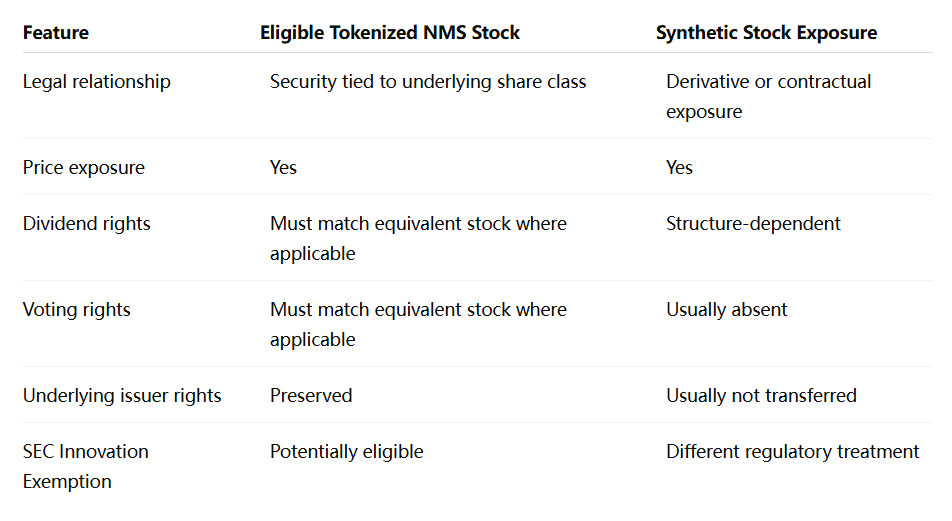
One of the strongest conditions in the SEC framework is that a tokenized NMS stock traded through a qualifying TSV must provide holders with the same rights and privileges as the equivalent class of traditional stock. SEC statements specifically point to rights such as receiving dividends and exercising voting rights.
This separates the framework from many synthetic equity products that merely track the market price of a stock. A derivative tied to Apple may deliver price exposure without giving the holder any ownership rights in Apple. An eligible tokenized Apple share under this SEC framework, by contrast, must preserve the substantive rights associated with the equivalent traditional security.
That requirement is strategically important for the broader tokenization industry. If tokenized stocks are to become part of mainstream securities infrastructure, they cannot rely only on price tracking. Investors, issuers, brokers and regulators need certainty about dividends, voting, ownership records, corporate actions and what happens if the tokenization provider fails.
Issuers Retain an Important Degree of Control
The SEC also requires a TSV to notify an issuer before allowing trading in a tokenized version created by an unaffiliated third party, and the issuer must be given an opportunity to object. SEC Chair Atkins stated that issuers can prevent their security from trading on a TSV under this process.
That condition addresses a sensitive issue in tokenized equities: whether an unrelated platform should be able to create an onchain representation of a public company’s shares without the issuer’s involvement. The SEC framework does not completely prohibit third-party tokenization, but it stops short of making issuer consent irrelevant.
From a market-structure perspective, this could influence which business model becomes dominant. Issuer-led tokenization offers stronger corporate integration but may develop slowly. Third-party tokenization can expand coverage faster, but it needs governance controls that prevent misleading or unwanted representations of public-company securities.
Why Are AMMs Important for Tokenized Stock Trading?
The Innovation Is in the Trading Architecture, Not Only the Token
Tokenized securities have existed in various forms for years, but the SEC exemption becomes more consequential because it addresses how those assets can trade after issuance. Qualifying TSVs can use permissioned AMMs and liquidity pools rather than relying exclusively on the continuous central limit order books associated with conventional stock exchanges.
That is a fundamental market-design difference. Traditional equities are traded through bids and offers submitted by market participants and intermediaries. An AMM can instead use pooled liquidity and algorithmic pricing rules to facilitate transactions. DeFi has demonstrated that this model can provide always-available liquidity for digital assets, but applying it to regulated securities creates a new set of questions around spreads, price formation, inventory risk and investor protection.
Importantly, the SEC framework combines open blockchain infrastructure with permissioned market access. Smart contracts must be public and auditable and operate on a public permissionless distributed ledger, but participants interacting with the TSV are subject to the venue’s access standards.
This hybrid design may prove more relevant to institutional tokenization than either fully closed private blockchains or completely permissionless securities markets. The blockchain can remain independently observable while access to regulated securities trading remains controlled.
Public Smart Contracts Could Change Market Transparency
Requiring smart contracts to be public and auditable creates a transparency model very different from much of conventional financial infrastructure. Market participants can potentially inspect execution logic, pool mechanics and contract behavior directly rather than relying exclusively on proprietary exchange systems.
That transparency does not eliminate risk. Smart contracts can contain bugs, economic assumptions can fail and public code does not guarantee that every investor understands the risks. But the model creates the possibility of machine-verifiable market infrastructure in which key execution rules can be monitored continuously.
If the experiment succeeds, the longer-term impact may therefore extend beyond tokenized stocks themselves. Blockchain-based execution could influence how regulators think about auditability, settlement records and transparency across other securities markets.
Why Does the Five-Year Period Matter?
The SEC Is Buying Time for Evidence-Based Rulemaking
Five years is unusually meaningful because it gives market participants enough time to build infrastructure and generate real operating data while preserving the SEC’s ability to change the regulatory approach later. The agency explicitly characterizes the relief as temporary and has requested public comment on potential modifications and next steps.
This creates a regulatory trade-off. A very short pilot could fail simply because firms lack enough time to justify the cost of building compliant infrastructure. Permanent relief, on the other hand, could lock regulators into rules before they understand how onchain markets behave at scale. A five-year window attempts to sit between those extremes.
For the industry, the most important evidence will not be the number of tokenization announcements. Regulators will be able to observe real trading volumes, liquidity concentration, investor participation, smart-contract incidents and how tokenized markets behave during periods of volatility. Those observations could eventually shape permanent rules for blockchain-based securities trading.
The framework should therefore be viewed as the beginning of a regulatory data-gathering phase rather than the final design of U.S. tokenized capital markets.
Could Tokenized Stocks Improve Market Efficiency?
Onchain Markets Could Compress Trading and Settlement Workflows
The strongest long-term argument for tokenized securities is not that investors need a blockchain version of every stock ticker. The more consequential opportunity is integrating trading, ownership records and settlement into programmable infrastructure.
Traditional securities markets separate multiple functions across exchanges, brokers, clearing entities, custodians, transfer agents and settlement systems. That architecture provides extensive safeguards, but it also creates reconciliation and operational complexity. Tokenized infrastructure could potentially allow ownership records and transaction logic to interact more directly.
The SEC exemption does not itself eliminate traditional clearing or settlement functions, nor does it prove that an AMM is more efficient than an order book. What it does provide is a controlled environment in which those claims can be tested against real securities.
The most important metrics will therefore include transaction costs, liquidity depth, settlement reliability and whether institutional participants find meaningful operational advantages. If tokenized stock trading only replicates existing market functions with additional blockchain complexity, adoption could remain limited. If it materially improves capital efficiency or access without weakening investor protection, the case becomes much stronger.
What Are the Main Risks and Limitations?
Liquidity Fragmentation May Be More Important Than Blockchain Speed
One potential weakness is fragmentation. Traditional stocks already trade across multiple exchanges and alternative trading systems, but those venues operate within a mature market structure with consolidated data and established routing practices. Adding blockchain liquidity pools could create additional venues where the same economic security trades through different mechanisms.
If tokenized markets remain small, spreads could be wider and price discovery could remain dependent on conventional exchanges. If they grow rapidly, regulators will need to determine how onchain prices interact with the National Market System. The requirement to halt tokenized trading alongside the primary listing exchange demonstrates that the SEC is already treating this linkage as important.
Smart-contract risk also remains material. Public and auditable code improves transparency but cannot guarantee flawless execution. A software vulnerability affecting a tokenized stock venue would involve regulated securities rather than purely crypto-native assets, potentially raising difficult questions about trade reversals, ownership records and investor compensation.
Finally, the exemption itself is temporary. Market participants building around the framework need to consider the possibility that permanent rules could alter their business models before the five-year period ends.
MEXC View: Tokenization Is Moving From Assets to Market Structure
The most consequential part of the SEC’s action is not the ability to place a stock token on a blockchain. Tokenization becomes economically important when the surrounding financial functions—trading, liquidity provision, settlement and ownership records—begin to operate through programmable infrastructure as well.
For digital-asset markets, this is an important distinction. Much of the first RWA cycle focused on tokenized Treasury funds and other assets whose primary innovation was digital issuance. The SEC framework moves the discussion toward secondary-market architecture. Permissioned AMMs, auditable smart contracts and tokenized securities with full shareholder rights begin to test whether blockchain can change how regulated markets operate rather than merely how assets are represented.
The relevant indicators over the next several years will therefore be liquidity, trading costs, institutional participation and the reliability of tokenized corporate actions. If those metrics improve, tokenization could become an infrastructure story rather than simply an asset-format story. If activity remains fragmented and thin, conventional market architecture may remain more efficient despite the technological novelty.
The SEC Framework Turns Tokenized Stocks Into a Real Market Test
The SEC’s five-year Innovation Exemption moves tokenized stock trading into a more consequential phase. The United States is no longer examining only whether securities can be represented on blockchains; the regulator is now allowing qualifying venues to test how actual NMS stocks can trade through permissioned AMMs and liquidity pools under temporary exemptions from specific Exchange Act definitions.
The constraints are substantial. Eligible assets face symbol and volume limits, shareholder rights must be preserved, issuers can object to unaffiliated third-party tokenization, smart contracts must meet transparency requirements and tokenized trading must stop when the underlying stock is halted. Those conditions make clear that this is not unrestricted blockchain trading.
That limitation is also what makes the experiment meaningful. The SEC is attempting to isolate technological innovation from the legal protections attached to traditional securities. If the model works, future rules could allow more of the securities-market stack to move toward programmable infrastructure without requiring investors to give up conventional ownership rights.
The next five years will therefore be judged less by the number of stocks that receive tokenized versions and more by whether these venues can demonstrate durable liquidity, reliable execution and measurable operational advantages. Tokenized stock trading now has a regulatory pathway in the United States; the harder task is proving that the market structure is genuinely better.
Sources
https://www.sec.gov/files/rules/exorders/2026/34-106402.pdf
https://www.sec.gov/rules-regulations/2026/09/4-927
Risk Disclaimer: This article is for reference only and does not constitute investment advice. The cryptocurrency market is highly volatile. Please make decisions cautiously based on your individual circumstances.