Overview
Tokenized stock trading has reached a new liquidity milestone, generating approximately $20.9 billion in decentralized exchange volume over the past 30 days. Uniswap accounted for 60.1% of that activity, with Uniswap v4 representing 40.7% and v3 another 19.4%, equivalent to roughly $12.6 billion in combined trading volume. The figures show that tokenized equities are progressing beyond issuance and brokerage access toward an increasingly active onchain secondary market.
The numbers require careful interpretation. The $20.9 billion represents cumulative trading turnover, not tokenized-stock TVL, investor holdings or new capital entering the market. The same assets can trade repeatedly and therefore contribute to volume multiple times. Nevertheless, the concentration of activity on decentralized exchanges matters because it shows where price discovery and liquidity are beginning to form.
The deeper development is that equity-linked tokens are increasingly behaving like programmable financial assets. They can potentially move between wallets, trade through automated market makers and interact with lending or structured-product infrastructure. That creates opportunities traditional brokerage positions cannot easily replicate, while also introducing new questions around shareholder rights, oracle design, liquidity concentration and trading outside conventional market hours. Tokenized stock trading is therefore moving from an issuance story toward a market-structure story.
Key Takeaways
- Tokenized stocks generated approximately $20.9 billion in 30-day DEX trading volume.
- Uniswap controlled 60.1% of activity, with v4 alone accounting for 40.7%.
- Trading volume measures turnover rather than capital invested or TVL.
- Liquidity is becoming a more important competitive advantage than simply issuing more stock tokens.
- Legal ownership, corporate actions and off-hours pricing remain major structural challenges.
Why Did Tokenized Stock Trading Reach $20.9B?
The $20.9B Figure Measures Market Activity, Not Capital Inflows
The first analytical distinction is between turnover and assets. A decentralized exchange records the notional value of each swap, so the same $1 million of capital can generate many millions of dollars in volume if it changes hands repeatedly. Market makers, arbitrageurs and active traders can therefore produce substantial turnover without a comparable increase in underlying tokenized-stock holdings. Describing the $20.9 billion figure as “capital flowing into tokenized equities” would materially overstate what the data shows.
Even with that limitation, accelerating turnover is relevant because liquid secondary markets are necessary if tokenized securities are to evolve beyond digital wrappers around traditional assets. Issuing a token representing equity exposure is technically straightforward compared with building a market where users can enter and exit positions efficiently, prices remain close to underlying securities and liquidity persists during volatility. High trading activity suggests that tokenized equities are beginning to develop this second layer.
The next question is market quality. Sustainable adoption should eventually produce not only higher volume but also tighter spreads, deeper liquidity, more diverse counterparties and consistent activity across market conditions. If volume is generated primarily by short-lived speculation or repeated arbitrage around a limited set of tokens, the economic significance is narrower. The $20.9 billion milestone is therefore evidence of growing market activity, not proof that tokenized equities have already achieved mature adoption.
Why Uniswap's 60.1% Share Matters
Uniswap’s combined 60.1% share shows that tokenized equity liquidity is already concentrating around a relatively small number of execution venues. Uniswap v4 accounted for 40.7% of total DEX volume, while v3 contributed 19.4%. This concentration can be beneficial during an emerging market’s early development because traders, arbitrageurs and liquidity providers know where counterparties are most likely to be found, reducing the fragmentation that would arise if liquidity were spread thinly across dozens of protocols.
Uniswap also entered Robinhood Chain as its primary public AMM, supporting Stock Tokens across its interface, wallet, API and multiple protocol versions. That distribution gives tokenized equities access to infrastructure originally built for crypto-native assets but increasingly capable of handling RWAs. The important competitive advantage is therefore not simply Uniswap’s brand or existing DEX volume; it is a mature liquidity stack that can be reused as new asset classes move onchain.
However, concentration creates its own risk. If more than half of tokenized stock trading depends on one protocol family, smart-contract failures, liquidity-provider behavior or changes in routing could have disproportionate effects. Market maturity should eventually be measured by resilience as well as market share.
Why Is Uniswap v4 Already Leading Tokenized Stock Trading?
Flexible Liquidity Infrastructure Is Becoming More Important
Uniswap v4’s 40.7% share is notable because it suggests that tokenized assets are moving directly into newer liquidity infrastructure rather than simply remaining on the most established protocol version. V4 introduces a more flexible architecture in which developers can use hooks to customize pool behavior, fees and other market functions. Those capabilities can eventually become useful for assets whose trading conditions differ from standard crypto tokens.
It would be premature to attribute all tokenized-stock growth directly to v4 hooks, because trading volume depends on asset availability, liquidity incentives, user routing and market-maker participation as well as protocol design. The stronger conclusion is that tokenized equity liquidity is proving capable of migrating toward new DEX infrastructure relatively quickly.
That matters because equities create market-design requirements that crypto-native tokens do not always have. Stock markets contain opening and closing auctions, trading halts, corporate actions and defined sessions. A programmable AMM architecture could eventually help developers build specialized behavior around such requirements, although regulatory and legal infrastructure would still need to support it. The opportunity is therefore not merely “stocks on an AMM,” but AMMs increasingly adapting to the characteristics of regulated financial assets.
How Is Tokenized Stock Trading Different From Traditional Equity Trading?
The Execution Layer Changes, but the Underlying Economics Do Not Disappear
Traditional equities primarily trade through exchanges, alternative trading systems and broker-dealer infrastructure using order books and established market-making mechanisms. Tokenized stocks can instead trade through blockchain-based liquidity pools in which smart contracts execute transactions directly against available liquidity. This changes how execution, custody and settlement can interact, potentially allowing assets to move between applications without repeatedly returning to a centralized broker.
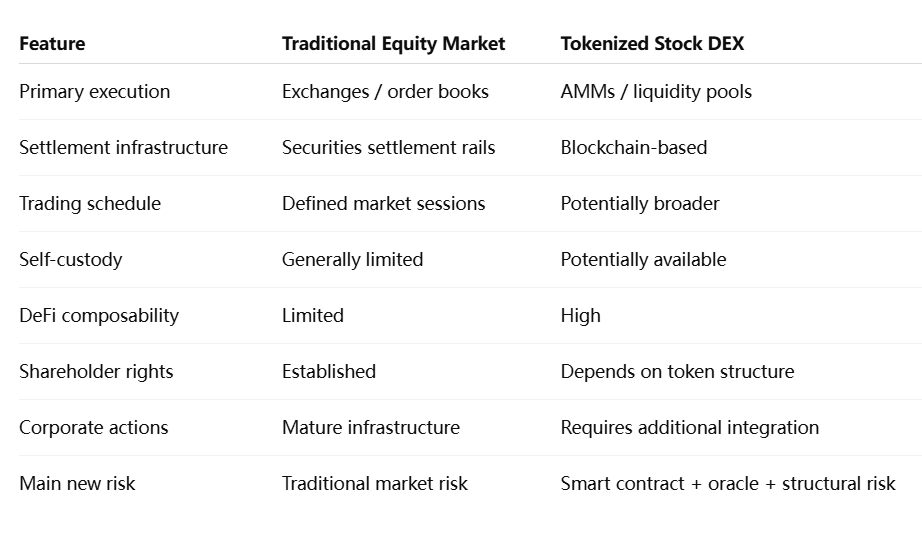
The important analytical point is that blockchain composability does not automatically solve securities-market complexity. A stock is more than a price ticker. Ownership determines dividend entitlements, voting, tender offers, splits, mergers and other corporate actions. A token may trade efficiently on a DEX while providing a materially different legal relationship with the underlying issuer.
This makes legal architecture increasingly important as trading volume grows. The industry is beginning to move from the simple question of whether stocks can trade onchain toward the harder question of what exactly the token holder owns.
Does $20.9B Mean Tokenized Stocks Have Gone Mainstream?
Volume Alone Is an Incomplete Adoption Metric
No. High turnover is an important liquidity signal, but mainstream adoption would require a wider set of evidence. Holder growth, retained balances, geographic access, liquidity depth, institutional participation and the amount of tokenized equity used as collateral would provide a more complete picture.
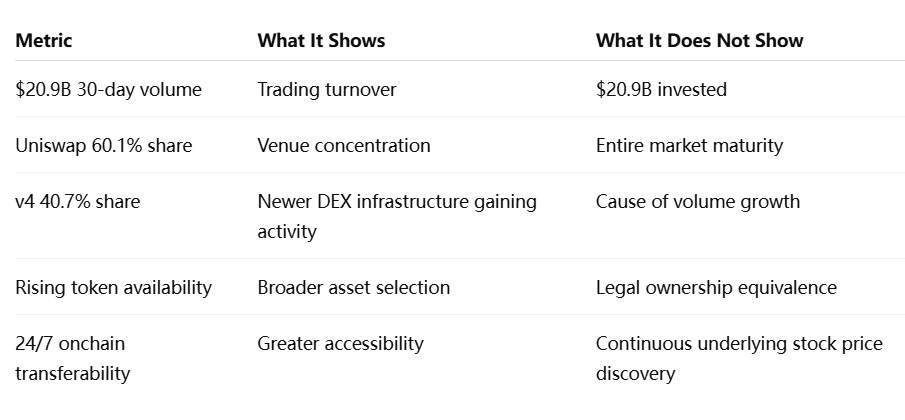
This distinction becomes particularly important when tokenized assets trade outside conventional U.S. equity hours. A blockchain market can remain operational on weekends, but the underlying security may not have an active primary market price. A token can therefore develop a temporary premium or discount based on expectations rather than contemporaneous cash-market transactions.
For tokenized stock trading to mature, market participants will need robust approaches to reference pricing, market closures and corporate actions rather than simply deeper AMM liquidity.
Why Shareholder Rights Are Becoming the Next Major Issue
A Tradable Token Is Not Automatically a Share
The rapid growth of tokenized stock trading is exposing a structural distinction that was less important when the market was small: economic exposure and legal equity ownership are not the same thing. Some products represent issuer-recognized securities, while others are debt claims, custodial representations or synthetic instruments designed mainly to track stock prices.
That distinction affects what happens beyond buying and selling. A conventional shareholder participates in an ownership system containing official shareholder records, voting processes, dividends and corporate communications. If a token is disconnected from that infrastructure, the user may receive price exposure without receiving the same legal position as a shareholder.
This is likely to become one of the defining competitive questions for tokenized equities. Onchain markets have made financial assets technically composable; the next challenge is achieving what could be called legal composability—ensuring that the token’s movement through wallets and protocols remains compatible with recognized ownership, corporate actions and investor protections.
The emergence of industry initiatives focused on issuer-sponsored tokenization reflects this transition. Liquidity can make a market attractive, but legal clarity determines whether tokenized shares can ultimately function as a credible alternative form of securities ownership.
What Could DeFi Do With Tokenized Equities?
Collateral Utility Could Matter More Than Spot Trading Volume
The next phase of development may be driven less by spot DEX volume and more by what can be built on top of tokenized equities. If legally and technically suitable equity tokens become acceptable collateral, users could potentially borrow stablecoins against stock portfolios, build automated hedging strategies or combine equities with tokenized Treasuries and other RWAs in programmable portfolios.
This would extend DeFi beyond a collateral base dominated by crypto-native assets. Equities introduce cash-flow characteristics and market drivers that differ from BTC or ETH, potentially creating more diversified onchain credit markets.
The difficulty is risk management. A protocol accepting equities must account for market closures, trading halts, dividends, splits and sudden corporate events. Reliable market data and oracle infrastructure become essential because an inaccurate stock price can generate inappropriate liquidations even when the smart contract itself operates correctly.
Tokenization therefore pushes several parts of financial infrastructure onchain simultaneously. Assets, liquidity, market data and ownership records increasingly need to evolve together.
What Are the Main Risks?
Liquidity Concentration and Legal Structure Matter More Than Raw Blockchain Speed
The current market faces several interconnected risks. First, concentrated liquidity increases dependence on a small number of protocols. Second, different token structures can give users very different legal rights even when the products appear similar in an interface. Third, continuous blockchain trading creates potential price dislocations when underlying exchanges are closed.
Smart-contract and oracle risk add another dimension. A tokenized Apple share may ultimately reference one of the world's most liquid securities, but its onchain representation can still suffer from a contract bug or incorrect price input. Tokenization therefore adds new infrastructure risk without eliminating conventional equity risk.
Regulatory fragmentation could also affect liquidity. If the same product can be traded only by users in certain jurisdictions, global onchain liquidity may remain segmented despite the technical openness of blockchain networks.
MEXC View: Liquidity Is Becoming the Real RWA Moat
Token issuance is becoming easier. The more difficult competitive advantage is creating durable liquidity, reliable price discovery and financial utility around the tokenized asset. The $20.9 billion volume figure is meaningful because it suggests the tokenized-equity market is beginning to compete at the execution layer rather than merely at the issuance layer.
Uniswap’s 60.1% share illustrates the strength of network effects in this transition. Once a venue attracts meaningful liquidity, traders, market makers and applications have incentives to route additional activity there, reinforcing its position. But the same concentration means the next phase should be evaluated through execution quality and resilience rather than market share alone.
The broader RWA market may follow a similar pattern. Tokenized AUM identifies where assets exist; liquidity and collateral utilization show whether those assets have become functioning financial instruments.
Tokenized Stock Trading Is Moving From Issuance to Liquidity
Tokenized stock trading reaching approximately $20.9 billion in 30-day DEX volume marks an important transition for onchain equities. The number does not represent $20.9 billion of new investment capital, but it demonstrates that tokenized equity exposure is generating substantial secondary-market turnover. Uniswap’s 60.1% share further shows that a recognizable execution layer is beginning to emerge.
The more important development is what comes next. The market has largely demonstrated that equity-linked tokens can be issued and traded. It now needs to demonstrate that those markets can maintain deep liquidity, reliable reference pricing and consistent treatment of shareholder rights and corporate actions.
This is where tokenized equities become more than another RWA category. If the assets can combine decentralized liquidity with credible ownership structures and eventually serve as collateral across onchain finance, they could create a new securities-market layer rather than merely reproduce brokerage exposure on a blockchain.
The $20.9 billion milestone therefore matters not because tokenized equities have already replaced traditional stock markets, but because tokenized stock trading is starting to develop its own liquidity infrastructure. Whether that infrastructure can also support institutional ownership, risk management and corporate governance will determine how important the market ultimately becomes.
Sources
https://blog.uniswap.org/robinhood-chain-is-live
https://developers.uniswap.org/docs/protocols/v4/deployments
https://docs.robinhood.com/chain/stock-tokens/
Risk Disclaimer: This article is for reference only and does not constitute investment advice. The cryptocurrency market is highly volatile. Please make decisions cautiously based on your individual circumstances.