

Author: Tiger Research Reports
Compiled by: Shenchao TechFlow
Shenchao Introduction: In Q3, crypto market sentiment shifted from fear to greed, but corporate financing did not recover in tandem; money bypassed startups and flowed directly into assets. This report breaks down five key changes: M&A shifted from buying tracks to filling license gaps, established VCs lost pricing power, early-stage rounds contracted, debt financing surpassed equity, and capital concentrated in infrastructure that connects with traditional finance. For teams still relying on VC equity financing, the signal is already clear.
Key Points
- The number of M&A transactions remained stable, but large acquisitions gave way to smaller deals, with buyers placing more value on specific capabilities such as licenses, payments, and institutional trading.
- Established lead VCs saw reduced influence over deal terms, while strategic investors became more active, including CEX-affiliated VCs hoping to grow their own exchange and public chain ecosystems through investments.
- Seed rounds and other early-stage rounds contracted, with capital concentrating on Series A to C companies that have already proven their business through revenue and licenses.
- Venture equity financing decreased, while cash-flow-based financing methods expanded, including bond issuance, credit lines, and SPAC listings.
- Capital concentrated in areas related to traditional finance and real-world use cases, such as payments, stablecoins, tokenized securities, and AI-related infrastructure, rather than isolated blockchain ecosystems.
1. Market Rebound, Opportunities Shift to the Institutional Side
In Q3 2026, crypto market sentiment shifted from fear to greed.
After two consecutive quarters of declines in the first half of the year, Bitcoin rose 43% in Q3, posting its strongest third-quarter performance since 2017. U.S. spot Bitcoin ETFs recorded $6.34 billion in net inflows. The Crypto Fear and Greed Index, which had been in extreme fear territory throughout the first half, entered greed territory on August 20 and remained at that level for most of September.
However, disclosed transaction amounts show that this rebound did not translate into more investment in crypto companies.
Funds that flowed back as prices recovered went directly into crypto assets themselves, while corporate investments that lock up capital for years did not follow short-term sentiment changes. The following sections analyze the main changes in Q3.
2. Five Key Changes in Q3
- M&A: From expansionary deals to capability-based acquisitions
- VC market: Lead investors lose ground, strategic capital rises
- Financing stages: Caution in early rounds, focus on proven businesses
- Financing methods: Listings and debt financing surpass equity
- Sectors: Capital concentrates in infrastructure connecting traditional finance
2.1. M&A: From Expansionary Deals to Capability-Based Acquisitions
The number of M&A transactions in Q3 was flat compared with the first half, but deal sizes fell sharply.
M&A transaction counts were 39 in Q1, 36 in Q2, and 37 in Q3, while deal sizes appear to have declined. Data from Architect Partners, an M&A advisory firm that independently tracks crypto transactions, shows that the number of crypto M&A deals fell 7% quarter-over-quarter in Q3, while deal value dropped 83%.
The decline in deal size was due to a change in targets. The first half was driven by deals to acquire entire companies to build new business lines, such as Mastercard's $1.8 billion acquisition of BVNK. Q3 acquisitions instead filled gaps in buyers' existing businesses.
Circle agreed to acquire Singapore-based cross-border payments company Tazapay, MoonPay agreed to acquire North Capital, which holds a U.S. securities license, and BitGo acquired NYDIG's institutional trading business.
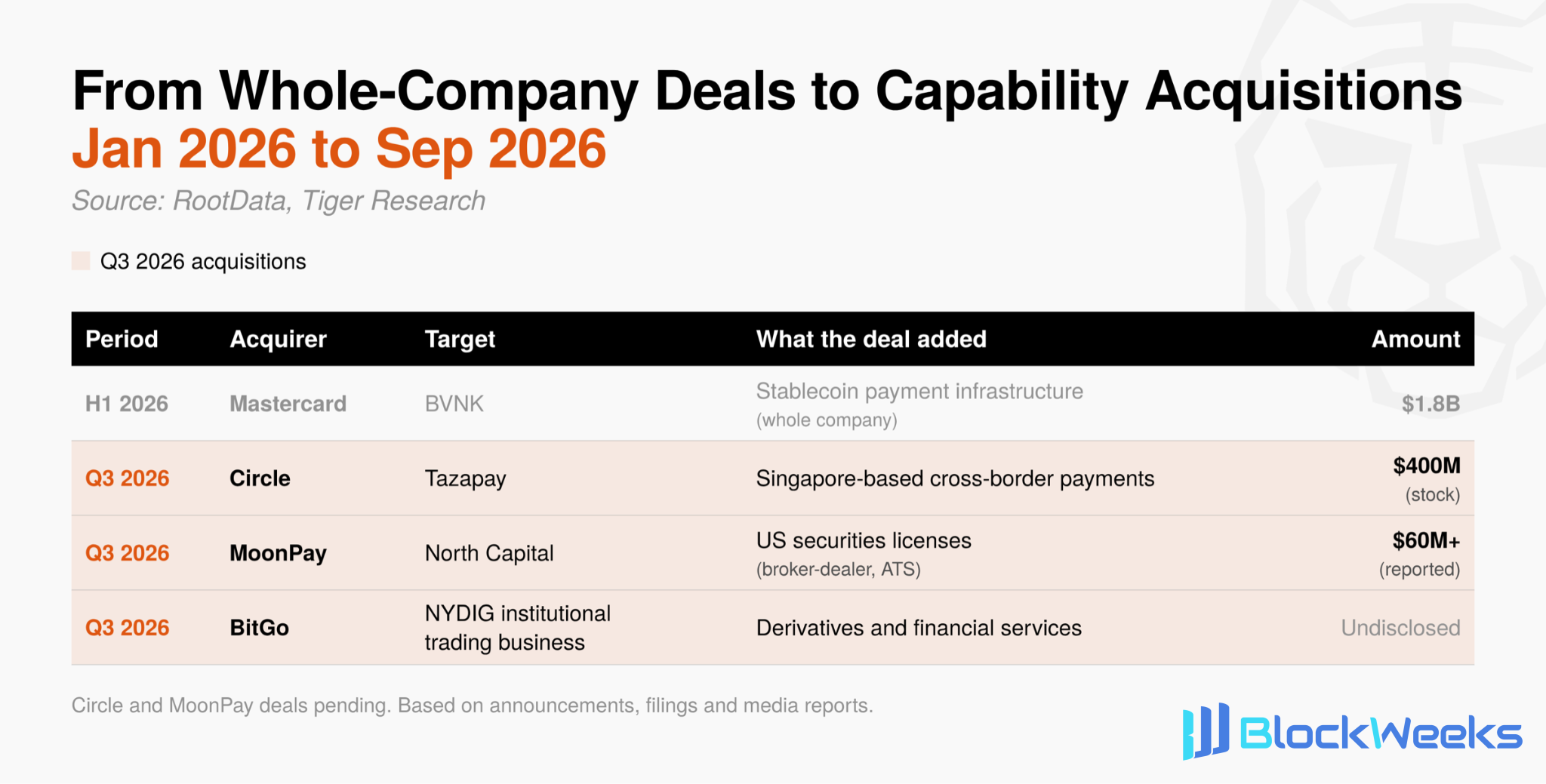
Obtaining licenses and proving a capability internally takes a long time, while acquisitions can secure both at once immediately. At a stage when the industry's operating structure is still taking shape, this time savings has become a competitive advantage. The focus of M&A is rapidly shifting from expanding into new businesses to acquisitions that obtain specific capabilities.
2.2. VC Market: Lead Investors Lose Ground, Strategic Capital Rises
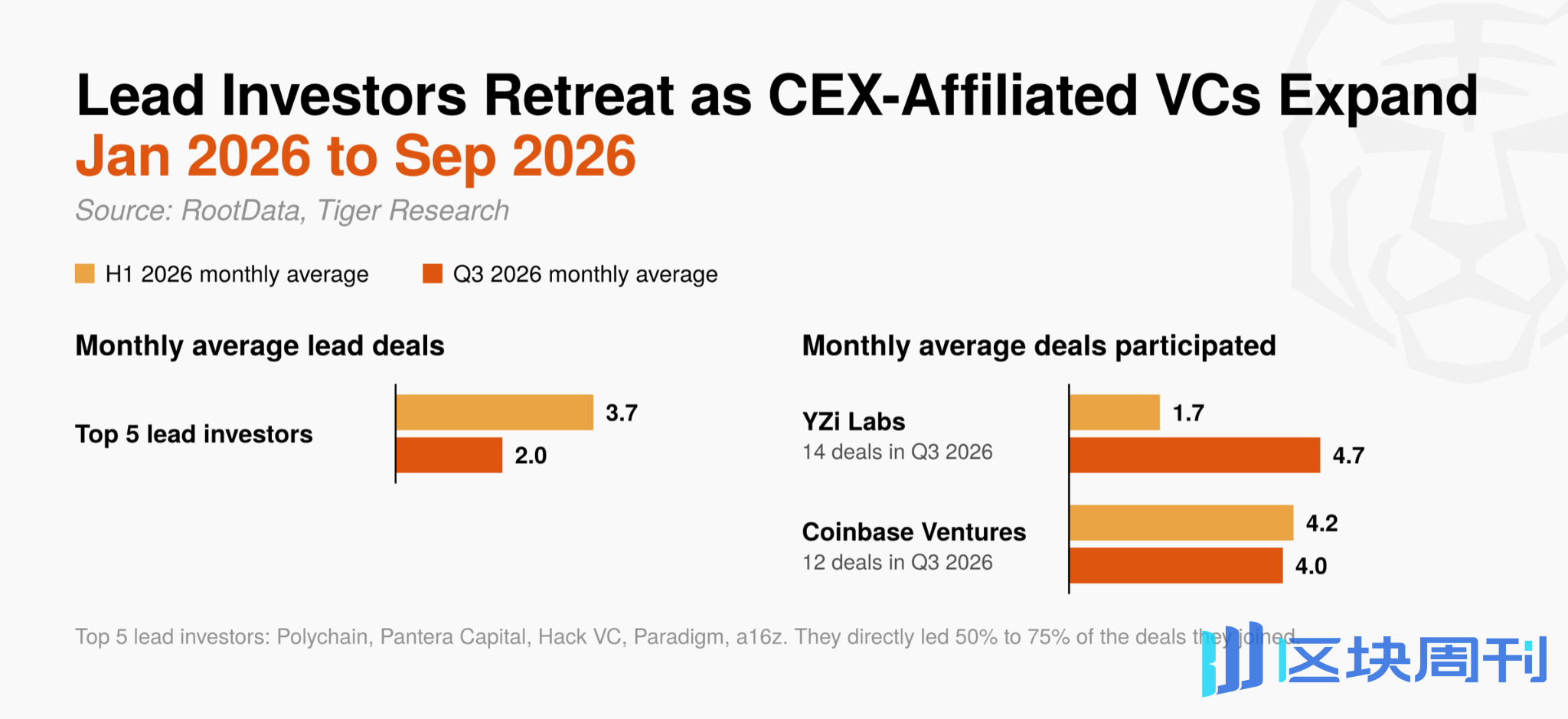
The influence of major lead investors has declined noticeably. The five most active lead investors since 2024 (Polychain, Pantera Capital, Hack VC, Paradigm, and a16z) led an average of 2.0 deals per month in Q3, down from 3.7 in the first half.
These firms previously directly led 50% to 75% of the deals they participated in and set valuation anchors for the market, but their control over rounds is weakening.
By contrast, YZi Labs (formerly Binance Labs) participated in 14 deals, nearly triple its monthly average in the first half, followed closely by Coinbase Ventures with 12.
The rise in participation by CEX-affiliated VCs is because their investment goals are structurally different. Financial VCs pursue capital gains from increases in equity or asset value, while CEX-affiliated VCs can also gain additional benefits such as trading volume and new users when portfolio projects launch on their own exchanges or public chains (such as BNB Chain or Base).
Therefore, even amid uncertainty in prices and valuations, these institutions have clear reasons to continue investing. As a result, Q3 rounds reflected more the influence of strategic investors seeking to grow their own platforms than that of financial investors setting prices.
The Q3 VC market showed a shift: from financial investment aimed at high returns to strategic investment that creates business and ecosystem synergies.
2.3. Financing Stages: Caution in Early Rounds, Focus on Proven Businesses
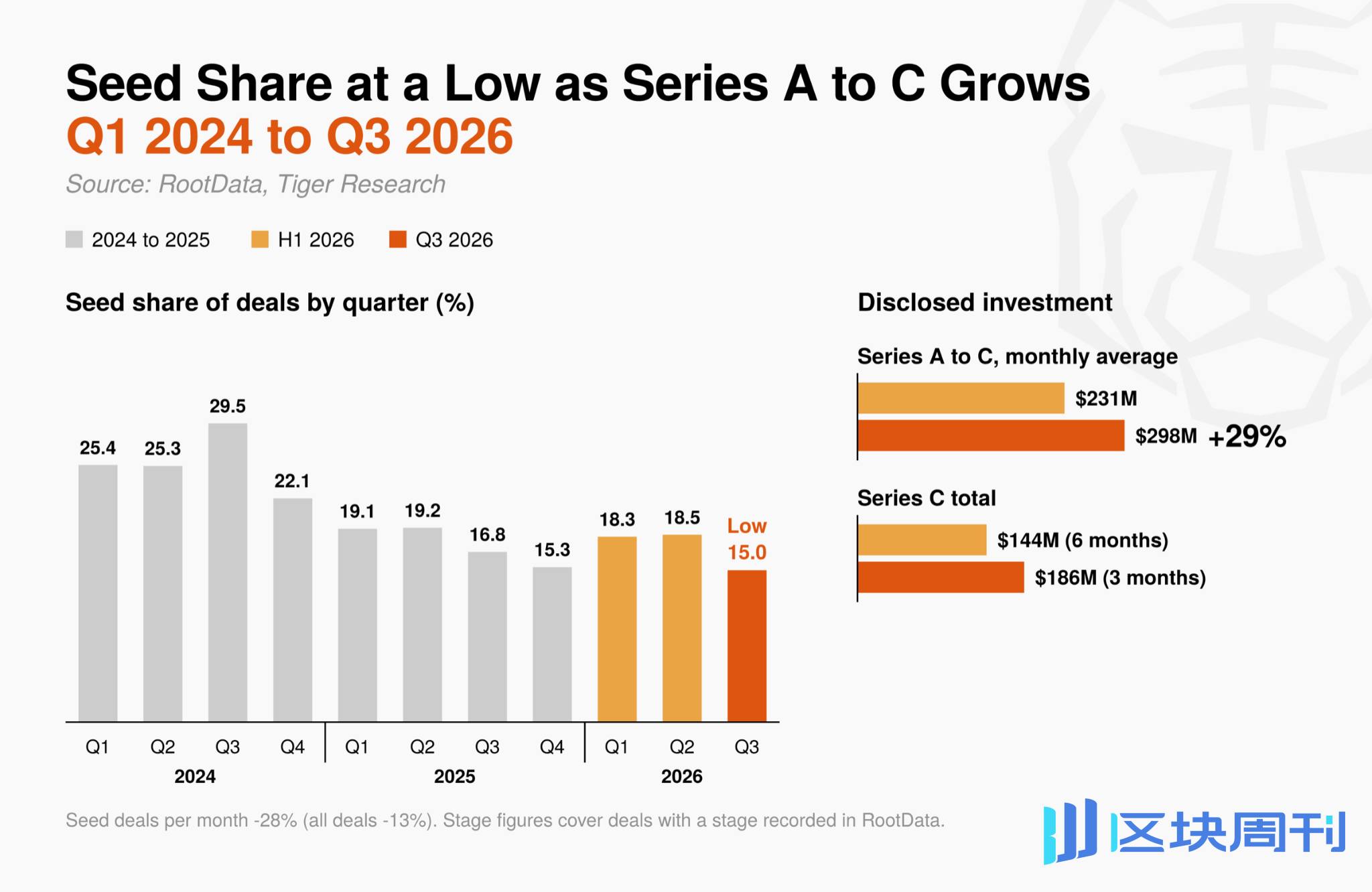
Investors are unwilling to take unproven risks. Seed rounds accounted for 15.0% of all deals, the lowest quarterly share since 2024. The average monthly number of seed deals fell 28%, more than double the 13% decline in overall deal count.
Disclosed Series A to C investment amounts rose 29% quarter-over-quarter, with Q3 Series C financing alone exceeding the total for the entire first half.
Early-stage investing spreads capital across a large number of small projects, relying on a few successes for high returns. For this model to work, follow-on investors must continue buying equity or tokens at higher valuations.
As corporate investment overall became more cautious in Q3, market expectations for such follow-on investment seem to have weakened. Investors instead concentrated funds on expansion rounds for companies that have already proven their business through revenue and licenses.
Jeeves and EDX Markets both completed Series C funding in Q3. They are payment and trading infrastructure companies and reflect the same pattern. Market investment criteria are shifting from token issuance timelines to actual business evidence.
2.4. Financing methods: listings and debt financing surpass equity
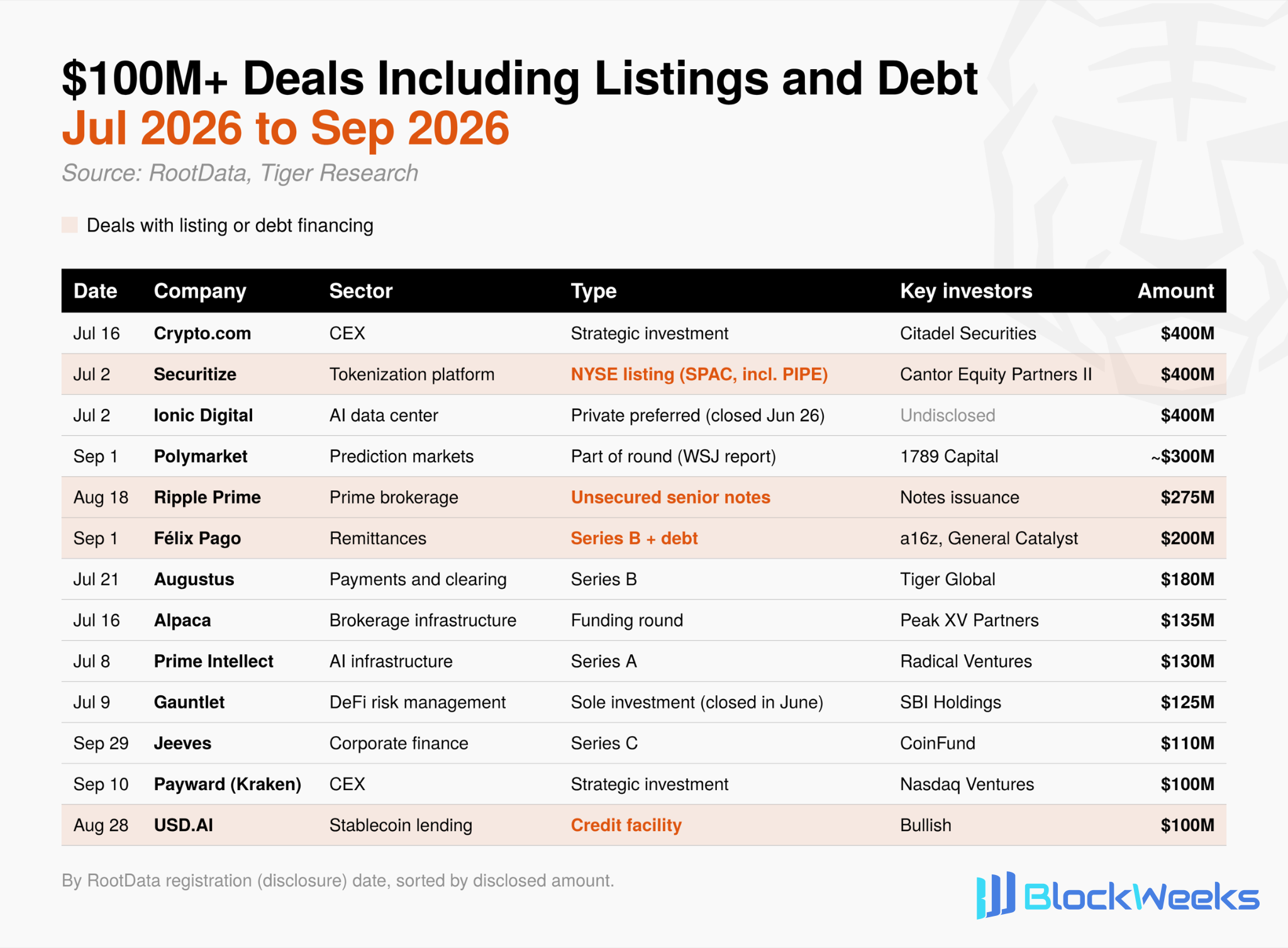
Large amounts of capital in Q3 also came from outside venture equity. Of the 13 deals worth more than $100 million, 4 involved listings or debt financing.
Securitize listed on the New York Stock Exchange through a SPAC merger, and Ripple Prime issued $275 million in unsecured senior notes. On a monthly basis, venture and strategic equity financing fell 24%, while debt financing rose from $70 million to $190 million, and listing fundraising rose from $80 million to $150 million.
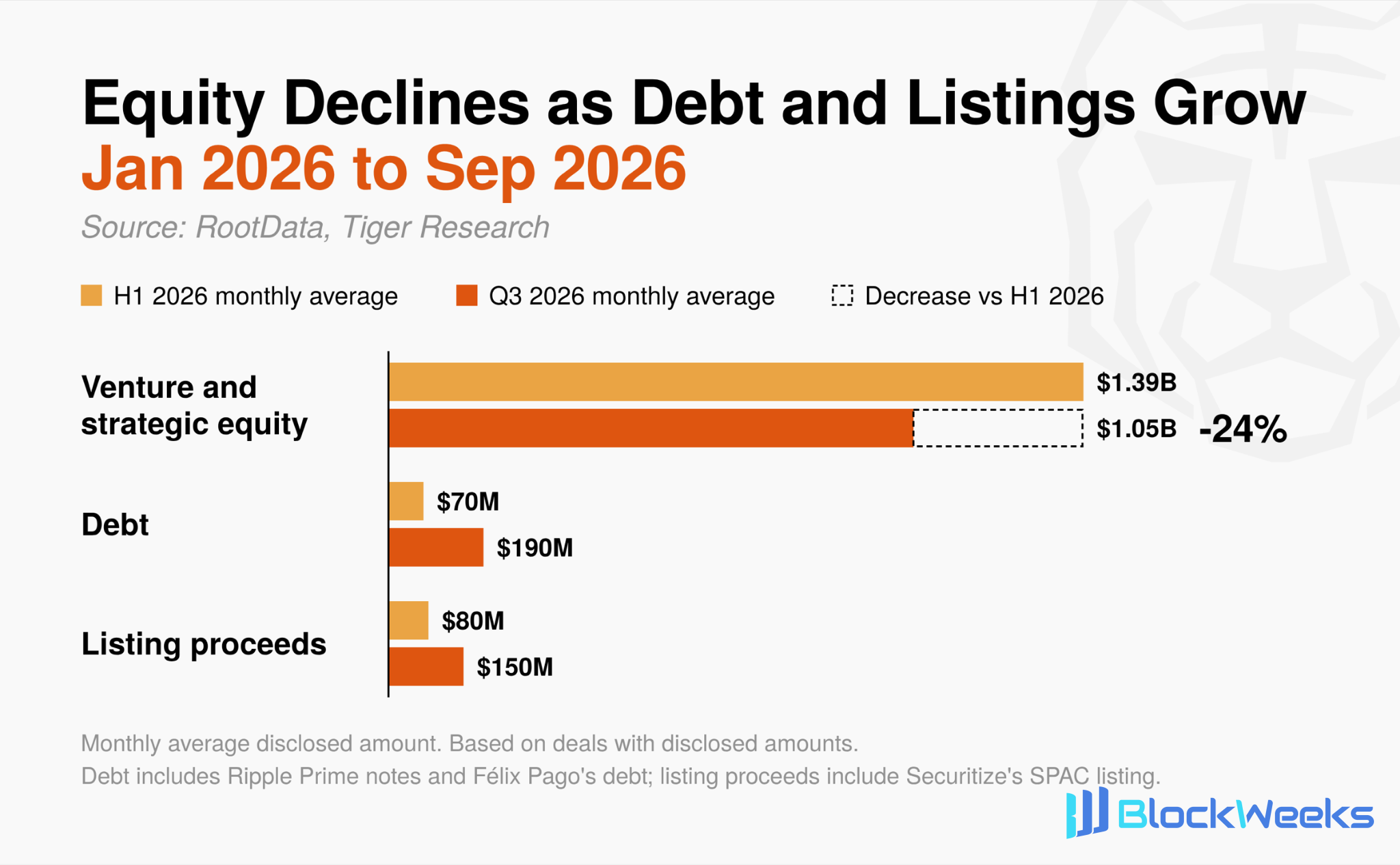
Bonds and listings require either repayment capacity or a valuation from the public market. In the first half, debt financing mainly came from Bitcoin treasury companies, such as Metaplanet borrowing to buy Bitcoin.
In the third quarter, companies with cash flow, such as prime brokers, remittance and stablecoin lending, borrowed to expand their businesses. The repayment basis shifted from the Bitcoin price to corporate cash flow. Some companies can now finance like ordinary businesses and no longer need venture capital, which may narrow the role of VC to the early stage.
2.5 Sectors: Capital concentrates in infrastructure related to traditional finance
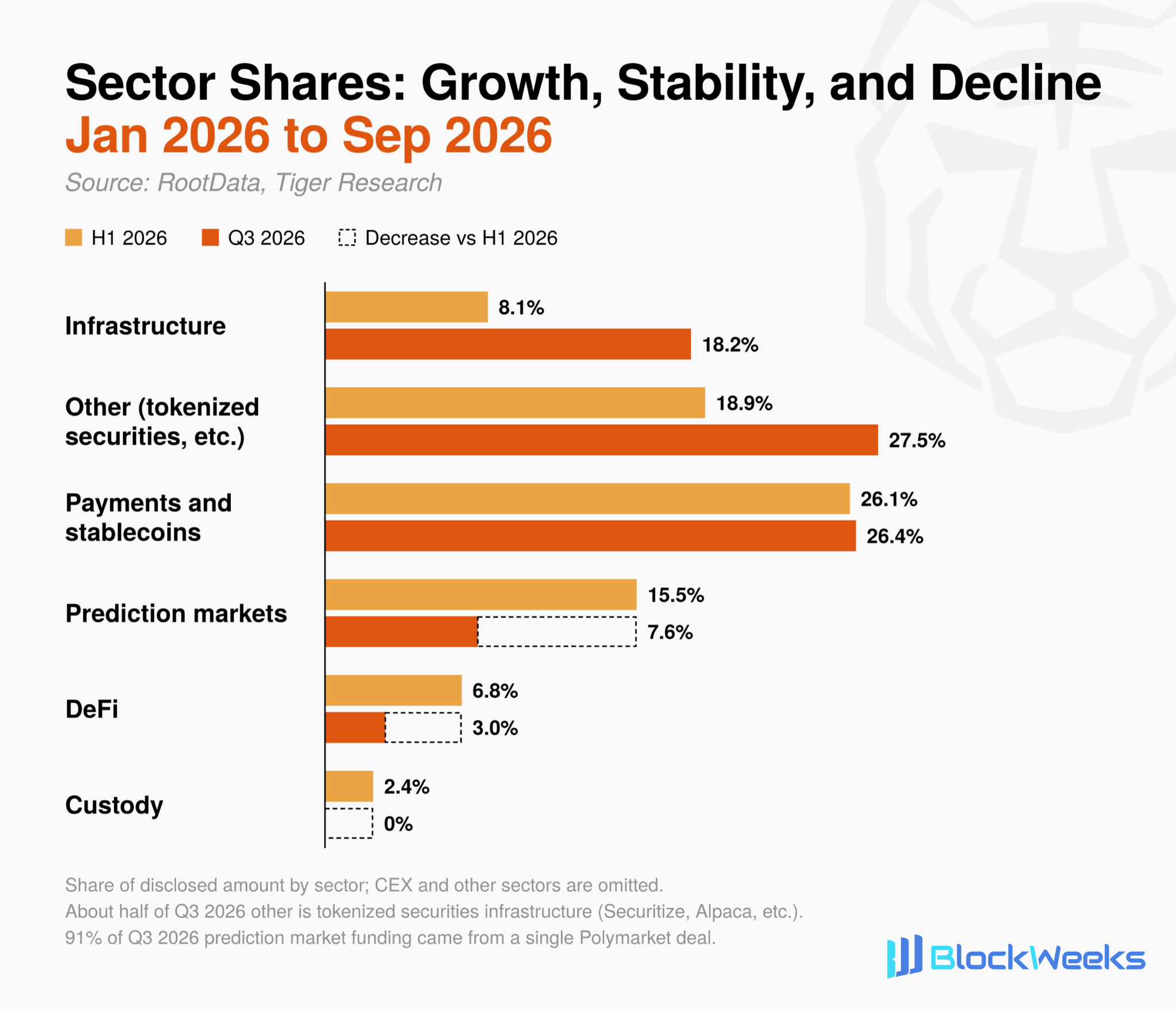
By sector, capital in the third quarter flowed to areas connecting traditional finance with the crypto ecosystem, rather than new layer 1 and layer 2 protocols.
The infrastructure sector's share of disclosed investment more than doubled from 8.1% in the first half to 18.2%. The growth came from AI-related deals, not new blockchain mainnets. Leaders included Ionic Digital, which shifted its business to AI data centers, and AI training infrastructure company Prime Intellect.
Of the capital classified as "other," about half flowed to tokenized securities infrastructure, such as Securitize and Alpaca. Payments and stablecoins were the only sector whose share remained unchanged.
In contrast, sectors not closely tied to traditional finance attracted much less capital. In prediction markets, a single Polymarket deal of about $300 million accounted for 91% of third-quarter investment. DeFi investment fell 71%, the number of deals also declined, and its share was only 3.0%. The largest DeFi deal was Cari Network, a deposit token network backed by U.S. regional banks. There was no new investment in custody, and activity was limited to consolidation among established companies, such as BitGo's acquisition of NYDIG's trading business.
In the third quarter, capital flowed only to established companies that already hold licenses and regulatory approvals, or to projects associated with traditional financial institutions such as banks. Investment clearly shifted from projects building a new crypto ecosystem to the distribution channels and infrastructure needed for traditional financial capital to enter the crypto market.
3. Implications for various market participants
Despite the price rebound, capital flowing into crypto companies in the third quarter remained tight. Capital instead changed its targets: small acquisitions that add specific capabilities replaced large deals, and strategic investors seeking to expand their own platforms were more prominent than financial lead investors.
Capital also concentrated on companies that have proven their business through revenue and licenses, rather than early-stage projects. As the control and fundamentals trends mentioned in the previous report continue, the following sections list the main tasks facing various market participants.
3.1 Crypto companies and founders
Prepare for a longer early-stage financing cycle: the decline in the number of seed rounds in the third quarter was faster than the market average. Before the next round, companies should conservatively recalculate their runway so they can reach specific milestones, such as revenue, licenses or important partnerships.
Review the terms of strategic investment: capital from CEX-affiliated VCs is still flowing in, but may come with conditions, such as requiring commitments to use a specific CEX or blockchain. Companies should check in advance whether these conditions will restrict future financial investment or a company sale.
Build regulatory and licensing capabilities: recent acquirers focus on capabilities that can be used immediately, such as securities licenses, payment networks and trading infrastructure, rather than the entire company. Companies considering a sale or partnership should clarify their core capabilities and how they match the business of potential partners.
Use more diverse financing methods: companies with stable cash flow can consider traditional financing, such as issuing bonds or credit lines, to reduce equity dilution.
3.2 Traditional financial institutions and enterprises
Enter the market through acquisitions: for new crypto businesses, acquiring a specialized company with licenses and operating experience may be more efficient than building infrastructure in-house. M&A around infrastructure, licenses and trading capabilities continues to increase.
Evaluate deals on actual terms: looking only at disclosed deal amounts cannot determine how the market values these businesses. Buyers should prioritize fit with their own business and work with professional advisors to test whether a deal can create value beyond the price.
3.3 Investors and retail participants
Treat financing news with caution: VC financing announcements should not automatically be seen as buy signals. The large-scale token sales and excess trading returns of the past are harder to expect in the current market, and retail investors should recognize that the upside of early positions is limited.
Evaluate projects on fundamentals: projects should be assessed by revenue structure, regulatory compliance and links to traditional finance, rather than token issuance timelines or short-term news.
The crypto market is moving beyond short-term expectations and toward demonstrating real value and practical use. Some investors may regret such changes, but the market's transformation into an industry can be seen as healthy development.
Market participants who can recognize this structural change and strengthen their core competitiveness and risk management will be better prepared for the next phase of the market.
Data and methodology
Data source: Data from January 2024 to September 2026 is based on the RootData API, covering 3,515 financing rounds, labeled by RootData registration date. Ionic Digital and Gauntlet, completed in June but announced in July, are counted in the third quarter. Of RootData's 195 third-quarter records, two were not investments: one was a DEX launch partnership between Robinhood and dYdX Labs, and the other was membership in the Ethereum institutional alliance. These two were excluded, leaving 193 deals for analysis.
Amount basis: The amounts in this report are the sum of deals with disclosed amounts. Of the 193 deals in the third quarter, 112 disclosed amounts; of the 441 deals in the first half, 286 disclosed amounts. Deals with undisclosed amounts are not included, so actual volume is greater than the figures shown. A Raven financing round recorded in RootData as $90 million was excluded because the original source showed that figure was a valuation rather than an investment amount.
M&A amount: Disclosed M&A amounts and M&A's share of the decline at 83%, based only on transactions with amounts recorded in RootData. Transactions with disclosed amounts but not recorded in RootData, such as Circle and Tazapay, which according to SEC filings was $400 million, and Mirae Asset and Korbit, approximately KRW 141.4 billion, about $100 million, are noted separately in the main text. The Q3 M&A comparison references Architect Partners' quarterly data.
Funding type: M&A follows RootData's round types. Public listing fundraising includes IPOs, post-listing financing, and Securitize's listing. Debt includes debt financing, Ripple Prime notes, and the debt portion of Félix Pago's round. Token sales include OTC and public sale rounds. All remaining transactions are classified as venture capital and strategic equity investments, which also includes purchases of existing shareholder shares, such as Hana Financial Group and Samsung Securities buying Dunamu shares in the first half.
First half vs. third quarter comparison: Because the two periods differ in length (six months and three months), both transaction counts and amounts are converted to monthly averages for comparison. First-half data has been recalculated based on RootData's subsequent data revisions (441 transactions, previously 435).
Funding stage: Data by stage, such as seed rounds and Series A to C, includes only transactions with stages recorded in RootData (143 of 193 in Q3). For example, Fasset's Series C and Augustus's Series B are not included in stage statistics because RootData did not record their stages.
Sector classification: Each transaction is assigned to a single sector based on RootData project tags, and is prioritized into the more specific business model sectors in the following order: prediction markets, CEX, custody, payments and stablecoins, DeFi, gaming, NFT, social and entertainment, infrastructure. Large transactions without tags are manually classified after reviewing the business, and transactions that cannot match any sector are counted as other.
Transactions with institutional participation: Transactions in which at least one investor classified by RootData as a company or institutional entity participated. This is the same definition as "transactions with traditional financial institution participation" in the previous report.
Transactions with direct participation by traditional financial institutions: Transactions in which at least one bank, securities firm, asset management company, exchange operator, payment network, credit rating or data company, traditional market maker, or the investment arm of any of the above participated. Transactions without investor information in RootData are not included in the statistics, so this share is a conservative figure. For example, Hana Financial Group and Samsung Securities' acquisition of Dunamu shares in the first half, and a U.S. regional bank's Q3 investment in Cari Network, were not counted because investor information could not be obtained. Investors identified through keyword matching were all reviewed one by one, and fintech companies such as PayPal, Stripe, Robinhood, and Nium are not included as traditional financial institutions.
Verification of key transactions: The key Q3 transactions mentioned in the text have all been cross-verified against company press releases, regulatory filings, and mainstream media reports. Transactions still at the agreement stage (S&P Global and OpenZeppelin, Nasdaq and LeveL Markets, Circle and Tazapay) have not yet closed.
Market indicators: Bitcoin price and quarterly returns are based on Binance BTC/USDT daily closing prices (UTC). The Crypto Fear & Greed Index comes from Alternative.me, and U.S. spot Bitcoin ETF net flows come from SoSoValue data cited by Investing.com. The CLARITY Act vote and SEC exemptions are based on U.S. Senate voting records and related reports on SEC announcements.
Terms of Use
Tiger Research permits fair use of its reports. "Fair use" is a principle that broadly allows the use of certain content for public interest purposes, as long as it does not harm the commercial value of the material. If the use complies with the purpose of fair use, the report may be used without prior permission. However, when citing Tiger Research reports, you must 1) clearly indicate the source as "Tiger Research," and 2) include the Tiger Research logo. Reorganizing and publishing the material requires separate negotiation. Unauthorized use of the report may result in legal action.