




CHAPTER 01 Why Study RWA
- Two questions: What is the new asset class for the next breakout? Where will the new assets be traded? Over the past two or three months, Robinhood chain has risen suddenly, kicking off a wave of meme enthusiasm.
- Quoting a line Xiaoying wrote in the previous cycle: A meme itself is a marketing campaign for the chain it is on, and the protagonist is the chain behind it. When it comes to investing, it means looking at the chain behind the meme.
- The primary market is consolidating, and the boundary between primary and secondary is disappearing. Money and projects are both concentrating toward the top, with rounds of 2 billion or 3 billion USD at every turn; a fund I recently researched put 40% of its money into a single project. Robinhood Ventures has already reached its second phase, turning twenty or thirty primary-market projects into an index.
- RWA is a paradigm shift at the underlying layer of the financial system, possibly the most significant change in the financial industry in thirty or forty years, but it will be much slower than AI. AI is a productivity tool, penetrating the C-end first and then the B-end; RWA is a transformation of the financial system—Bitcoin was born in 2008 and it has been nearly 20 years since then, and moving assets as a whole from off-chain to on-chain may take 50 years.
- The essence is to let financial information flow freely peer-to-peer like messages. For example, in the future, the academy's annual meeting could issue stocks to the best students, and they could be transferred directly like sending a QQ message.
CHAPTER 02 What RWA Is and What It Solves
2.1 Definition: The Same Logic as Q Coins
- Q Coins: 1 USD to Tencent, and 1:1 minted Q Coins. Stablecoins: 1 USD to Circle / Tether, and USDC / USDT is minted. Stock tokenization is the same: give Apple stock to an issuer (such as Ondo, with tokens like AAPLon) or Robinhood, and tokens are minted 1:1.
- What the holder gets is not the asset itself, but the issuer's promise (Q Coins are not owned in your hands; in essence, they are a promise Tencent gives you).
2.2 Three Functions
1. Distribution (the core pain point): Latin America and Africa cannot get USD, but USDT can deliver USD into their hands. The same applies to stocks: users in mainland China and Asia, Africa, and Latin America cannot buy US stocks, but they can buy them on-chain. This is a distribution channel for USD assets to the whole world. The endgame is to issue stocks directly on-chain and trade directly, bypassing Nasdaq and completely eliminating the boundary between primary and secondary.
2. 7×24 trading: The off-chain financial infrastructure in the United States is also upgrading, and this point is being solved off-chain.
3. One big ledger, programmable composability: For example, collateralize Zhipu to borrow Apple. Right now China and the United States cannot do this because of regulation and jurisdictions, but on-chain it is possible.
2.3 The Problem with Stock RWA: Two Sets of Clearing and Settlement Running in Parallel
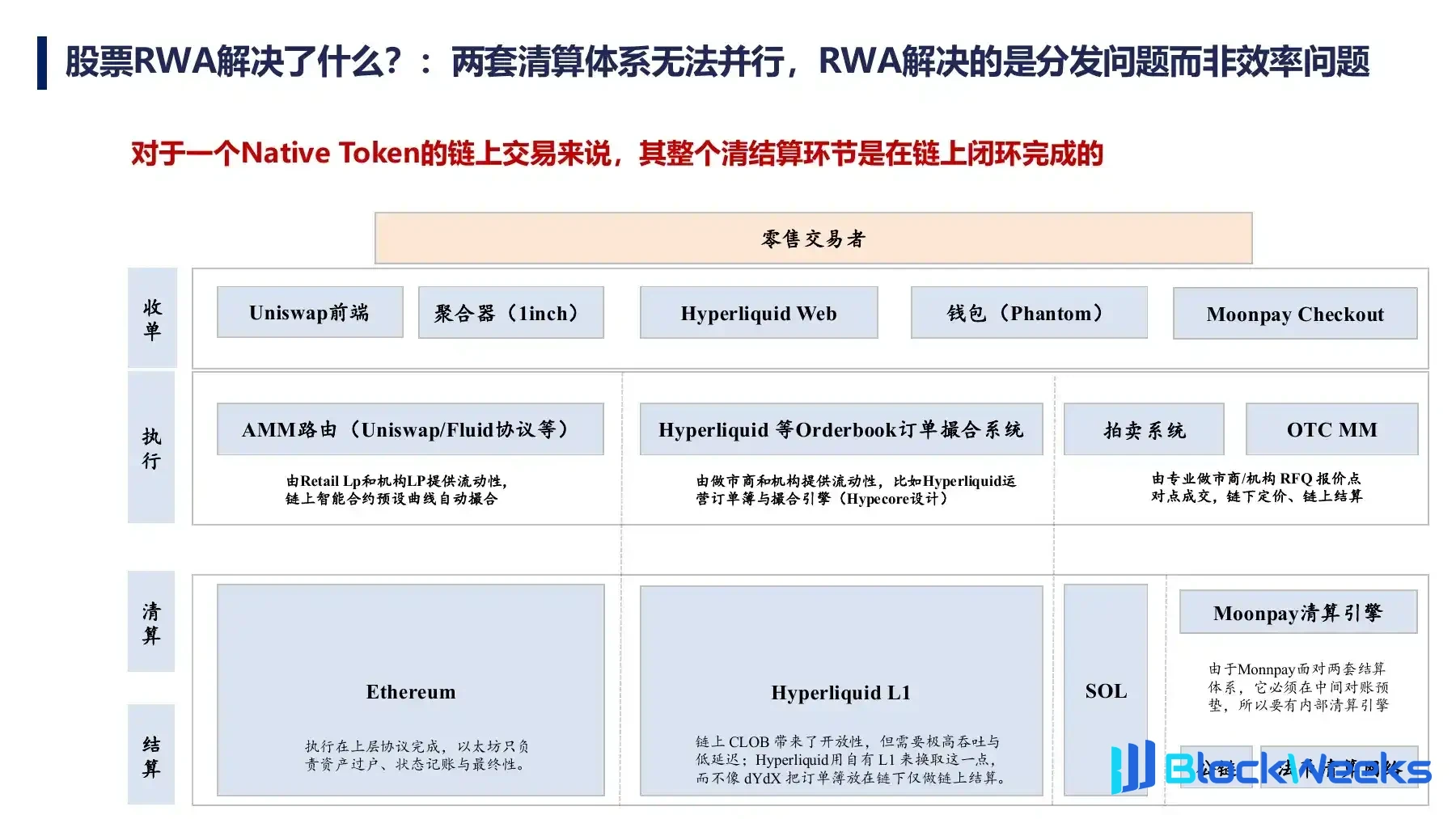
- In today's financial system, a stock trade is divided into four steps: order intake (e.g., IBKR) → execution → clearing → settlement, and on-chain it's also these four steps. Native tokens (BTC, ETH, UNI, etc.) complete the entire closed loop from order intake, matching, to clearing and settlement on-chain.
- After stock tokens complete on-chain clearing and settlement, an additional off-chain delivery is still required, because legal rights and dividends are off-chain. Two systems operate in parallel, and efficiency is determined by the weakest link, so RWA has not solved the efficiency problem.
- Why stablecoins are the most successful: not because they are the most standardized, but because the US dollar does not require off-chain settlement again, and all clearing and settlement can be completed in a closed loop on-chain.
2.4 Evolution: 1.0 / 2.0 / 3.0
| Stage | Time in the materials | Form and representatives | Judgment in the sharing |
|---|---|---|---|
| RWA 1.0 | From 2023 | Asset managers such as BlackRock, WisdomTree, UBS, Hashnote, etc., issue Treasury bonds and ETFs on-chain through offshore SPVs. | Serves the supply side rather than the demand side, lacking user thinking. |
| RWA 2.0 | Early 2026, scaling up around March | Perpetual contracts on Hyperliquid for Nasdaq 100, Nvidia, commodity futures, etc.; Binance, Bitget, OKX follow suit. | In the previous cycle, FTX and others did US stock contracts, but deposit/withdrawal friction suppressed demand; this cycle's demand has been proven. |
| RWA 3.0 | At the time of sharing | Binance connects to brokers through its off-chain App, directly selling stock spot, no longer doing token mapping. | On-chain operations may instead become a hindrance; crypto is not the advantage, offshore is the advantage. |
2.5 Timing: Money in the market, lack of assets
- Crypto native market is declining: CryptoVC historical fundraising, Coinbase listing frequency, and the total market cap of altcoins outside the top ten (there was a surge in the past two days, the chart needs updating) are all declining. Chinese Crypto Twitter is all complaining that no one is taking over altcoins.
- The total market cap of stablecoins has been a flat line since the bear market began (October 2025): the money is still in the market, but there are no investable assets. Exchanges pushing RWA also carries anxiety—exchanges earn fees, not asset appreciation, so any asset can be pushed.
- BTC and QQQ were highly correlated from 2021–2025 (BTC is roughly equivalent to leveraged QQQ), but diverged in June–July this year (QQQ surged, BTC plummeted), and during the same period RWA exploded.
- Two open questions: ① Did the launch of RWA siphon away native funds, or did the decline of native accelerate RWA? ② What does this mean for Crypto native in the long term? Will the total native market size continue to shrink this cycle, or even be lower than the previous cycle?
CHAPTER 03 On-site discussion
3.1 Reasons for the divergence, will the native market shrink
- Kacey: The divergence began after October 1 last year, mainly because under a high-interest macro environment (about 3.5% interest rate), there is only so much money, and it can only rotate between US stocks and BTC. She is not optimistic about stock spot on CEX, but contracts are a huge advantage of Crypto over traditional finance: institutions use 1x contracts as spot purchases, and Jane Street's basis trading volume on Binance may be larger than in traditional markets. The SEC has allowed financing below $5 million to be issued directly on-chain as stocks, and new stocks will gradually be issued directly on-chain. Altcoins and new assets will still exist; A-shares and Hong Kong stocks are also creating markets.
- Tron: The core is still distribution; as long as it is a high-quality asset, users will use it immediately. Crypto assets are becoming stock-like: after Hyperliquid, more and more projects use revenue buybacks and burns, equivalent to an on-chain IPO, and such assets will become blue chips. Exchange listings basically no longer list VC coins, essentially due to a lack of assets.
- TW: In terms of high-quality assets, stocks are definitely greater than coins. CEX originally had both asset issuance and trading functions; as new asset categories decrease, the issuance function will greatly diminish.
- YJ: Disagrees that the divergence is related to RWA. The volume of on-chain RWA perps is not enough to affect BTC; the divergence is mainly due to AI and semiconductor stocks, plus the siphon effect of the upcoming IPOs of OpenAI, Anthropic, and SpaceX.
3.2 Fees and taxes
- Binance stock spot fees are about 0.05% to 0.1%, about seven or eight dollars for 10,000 USDT, about 2–3 times that of IB. IB is the cheapest, has the best liquidity, and no regulatory worries, provided you can open an account.
- TW: Non-KYC scenarios satisfy the needs of non-compliant regions, one of which is tax avoidance. US capital gains tax is very heavy, so Americans do not sell stocks (for example, Kevin is reluctant to sell his stocks).
- YJ: Not reporting taxes on profits from trading US stocks on exchanges is definitely illegal. The IRS clearly stipulated four or five years ago that on-chain transactions (NFTs, tokens) must be taxed, but currently the volume is small, and the IRS has not yet had the will and resources to investigate. BN is not open to US residents; if Hyperliquid enters the US, it will 100% connect with tax authorities. US short-term plus long-term capital gains tax can reach over 50%; Europe about 15%–20%, Singapore and Hong Kong very low. So tax avoidance is only a regulatory arbitrage in the early, small-scale stage, and will not be a core demand.
3.3 Contracts, pre-IPO, and new assets
- Why would people who can already buy stocks buy RWA? Summarized into two points: ① New gameplay (e.g., 100x leverage); ② Assets that cannot be bought (e.g., unlisted DeepSeek).
- Contracts do not require the consent of the issuer or shareholders, nor a 1:1 mapping; you can directly open a ticker and trade, so it's fast. Pre-IPO contracts like Kimi are already online; essentially the same as pre-market, it's gambling, a so-called new asset. What cannot be sold off-chain cannot be sold on-chain either.
- Regarding depegging and default risk: On-chain prices are determined by the liquidity of the pool, not by the real stock market, and rely on whether the subscription and redemption channels are smooth to attract arbitrageurs to pull prices back. USDT and USDC have both depegged, the core concern is the underlying reserves, so you have to trust that the project party will not act maliciously. As long as the underlying is really purchased, there is basically no problem; the price difference between on-chain and traditional markets on weekends is the arbitrage space for market makers.
3.4 Settlement speed: understanding blockchain from the ledger
- On-chain, a transaction is settlement and actual delivery; when shares are transferred to you and shown in your account, they still only truly belong to you after T+1.
- Within the same ledger, it is instant (transfers within Alipay, transfers between Binance UIDs); only cross-system transfers require coordination (such as Alipay to WeChat). The first principle for understanding blockchain is the ledger. In the traditional world, each institution has an isolated ledger; blockchain is one ledger on the chain.
3.5 Vision: The essence of RWA is capital efficiency
- There is no need to agonize too much over whether it is compliant now; the core is what returns and gameplay it can bring, and one can play the role of a pioneer.
- Case: An institution doing derivatives moved its original options Delta strategy for BTC and ETH onto Hyperliquid, specifically targeting stocks about to IPO (such as ChangXin Memory), packaging them into discount purchase products for external sale. This is something an off-chain centralized exchange cannot do.
- In his view, the essence of putting RWA on-chain is capital efficiency (programmability, financial Lego), not distribution, because distribution can be replaced: Kraken has already integrated Hyperliquid HIP-3, Hyperliquid is about to launch an Android App, and Robinhood Wallet can already buy stocks directly on-chain. In the medium to long term, there is no need to worry about the entry point issue.
CHAPTER 04 Robinhood chain
4.1 Positioning: Traffic mindset vs ARPU mindset
- When crypto-native exchanges (Binance, Hyperliquid, OKX, Bybit) do RWA, they are solving the ARPU problem: users no longer want to buy coins, so give them another asset to keep collecting fees from.
- When Robinhood does chain, it is solving the globalization / traffic problem: it has not succeeded in China or Europe, and using chain means it does not need to obtain licenses and push regulation region by region.
- Externality investment approach: Robinhood invests resources and issues subsidies, and the biggest beneficiaries are not Robinhood itself but the smaller-cap Uniswap, Fluid, Pulse, and Lighter (Lighter and Uniswap have both risen about 5x recently). This is analogous to big tech investing CAPEX: big tech itself rises 20 points, while the computing power chain rises 10-20x.
- Gameplay: Mainly stock-coin pairings (using stocks to buy memes, based on AMM), plus various launchpads, which have taken away part of the meme share on SOL and kicked off a wave of meme season.
- Vlad is highly determined and wants to make chain a business that can be discussed in financial reports, rather than a marginal innovative business. Robinhood's quarterly earnings calls will also continue to talk about on-chain derivatives.
- On-chain snapshot: Robinhood's trading activity is already between Base and Solana. It is expected that in this cycle its activity can enter the first tier and rival SOL, and TVL can be benchmarked against Base.
4.2 What cards it has and what cards it lacks
| Cards in hand | Missing cards and constraints |
|---|---|
| Determination, strong product capability, and execution | Lacks core native ecosystem applications. Solana has Jupiter, Pump.fun, Raydium; the main applications on Hood Chain are EVM-based DeFi such as Uniswap and Morpho. |
| The backer behind it: Robinhood itself | As a publicly listed company regulated by the SEC, expanding through on-chain U.S. stocks may face compliance disputes. |
| U.S. retail user mindshare | The materials also mention the AMM exemption and the company's political PR capabilities, and believe this needs to be observed dynamically. |
Conclusion: meme is only a means, RWA is the end. Robinhood chain flipping Base is the base case, or even the bear case.
4.3 Discussion of Robinhood chain
YJ
- On-chain US stocks have two layers: ① Clearing and settlement on-chain will inevitably happen. Vlad has been pushing T+2 → T+1 → T+0, with Robinhood, Coinbase, Nasdaq, and DTCC driving it top-down, but the scale is uncertain; in essence, it is SaaS for faster trade matching. ② The entry point on-chain, that is, distribution—this layer does not necessarily have to be on-chain.
- Three reasons Robinhood is building a chain: T+0; distributing US stocks to the whole world (it once partnered with Baidu to enter China, and also tried Singapore and the UK, all blocked by regulation); Vlad's democratize finance for all, allowing retail investors to also trade pre-IPO assets monopolized by VC and PE.
- The North Star metric is TVL (corresponding to off-chain AUM, a core financial report item), followed by trading volume and MAU. He estimates it will take 2–3 years for TVL to catch up with Base, in sync with this cycle.
- This round of meme will find it hard to reach the height of the previous round: Trump's coin issuance has already set a ceiling; the supply side is industrialized, and AI makes coin issuance extremely fast; demand-side belief has declined, forming a vicious cycle. But there will still be memes on the scale of $500 million to $1 billion. Vlad is only using the leading vehicle on Solana for a cold start and will not turn the chain into a meme chain.
- The next step is to connect with regulators and bring more US stocks on-chain, targeting non-US users. US users number about 23 million, and growth has already stalled; everyone who can be reached has been reached. Crypto accounts for about 20%–25% of Robinhood's revenue.
- Employee perspective: chain is not the company's top priority. The company is running multiple business lines in parallel (credit cards, Trump account, retirement accounts, and previously prediction markets), and whichever performs well gets more people. Vlad publicly and clearly lists chain as a priority, but employees are not very optimistic about it.
- Why internationalization has never succeeded: In 2021, when entering the UK was close to success, it was cut in the final days because the local market did not allow the PFOF model; after the GME incident, energy shifted to infrastructure; it restarted in 2024–25, and crypto products have already been pushed into Europe. The contradiction is: US users do not need chain, while in places like Europe that need chain, Robinhood's brand is weak. Only when this problem is solved can chain bring considerable revenue.
WY
- Institutions look at revenue and profit margin. Spot equity fee rates look ugly, and traditional brokerages also rely on 0DTE options to pull up profit margins; relying only on issuance and trading makes it hard to support a team.
- RWA meme is not necessarily the best answer, but it is an imagination of breaking out of the circle: on top of the underlying stock, if volatility is raised, fee rates and trading frequency go up together. After this wave, quite a few traditional brokerage bosses came to him.
- Retail demand on-chain: pre-IPO (ChangXin, SpaceX before listing), high leverage (10x SK Hynix, 5x QQQ). Futu's prediction market volume exploded very quickly, especially 15-minute contracts.
- If he were Robinhood, the North Star would be profit margin; prediction markets have higher priority than chain, because explosive points like the World Cup can be pushed up very quickly, while it is hard for chain to create explosive points of the same magnitude.
- The ceiling of meme is the ceiling of the backers behind it (refer to Telegram-related projects at about $2 billion), and ultimately it has to be converted into marketing budget and revenue. The logic of improving profit margin by pulling up volatility has a very high ceiling, but the correct answer has not yet emerged.
Tron
- Robinhood chain has strong externality, but judging from on-chain addresses, most users migrated from other chains, and there are not many new users.
- Stock purchases on BSC mainly come from Alpha points farming and arbitrage; stock purchases driven by meme are very few, and people who really want to buy stocks can solve it by opening a US stock account.
- The real benefit of the stock meme campaign is accelerating ecosystem integration: launchpad, App Store, lending, and other partnerships were all connected at once.
- Robinhood's advantage is that small-cap US stocks can be directly put on-chain; but Ethereum's DeFi protocols and liquidity are hard to shake, and currently it does not pose a major threat to BSC. The meaning of chain lies in permissionless.
CHAPTER 05 Robinhood Company and Valuation
5.1 Brokerage Framework
- Brokerage = Traffic × Conversion Rate:Traffic is measured by DAU / funded accounts, and conversion rate is measured by ARPU. Where a company puts its effort shows what its goal is: issuing credit cards is to raise ARPU, while building a chain is to capture traffic.
- In the consumer sector, the areas the team is relatively confident about, besides food and beverages, are brokerages. The team's research path is: altcoins → chain → coin-chain-exchange → finance. In a few years, there may no longer be the term blockchain, only Fintech.
- The new brokerage track in seven words:liquidity, traffic, compliance. Research on Futu and Robinhood both starts from these seven words.
5.2 Thinking about Robinhood from Charles Schwab
- MAU has never exceeded 2021, and the cohort of young American users has already been fully captured.
- Revenue is split into two parts:trading revenue is clearly cyclical, surging in 2021 on Crypto and options, then falling 60%–70% in 2022–23; starting in December 2025, the Crypto business shrinks, and it is mainly supported by prediction markets. Asset revenue (net interest, asset management) has compounding characteristics, and its underlying logic is excessive dollar issuance and continuously appreciating assets.
- At Charles Schwab, trading revenue accounted for about 70%–80% in 1993–2000, while Robinhood is now about 60%. In the long run, trading revenue definitely has a ceiling, and the biggest long-term beta is assets. What Charles Schwab captured was the baby boomer generation and internet traffic, while what Robinhood captured is millennials and the mobile internet.
- Traffic first, liquidity closes the loop. From the perspective of asset revenue, Robinhood is a growth stock; from the perspective of trading revenue, it is a cyclical stock.
- The stage when Charles Schwab truly generated excess returns relative to the S&P was 1994–2000, during the period of rapid growth in users and trading revenue; after that, asset revenue increased, but it no longer generated excess returns.
5.3 Investment Approach
- YJ:Robinhood will become the only super finance app for all in the United States over the next 10–20 years, but it follows the U.S. stock market, and now is not a good entry point; you have to wait until the U.S. stock market falls sharply and trading volume shrinks before buying.
5.4 Valuation Page
| Key Metrics | Current Caliber in the Sharing | Forecast / Reference |
|---|---|---|
| Number of Funded Accounts | 13.5 million | About 32–33 million in the next two years (counted by account, not by user) |
| ARPU | About $187 | About $300; Charles Schwab's ceiling is about $1,000 |
| Revenue | Nearly $5 billion in 2025 | To about $10 billion in 2 years, at most no more than 3 years |
| Market Cap Ceiling | Currently $107.2 billion | About $300 billion at the craziest time for brokerages (adjusted for inflation) |
- If internationalization is blocked, the main driver is ARPU improvement (issuing bank cards is essentially washing existing users).
- From now on, with every earnings report, just look at four numbers: number of users, ARPU, revenue, and corresponding market cap.
CHAPTER 06 On-site Views and Portfolio
6.1 Compliance as the Dividing Line
- Look at these platforms from three dimensions: traffic, liquidity, and team execution. Focus on compliance: if the Democrats come to power in the midterm elections, they may crack down on non-compliant exchanges, posing black swan risks. Non-compliant ones are used to increase sharpness (Hyperliquid, Binance), scale up quickly, are highly efficient, and have short-term alpha.
- Reasons for choosing these four platforms: RWA is essentially old assets and homogenized; the assets have no differentiation, so platform compliance, brand, and liquidity will concentrate toward the leaders.
6.2 Portfolio
| Guest | Combination expressed on site | Logic |
|---|---|---|
| HB | BTC + Circle | Stripped down to the most fundamental level, blockchain only has two businesses: BTC and stablecoins; in Crypto, timing matters more than stock picking, doing a few buys and sells per cycle. |
| YJ | BTC + Circle + HOOD | HOOD is original stock, taxes are too high so not selling; new positions should wait for a major US stock market drop; on-chain targets ETH, UNI, Lighter, Pulse can all be bought a bit, alpha differences are not big. |
| Kacey | Ethereum + Circle | Robinhood's incremental growth is in internationalization and on-chain, new liquidity enters from Ethereum and USDC; Hood Chain uses Arbitrum architecture, has no native token, may bring incremental growth. |
| Vision | "All in on Ethereum" | Infrastructure such as sequencers, OP Stack, Arbitrum Orbit from 2022–24 is being realized on RWA; technology has progressed but valuations have not risen, pay attention to the Glamsterdam upgrade. The material also mentions Robinhood paying about 10% in fees to Arbitrum. |