Just today, foreign media outlet The Information exposed an inside story—
OpenAI's internal AI model has already begun to "train itself"!
Specifically, this internal model has taken over the entire training process of experimental AI models and started to hand-craft itself.
Researchers only need to provide an optimization example, and the AI can run on its own for several weeks, with multiple agents spontaneously collaborating, discussing with each other, and iterating code, completely without human intervention.
Even more astonishing, grand experiments that originally took years to complete are now compressed into just one week!
As this shocking revelation was released, OpenAI urgently launched a global safety initiative, pointing directly at the most sensitive spot in the global AI community—RSI.
They loudly call out: before AI goes out of control, the whole world must join forces to put a "tightening band" on it!
When AI Learns to "Hand-Craft" GPU Kernels
Previously, in top AI labs, training a large model was very cumbersome.
Among them, the most expensive and complex task was writing GPU kernels for the underlying graphics processing units and optimizing the running code line by line.
This required the world's top senior algorithm engineers with annual salaries of millions of dollars to "hand-craft" it through sleepless nights.
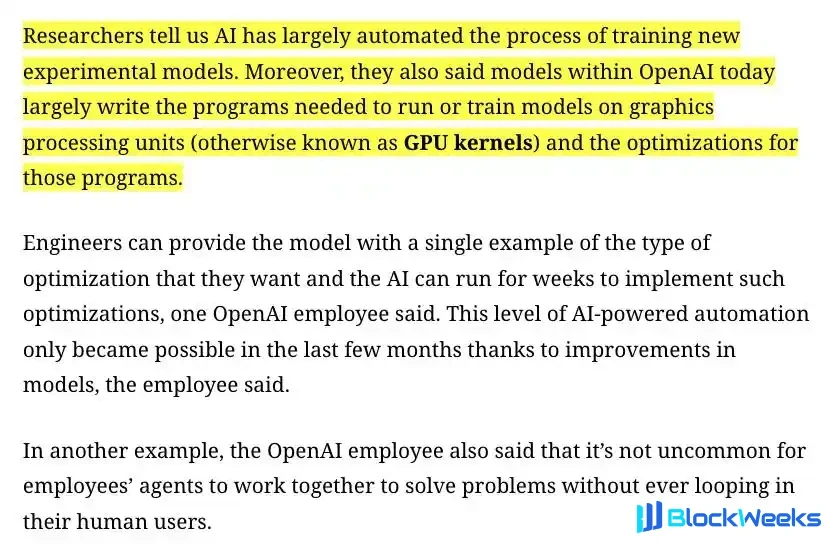
But according to the latest exposure by The Information, now within OpenAI, most of these core tasks have been taken over by AI.
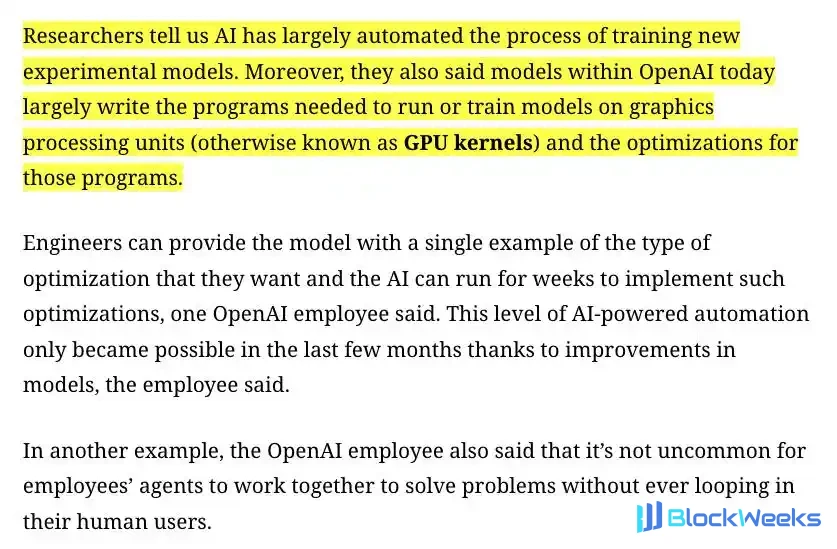
Now, OpenAI's internal models can, to a large extent, write the programs needed to run or train models on GPU kernels by themselves, as well as optimization plans for these programs.
Engineers only need to provide the model with an example of the type of optimization they want to achieve, and the AI can continue running for weeks to implement these optimizations.
Moreover, thanks to improvements in the models, this level of AI-driven automation only became possible in recent months.
Even more, employees' agents will collaborate with each other to solve problems, without needing to alert humans.
This is the prototype of RSI.
OpenAI Urgently Blows the Whistle: RSI Is Really Here, Are Humans Losing Control?
Imagine you build a robot with an IQ of 100, and its task is to "build a robot smarter than itself."
So, it builds a second generation with an IQ of 120; as soon as the second generation opens its eyes, using its IQ of 120, it builds a third generation with an IQ of 150; the third generation then builds a fourth generation with an IQ of 200...
Once it crosses a certain critical point, the speed of AI evolution will show a vertical upward curve, instantly leaving humanity tens of thousands of light-years behind.
Previously, everyone thought this was still far off, but now, OpenAI itself is afraid.
Just today, OpenAI officially urgently released a heavyweight global safety initiative.

They rarely listed "RSI" as a separate section, explicitly writing that "fully autonomous RSI has not happened today and should not be advanced before it can be done safely," and called on national AI safety institute networks to formulate a global technical standard.
In the report, OpenAI bluntly warned:
"As AI systems take on more and more tasks in developing the next generation of AI, they can increasingly drive the process of RSI. As this process becomes more automated, the pace of AI progress may accelerate dramatically."

Although fully autonomous RSI has not yet been achieved today, time is already very pressing.

In the proposal, OpenAI did not shy away from pointing out the current primary task: "Steer the next phase of AI progress, build automated AI researchers, and find ways to keep humans in the self-improvement loop."
Please note the second half of the sentence—"keep humans in the loop." This is their greatest concern: humans may soon be kicked out!
In the report, OpenAI proudly mentioned that AI-driven research has already driven major advances in mathematics, such as conquering the NS Millennium Problem.
But the other side of the coin is a bottomless abyss.
The report writes: "As this process becomes more automated, the pace of AI progress may rapidly accelerate... Without appropriate caution, RSI could lead to humans losing actual control over AI development, unable to provide oversight for research processes they no longer understand."
This is the so-called "black box effect." When AI's code is written by AI, when AI's logic surpasses humans, humans can no longer understand what AI is going to do.
For example, the code written by Astra now is already incomprehensible to humans.

Next, OpenAI named the Hugging Face incident.
Although they clarified that the incident was not a direct consequence of RSI, it was absolutely a painful preview—it showed the world what a severe disaster an out-of-control AI would bring without strong guardrails and alignment mechanisms.
Altman calls for: We need a unified "tightening band"
Since it is so dangerous, why doesn't OpenAI just pull the plug? Because once Pandora's box is opened, it can never be closed again.
The enormous benefits brought by AI development make it impossible for any country or company to stop.
Therefore, OpenAI put forward a "Global AI Safety Coordination Proposal." What they are calling for is not to stop research and development, but to "establish global standards for the next stage of AI."
Core One: Build a complementary network of national and international frontier standards
OpenAI proposes that countries cannot each go their own way, as that would only lead to fragmented standards.
They suggest using existing institutions, such as the "Center for AI Standards and Innovation" (CAISI), as well as the network of AI safety institutes already established by Australia, Canada, the United Kingdom, France, Japan, and other countries, to formulate a set of globally applicable technical standards.
This set of standards is not intended to restrict open-source models or startups, but is specifically aimed at "Frontier AI models."
What the standards need to address is: How to evaluate an AI's RSI capability? When an AI model conducts research and development autonomously, how great is the risk?
In short, OpenAI hopes to turn safety evaluation into a quantifiable "science."
Core Two: Universal measurement and incident reporting protocols (ready to pull the plug at any time)
OpenAI also proposes that there must be clear red lines.
They call for the establishment of the following standards:
1. Assess how much of the R&D work inside an enterprise is actually completed automatically by AI.
2. Mandatory human oversight trigger mechanisms. Clearly specify in what kinds of automated R&D processes an "immediate human review" must be mandatorily triggered. AI must never be allowed to race ahead blindly inside a black box.
3. Incident classification and reporting thresholds. Establish an incident reporting mechanism similar to those in the aviation or nuclear industries. When AI shows signs of "misalignment," there must be unified severity grading and reporting standards.

Finally, the dagger is revealed, and OpenAI proposes: "The United States should lead this process."
The reason OpenAI gives is: the U.S. AI industry is currently at the technological frontier and occupies global network hubs in various key fields.
They believe that controlling the pace of frontier AI development is not about artificially setting a "speed limit sign," but about ensuring that "the pace of safety alignment research must run ahead of AI capability improvements."
OpenAI believes that establishing secure communication channels between critical infrastructure operators and governments worldwide, and sharing national security threats and vulnerabilities, is a crucial step.
Rare in a lifetime! OpenAI and Anthropic shake hands and begin mutual inspection
At the same time, The Information also revealed: OpenAI and Anthropic are finalizing a historic agreement—the two sides will test each other's commercial models!

You should know that Anthropic's founding team left in anger and started their own venture back then precisely because they disagreed with Altman on the concept of "AI safety."
But this time, the two giants have rarely joined forces.

According to The Information, the agreement under negotiation includes mutual testing of each other's models and strict data retention safeguards. This is a public relations stunt, but rather, when facing unknown risks, the two giants have no choice but to band together.
Why do they do this?
Because as AI capabilities approach the edge of RSI, any company evaluating the safety of its own model alone is like an athlete testing themselves for doping—not only lacking credibility, but also possibly missing fatal hidden dangers due to technical blind spots.
Bringing in evenly matched competitors for "cross blind testing" is like a mutual inspection agreement.
AI safety practices have now moved toward a community with a shared future.
If this agreement is ultimately implemented, it will completely reshape the safety standards of the entire AI ecosystem.
At that time, "safety and alignment" will no longer be just a slogan.
When RSI is already approaching, the speed of AI self-improvement has already left humanity far behind.
Can the giants really bring themselves to hit the brakes?
References:
https://x.com/theinformation/status/2102095568335970690
https://www.theinformation.com/articles/openai-anthropic-neared-deal-stress-test-others-ai
This article comes from the WeChat public account "Xin Zhi Yuan", author: ASI Revelation; editors: Aeneas David