
Overview
South Korea is moving its tokenized-securities framework from legislation into production infrastructure, with Korea Securities Depository (KSD) preparing a platform designed to connect multiple distributed ledgers, including Avalanche, Hyperledger Besu and Hyperledger Fabric. Samsung SDS, which previously worked on KSD's testbed, is building the production platform with completion targeted for February 2027, alongside the implementation of Korea's revised legal framework for tokenized securities.
The most important point is not that Avalanche is being used. KSD is not selecting Avalanche as Korea's single national securities blockchain. Instead, South Korea is developing a regulated securities architecture in which different approved ledgers can coexist while KSD continues to provide an authoritative layer for issuance controls, rights management and reconciliation. This makes the project less about choosing a winning blockchain and more about solving the harder institutional problem of maintaining consistent legal records across multiple technological environments.
KSD tokenized securities therefore provide a useful model for how capital-market tokenization may evolve. Traditional securities systems need one reliable answer to questions such as how many securities legally exist, who owns them and whether rights have transferred. Distributed ledgers can improve programmability and market connectivity, but they also create new reconciliation challenges. Korea's approach attempts to combine blockchain flexibility with the institutional discipline of a central securities depository.
Key Takeaways
- KSD's production platform is designed to support Avalanche, Hyperledger Besu and Hyperledger Fabric rather than one exclusive chain.
- Samsung SDS is building the production system with completion targeted for February 2027.
- KSD remains central to issuance-volume controls, securities-rights management and record reconciliation.
- The blockchain does not replace the securities register; it becomes part of the securities infrastructure.
- The real institutional challenge is keeping legally authoritative records consistent across multiple ledgers.
What Is KSD Actually Building?
Samsung SDS won KSD's security-token platform implementation project after previously completing consulting and testbed work. The production system is intended to connect distributed-ledger activity with KSD's existing electronic-securities infrastructure, including real-time monitoring of how many tokenized securities are issued and circulated.
That function is critical because tokenization does not eliminate the need for authoritative securities records. In a conventional market, a central register determines the legally recognized number of securities in existence and records the rights attached to them. Once those securities can also exist on distributed ledgers, the market needs a mechanism to ensure that blockchain records do not diverge from the legally recognized issuance record.
KSD tokenized securities are therefore best understood as a layered architecture. Distributed ledgers can record issuance and transfers, while KSD preserves the institutional controls needed to confirm total supply, ownership rights and consistency with Korea's regulated securities system. Under the Financial Services Commission's proposed framework, the relevant ledger infrastructure is also intended to involve KSD and multiple account-management institutions rather than a single issuer operating an isolated blockchain database.
For broader context on the project, see the MEXC On-Chain Daily Report: Solana Alpenglow Confirmed for October 21 Launch, which also covers KSD's multi-ledger platform.
Is Avalanche Becoming Korea's National Securities Blockchain?
No. Avalanche is one supported ledger technology, not an exclusive national blockchain.
KSD's technical direction includes Avalanche alongside Hyperledger Besu and Hyperledger Fabric. This is an important distinction because the market could otherwise misread Avalanche's inclusion as evidence that South Korea has selected one public blockchain for the national securities system.
Avalanche's role is still strategically meaningful. Its inclusion shows that a public-chain ecosystem can participate in regulated capital-market infrastructure rather than institutional tokenization being restricted entirely to permissioned enterprise ledgers. But the larger decision is Korea's willingness to support different technical environments under one securities framework.
That is the more important precedent.
Why Does Korea Need Multiple Ledgers?
Financial institutions rarely adopt blockchain from the same starting point. One securities firm may prefer an EVM-compatible enterprise environment such as Hyperledger Besu, another may favor Fabric's permissioned architecture, while another may see value in Avalanche's broader tokenization ecosystem. Requiring every market participant to abandon existing infrastructure and move to one state-selected chain could reduce some interoperability problems, but it would also create technology concentration, migration costs and dependence on one architecture.
Korea's model instead separates the underlying ledger from the authoritative securities framework. An issuer or financial institution can use an approved distributed ledger, but the resulting issuance still needs to fit within KSD's broader system of rights recognition and supply control. This creates a structure in which technological diversity is tolerated as long as legal consistency is preserved.
That approach becomes more important as tokenized markets scale. A single-chain pilot is relatively simple. A national market containing stocks, bonds, funds and fractional investment securities across multiple institutions is much harder. The core question becomes how different ledgers can remain synchronized with one authoritative legal state.
Avalanche, Besu and Fabric Serve Different Institutional Needs
The three ledger technologies currently associated with KSD's technical direction have different design strengths. KSD has not publicly assigned each one a single exclusive role, but their architectures help explain why a multi-ledger framework can be attractive.
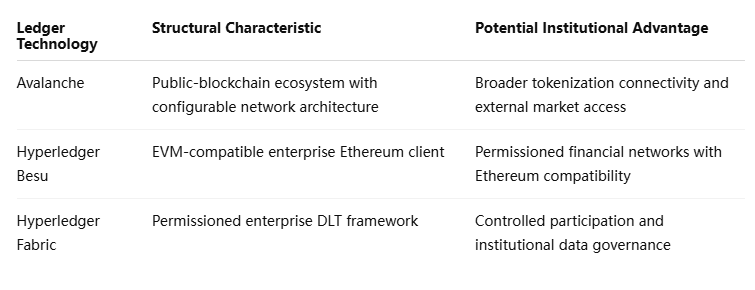
The important distinction is between open-market connectivity and controlled institutional environments. Public-chain technology can provide composability and broader access, while permissioned systems can provide tighter control over participants, transaction visibility and data governance.
A regulated securities system may need both. The challenge is not deciding which blockchain is universally superior, but ensuring that each approved environment can comply with the same rules governing issuance, investor rights and record integrity.
Why KSD Matters More Than the Blockchain Brand
Tokenization discussions often focus on where an asset is issued, but regulated securities markets care more about whether the token corresponds to an enforceable legal claim. That creates a series of questions that blockchain technology alone cannot answer.
Who verifies the total number of securities issued? Which record controls if a blockchain ledger and a securities registry disagree? How are dividends, interest payments and voting rights synchronized? How is duplicate issuance prevented if similar securities appear across multiple ledgers? What happens when one network becomes unavailable?
KSD sits at the center of those questions. Its planned real-time monitoring of total issuance and circulation indicates that Korea is treating tokenized securities as an extension of the existing securities infrastructure rather than as ordinary crypto tokens whose validity depends only on control of an onchain address.
Institutional tokenization is fundamentally a record-consistency problem before it is a token-issuance problem.
This is why KSD's role remains critical even as more activity moves to distributed ledgers.
What Changes When Korea's Rules Take Effect in 2027?
South Korea's revised tokenized-securities framework is scheduled to take effect on February 4, 2027. The legal changes allow securities issuance and circulation information to be recorded using distributed-ledger technology and are designed to support more than niche fractional-investment products. Over time, the framework can also cover traditional securities categories such as stocks, bonds and funds.
However, February 2027 should not be interpreted as the date when the entire Korean securities market moves onchain. The rollout is phased. The first stage is about establishing regulated issuance, account-management infrastructure, ledger participation and rights reconciliation. Broader trading and settlement models can develop later as the market gains operational experience.
This phased approach is significant because tokenization affects more than record storage. Investor protection, custody, settlement, corporate actions and market surveillance all need to remain enforceable as distributed ledgers become part of the securities infrastructure.
Can Multi-Ledger Securities Avoid Liquidity Fragmentation?
Technically, yes, but multi-ledger compatibility does not automatically create unified liquidity.
Supporting different ledgers gives issuers and financial institutions flexibility, yet it can also divide trading activity across networks, venues, custody arrangements and settlement models. KSD may be able to reconcile legal issuance without automatically making every token seamlessly transferable across every chain.
The long-term value of the system will therefore depend heavily on interoperability. If investors can move positions efficiently while KSD maintains a single authoritative legal record, the multi-ledger model could combine flexibility with market integrity. If each network becomes an isolated liquidity pool, the operational benefits of supporting multiple technologies could be offset by fragmentation.
The quality of gateways, shared standards and reconciliation rules may ultimately matter as much as the underlying chains.
MEXC View: The Institutional Winner May Be the Coordination Layer
Korea's model suggests that institutional tokenization may not converge on one universal blockchain. Banks, brokers and securities infrastructure providers already operate different systems, and national markets have little incentive to expose an entire capital-market architecture to one network or technology provider.
The more durable value may therefore sit above the individual chain. Infrastructure capable of maintaining issuance limits, synchronizing ownership records and connecting multiple approved ledgers becomes strategically important once tokenized assets exist across different technical environments.
This changes the way institutional blockchain adoption should be evaluated. The most important question may not be which chain hosts the most securities, but whether tokenized assets can move across different systems while preserving one coherent legal state.
If Korea's model works, interoperability and authoritative record management could prove more important to institutional adoption than blockchain exclusivity.
Risks and Limitations
The multi-ledger approach offers flexibility, but it also creates additional layers of complexity.
- Record-consistency risk: blockchain data and legally authoritative securities records must remain synchronized.
- Interoperability risk: supporting several technologies does not guarantee seamless cross-ledger transfers.
- Operational risk: gateways, nodes and reconciliation systems add new dependencies.
- Privacy risk: securities ownership data cannot simply be exposed on public infrastructure.
- Technology-specific risk: each ledger introduces different software and upgrade assumptions.
- Liquidity fragmentation: activity can split across chains, venues and settlement systems.
- Rollout risk: planned capabilities should not be treated as fully operational before the 2027 implementation.
There is also an important settlement distinction. Tokenized securities can be recorded on distributed ledgers without the cash leg of a transaction necessarily settling onchain. Therefore, “blockchain securities infrastructure” should not automatically be equated with fully atomic onchain settlement.
KSD Tokenized Securities Make Coordination the Real Test
KSD tokenized securities illustrate a more mature version of institutional blockchain adoption than simply issuing assets on a public chain. South Korea is building infrastructure in which different distributed ledgers can participate while KSD continues to preserve issuance controls and legal record consistency.
Avalanche's inclusion is important because it demonstrates that a public-chain ecosystem can become part of regulated securities infrastructure alongside enterprise technologies such as Hyperledger Besu and Fabric. But the deeper decision is Korea's willingness to support multiple ledgers rather than one national blockchain.
That architecture makes KSD more important, not less. The depository must help maintain one coherent securities record while issuance and transaction activity become technically distributed. The real challenge therefore shifts from creating tokens to ensuring that multiple tokenized environments cannot create duplicate claims, conflicting ownership records or fragmented legal states.
The February 2027 rollout will test whether this structure works in production. If it does, Korea could provide a useful model for other markets considering tokenization: institutional blockchain adoption may not require every asset to live on the same network. It may require infrastructure capable of making different networks behave like one legally coherent capital market.
Sources
MEXC internal link used:
https://www.mexc.com/learn/article/mexc-on-chain-daily-report-solana-alpenglow-confirmed-for-october-21-launch
MEXC background analysis on Korean tokenized securities:
https://www.mexc.com/crypto-pulse/article/hanwha-builds-a-tokenized-securities-platform-on-avalanche-as-south-korea-s-february-2027-rules-approach-149946
Samsung SDS — KSD Security Token Platform Implementation:
https://www.samsungsds.com/en/news/tk-260508.html
Financial Services Commission — Tokenized Securities Policy Roadmap:
https://fsc.go.kr/eng/pr010101/87653
Financial Services Commission — October 2026 Proposed Rules:
https://www.fsc.go.kr/eng/pr010101/87834
Financial Services Commission — Legal Ground for Security Tokens:
https://fsc.go.kr/eng/pr010101/86076
Risk Disclaimer: This article is for reference only and does not constitute investment advice. The cryptocurrency market is highly volatile. Please make decisions cautiously based on your individual circumstances.