In brief
- Google DeepMind found no statistically significant acceleration in the pace of its AI progress after April 1, 2026; its capability index has climbed a steady 0.1 points a month.
- Most production code at the lab is now more than 75% AI-written, but about 88% of code changes still need humans to steer the AI or write code themselves.
- Gemini 4 Argon solved roughly half of the internal research engineering tasks it finished, far below the 90% score DeepMind treats as a red flag for full automation.
Google DeepMind went looking for proof that AI is speeding up the development of AI itself. It didn’t find any.
In the safety report for Gemini 4 Argon, its most powerful model, the lab concluded AI research isn’t moving any faster, even though AI now writes most of the code DeepMind’s engineers ship.
The finding cuts against the scenario that has spooked AI executives into calling for a slowdown. It’s called recursive self-improvement: an AI builds a smarter version of itself, which builds an even smarter one, until progress outruns anyone’s ability to test, regulate, or switch it off—what the report calls “a situation where existing guardrails are severely inadequate.”
“There is currently no significant end-to-end acceleration of ML R&D, AI-driven or otherwise,” Haydn Belfield, a Google DeepMind researcher who worked on the assessment, wrote in a thread on X. “We therefore conclude that the risk from AI-driven ML R&D is currently low.”
ML R&D is shorthand for machine learning research and development, the work of building new AI models.
1/9
In the Gemini 4 Argon Safety & Security Report, we published our first holistic empirical assessment of ML R&D automation and acceleration inside Google DeepMind — combining capability benchmarks, a macro capability index, data on AI-written code and trajectory outcomes, and… pic.twitter.com/Vr8Q5Obbsp— Haydn Belfield (@HaydnBelfield) October 14, 2026
DeepMind tracks the issue because “AI could speed up frontier capability gains faster than safety, governance, and societal adaptation can keep pace,” Belfield wrote. More automation also means giving AI agents broader access to company systems, more room for a misaligned model (one pursuing goals its makers never intended) to cause trouble.
To measure progress, the team built GCI v1, an internal index that blends the scores of 123 AI models across 92 benchmarks into a single number per model—think of it as an IQ score for AI. “Frontier Gemini capabilities have improved at a remarkably steady pace of ~0.1 GCI points/month,” Belfield wrote.
In the report’s chart of that index, Gemini 1.5 Pro sits near 0.5 points in late 2024 and Gemini 3.8 Flash just above 2.9 in September 2026, with nearly every release hugging a straight line. Argon is the one dot poking above it, at roughly 3.3, though its error bar (the range its true score could plausibly fall in) stretches low enough to touch the trend.
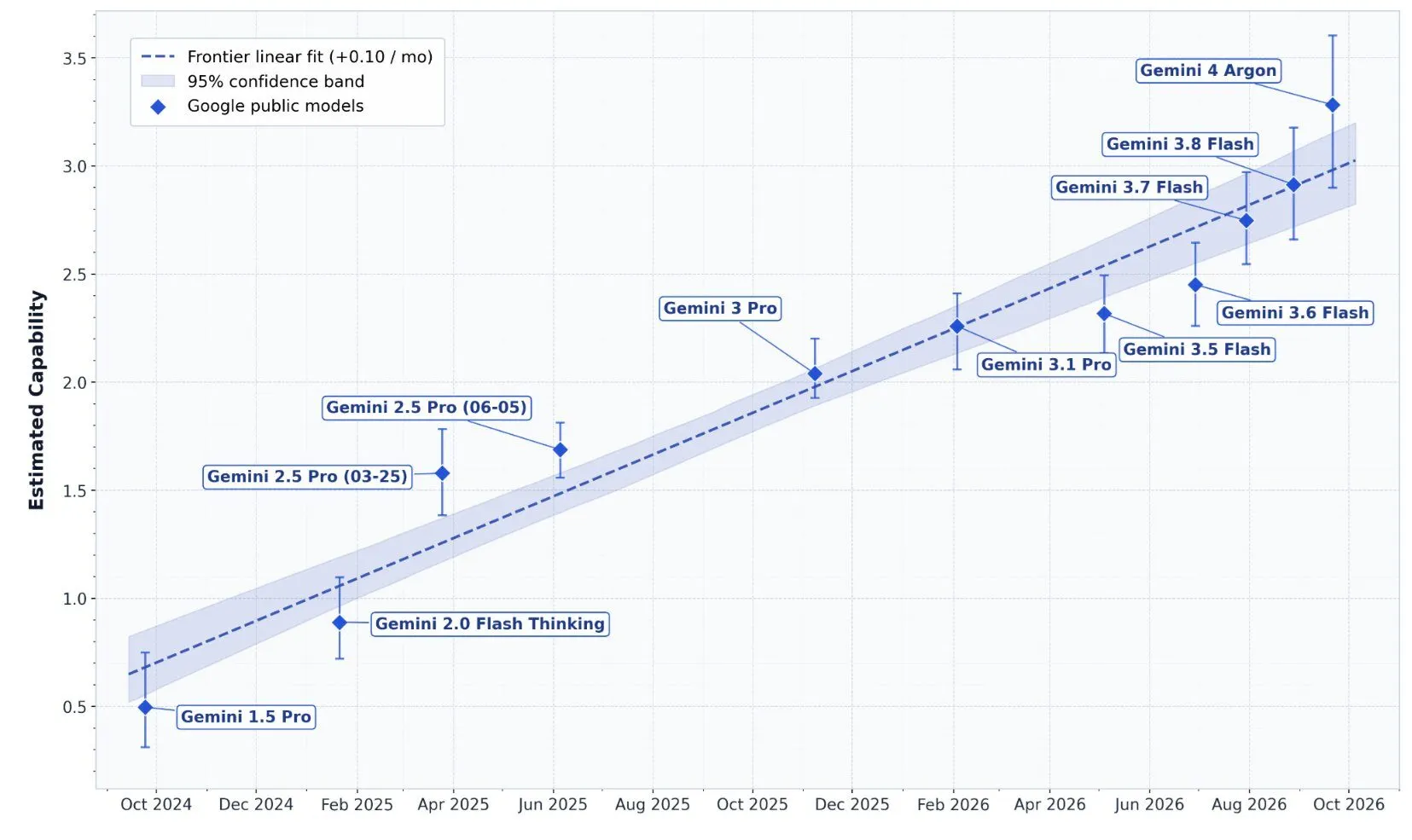
“While Gemini 4 Argon sits above [the] trend, we trace this to increased compute and organizational investment rather than reflecting AI-driven acceleration,” Belfield wrote. Google unveiled Gemini 4 Argon on September 30.
Most production code at DeepMind is now more than 75% AI-written, and the share of fully delegated pull requests (bundles of code changes submitted for review before they go live) rose from 7.5% to 11.9% between April and September. But “~88% of pull requests still require multi-turn human steering or human code authorship—and code changes remain subject to human review before submission,” Belfield wrote.
A survey of 12 senior DeepMind leaders and researchers found automation is highest in “well-specified, verifiable execution tasks and lowest in open-ended scientific ideation, novel experimental design, diagnosing subtle training instabilities, and long-horizon research taste.” In plain terms, AI is great at executing instructions and bad at deciding which ideas are worth chasing.
DeepMind also reviewed 1,389 logs of Argon working as an agent inside the company. The bigger the task, the less likely the model finished it alone and the more often a human stepped in.
The report landed a month after Anthropic CEO Dario Amodei argued that recursive self-improvement is already accelerating, a warning Sam Altman and Elon Musk endorsed and one that sent chip stocks down almost 6%. Days earlier, former Anthropic engineer Jacob Coxon had quit the industry, warning AI could “kill us all by the end of the decade.”
DeepMind’s numbers cover only its own lab, and the same report says it can’t rule out that an unrestricted Argon crosses its danger thresholds for cyberattacks and bioweapons information.
Join 72,000+ readers
Create an account to save your articles.
Add Decrypt as your preferred source to see more of our stories on Google.