

Bitcoin price has recovered above $80,000 at the time of reporting, gaining more than 1% over 24 hours as traders assess improving exchange flows, uneven ETF demand and geopolitical uncertainty ahead of the Federal Reserve’s interest rate decision.
Summary
- Bitcoin price recovered above $80,000 before the Fed’s October 28 decision, but remains below important resistance levels.
- U.S. spot Bitcoin ETFs recorded $110.3 million in inflows on October 26 after two sessions of withdrawals.
- Santiment reported net exchange outflows of 14,942 BTC, the largest daily withdrawal in five weeks.
- Reports of possible U.S. military action against Iran have raised concerns about oil prices and inflation.
- Bitcoin price must reclaim $81,400–$82,500 to strengthen its recovery, while $80,000 remains immediate support.
According to crypto.news market data, BTC was trading near $80,800 after moving between $79,416 and $81,159 over the past day. Trading volume stood around $23.5 billion, while its market capitalization remained above $1.62 trillion.
Despite the recovery, Bitcoin price has struggled to regain $82,000, leaving the latest advance short of a confirmed breakout.
The rebound follows a difficult week for institutional demand, although a return to positive ETF flows and substantial exchange withdrawals have provided some support.
Meanwhile, fresh reports of possible U.S. military action against Iran have introduced another source of uncertainty for financial markets.
Bitcoin price rebounds as ETF flows turn positive
Institutional flows improved on October 26 after two consecutive sessions of heavy withdrawals from U.S. spot Bitcoin ETFs. The funds attracted approximately $110.3 million, primarily through BlackRock’s IBIT.
The recovery followed combined outflows of roughly $773.5 million on October 22 and 23, including $635.6 million on the first day. As crypto.news reported on Bitcoin’s decline, the withdrawals coincided with leveraged liquidations and growing concerns over the Federal Reserve’s monetary policy outlook.
However, October 27 data from SoSoValue showed a smaller net inflow of approximately $24.54 million, suggesting that institutional demand remained uneven. Cumulative inflows stood near $57.32 billion, although daily purchases had yet to recover consistently from the previous week’s withdrawals.
On-chain activity presented a different picture. Santiment reported that approximately 14,942 BTC had left exchanges on a net basis, marking the largest daily outflow in five weeks.
Moreover, the analytics firm interpreted the withdrawals as a possible sign of reduced immediate selling pressure ahead of the Fed announcement. Exchange movements cannot establish whether holders intend to accumulate, however, because transfers can involve custody changes and transactions between platforms.
Federal Reserve decision adds uncertainty to Bitcoin outlook
The Federal Reserve’s October 28 policy announcement remains the central scheduled event for cryptocurrency traders, with attention focused on interest rates and Chair Kevin Warsh’s comments about inflation.
As previously outlined in the weekly economic calendar, investors face the Fed decision alongside third-quarter U.S. GDP figures, September personal consumption expenditures inflation data and earnings from major technology companies.
Markets expect policymakers to hold the federal funds target range at 3.75%–4.00%, following September’s quarter-point increase. Commentary suggesting another rate increase in December could weigh on speculative assets, while less restrictive guidance might support Bitcoin’s recovery.
CryptoQuant research head Julio Moreno reported that Bitcoin’s spot demand continued to contract during October as U.S. investors remained largely inactive. He noted that the firm’s Bull Score Index had declined from 90 to 60, indicating less favorable market conditions.
Moreno identified the 365-day moving average at $77,585, the trader realized price at $74,041 and the 200-day moving average at $73,028 as levels worth monitoring if the market weakens.
Iran tensions raise geopolitical risks for Bitcoin price
Geopolitical developments have complicated the market outlook following reports of preparations for possible renewed military action against Iran.
According to an October 28 Wall Street Journal report, U.S. officials warned several Gulf countries about the possibility of a short military campaign after the November 3 midterm elections. The report described military preparations involving air-defense systems and regional forces, although no final decision to launch strikes had been announced.
The developments have revived concerns about oil prices and potential inflation pressure. Higher energy costs could complicate expectations for future Federal Reserve policy, particularly if tensions translate into sustained increases in crude prices.
Bitcoin’s response remains uncertain. Although some investors regard the cryptocurrency as an alternative asset during geopolitical turmoil, recent trading has shown sensitivity to changes in liquidity, interest rates and appetite for financial risk.
Bitcoin price prediction: Can BTC reclaim $82,000?
Bitcoin’s daily technical structure remains cautious despite its recovery above $80,000. The chart readings place BTC near $80,915, below its nine-day moving average of $81,416 and 21-day moving average of $81,905.
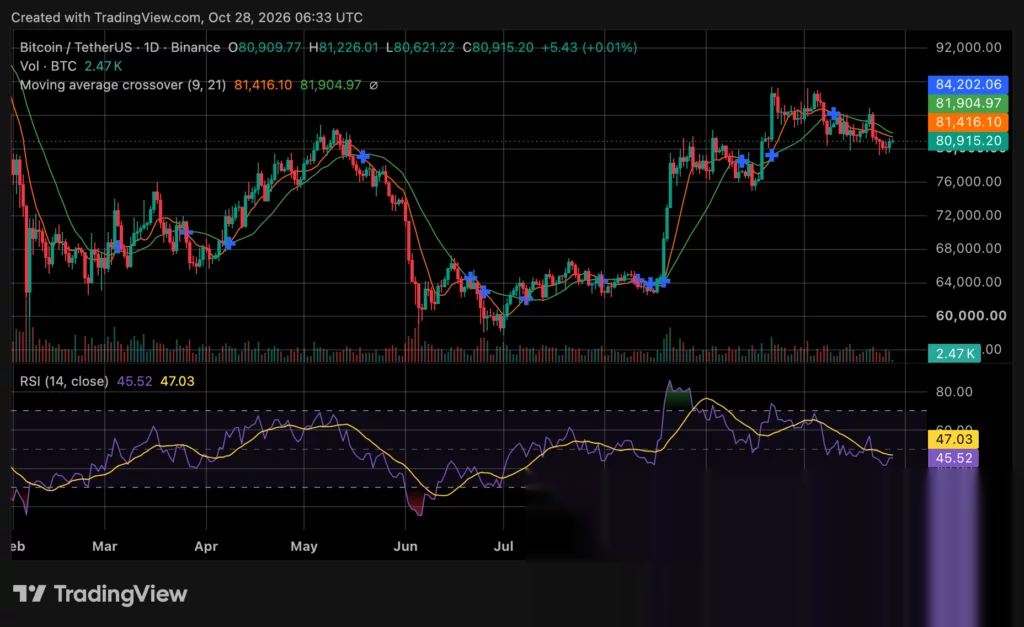
With the shorter moving average below the longer one, the chart retains a bearish crossover. The Relative Strength Index stands at 45.52, below the neutral 50 level, suggesting that buying momentum has not fully recovered.
Crypto analyst Rekt Capital identified $81,400 as an important three-day closing level after Bitcoin lost it as support. Failure to reclaim the area could reinforce its role as resistance, while a sustained recovery would strengthen the case for testing 82,000–82,500.
Immediate support remains near $80,000, followed by $78,000 and $76,000 if selling resumes. A move above the short-term moving averages could bring $84,202 into focus, with stronger resistance around $86,000.
Separately, analyst Ali Martinez noted that Bitcoin recorded negative fourth-quarter returns during the previous three U.S. midterm election years: 2014, 2018 and 2022.
Those historical observations describe past performance and do not establish that Bitcoin will repeat the pattern in 2026.