
Author: Shenchao TechFlow
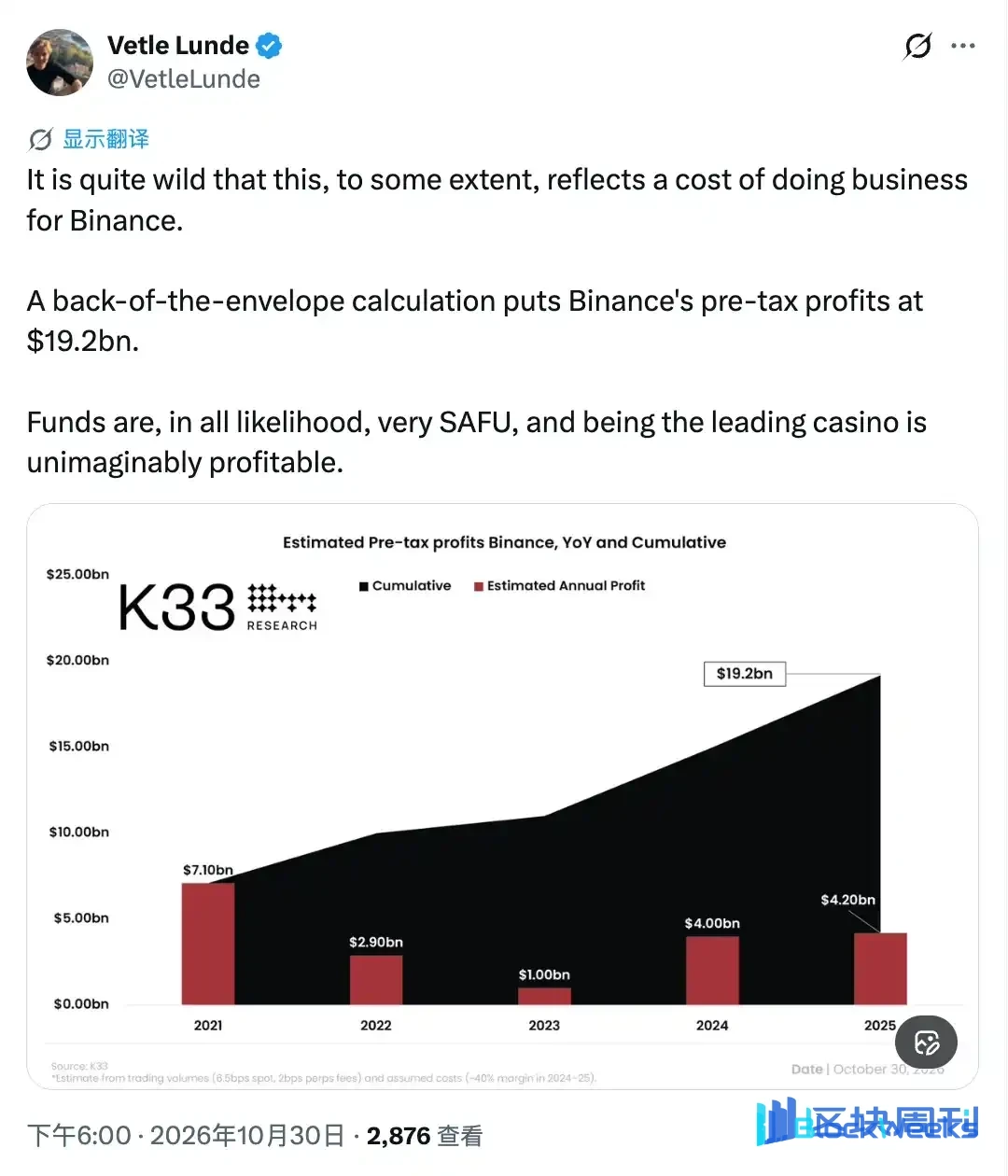
Shenchao Introduction: As a globally leading crypto asset infrastructure and trading platform, Binance's financial profitability and risk response capabilities have always been closely watched by the market. The latest research by K33 Research estimates that from 2021 to 2025, Binance's cumulative pre-tax profit was approximately 19.2 billion USD, demonstrating the strong profitability foundation of its core trading business.
During this period, the platform also bore significant expenditures in regulatory compliance and security protection. The research report points out that over the past five years, its known fines and losses from hacking incidents totaled approximately 10.7 billion USD, equivalent to 56% of the estimated pre-tax profit for the same period, including the U.S. regulatory settlement reached in 2023 and recent security incidents.
Facing industry security challenges, industry collaborative defense and reserve mechanisms have played a key role. Currently, approximately 3 billion USD of stolen assets have been frozen on-chain, and the SAFU protection fund has also quickly played a buffering and backstop effect. As the global market landscape evolves, objectively reviewing its financial and capital data provides an important reference for observing the stable operation of the industry's leading platforms.
K33 Estimates Five-Year Profit of 19.2 Billion: Compliance and Security Expenditures Account for Fifty Percent
According to the financial estimation model disclosed by Vetle Lunde, Head of Research at K33 Research analysis, Binance's total pre-tax profit created during 2021 to 2025 is estimated at approximately 19.2 billion USD, demonstrating the deep profitability capability of its global trading business.
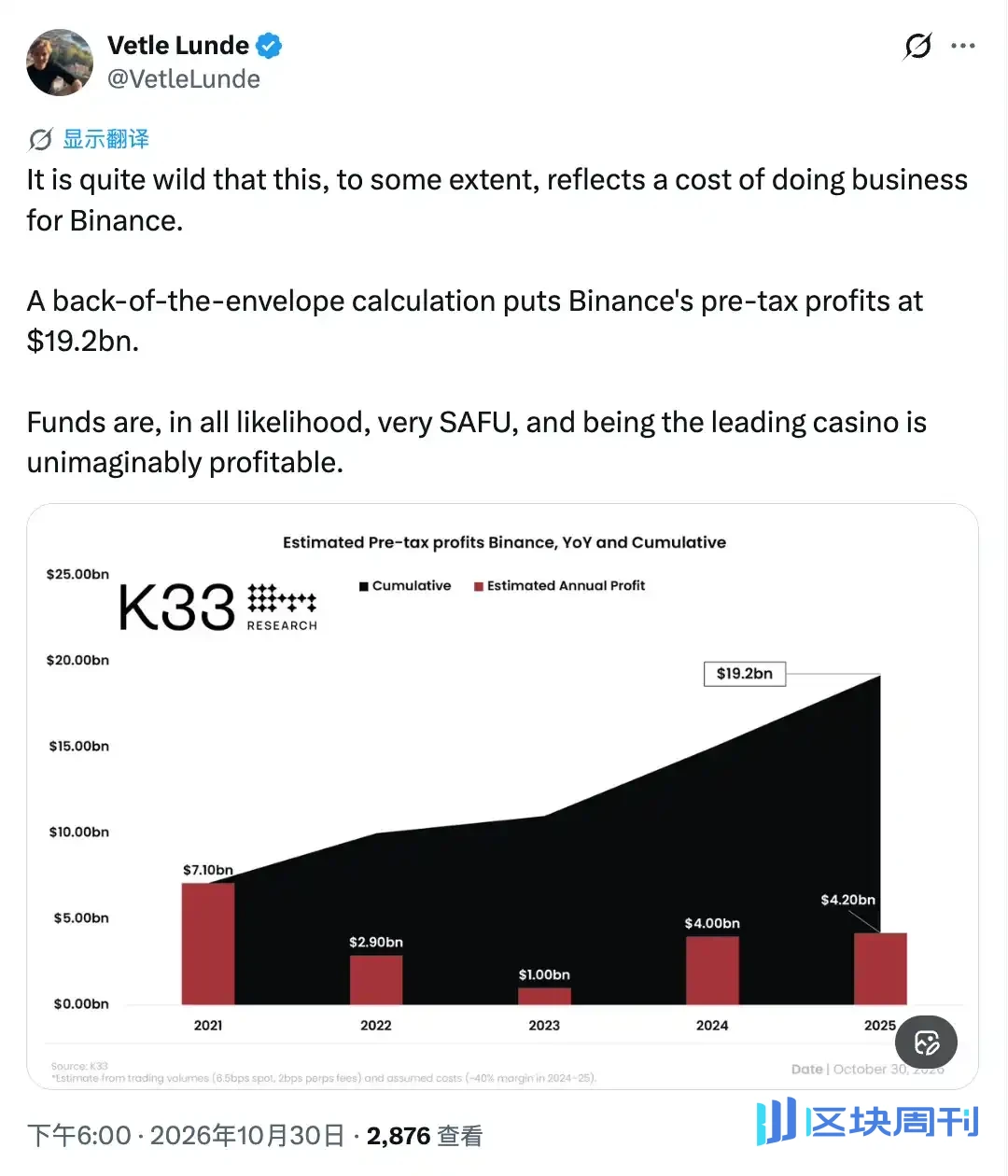
At the same time, the research report conducted a comprehensive statistical analysis of risk expenditures during this period. Data shows that Binance's known regulatory fines and hacking incident losses over the past five years totaled approximately 10.7 billion USD, equivalent to 56% of the estimated pre-tax profit for the same period, with related expenditures mainly concentrated in regulatory compliance and sudden security incidents.
The research report also objectively notes that since Binance has never publicly disclosed consolidated group financial statements, the above profit and cost data are all estimated based on third-party public information and industry models. This quantitative review provides an important data sample for the industry to observe the comprehensive revenue and expenditure structure of leading trading platforms over a long cycle.
Breakdown of Cost Components: 4.3 Billion Compliance Settlement and 6.3 Billion Security Expenditure
Among the known expenditure components, regulatory fines totaled approximately 4.34 billion USD. The main portion originated from the historic criminal settlement reached between Binance and the U.S. Department of Justice and regulatory agencies at the end of 2023, amounting to 4.32 billion USD, with the remainder being approximately 20 million USD in fines issued by regulatory agencies in multiple countries.
In terms of security incidents, the research report statistics show historical losses totaling approximately 6.38 billion USD. This includes approximately 7,000 BTC lost by the platform in 2019 (worth approximately 41 million USD at the time), as well as approximately 6.34 billion USD in potential book losses caused by a hacking attack in October 2026.
In response to the recent security incident, industry on-chain risk control and multi-party collaboration demonstrated rapid response. Currently, approximately 3 billion USD of stolen assets have been successfully frozen by various public chains and are expected to be recovered subsequently; at the same time, the platform quickly utilized 7,500 BTC from the SAFU fund, covering approximately 9% of the loss exposure, effectively protecting user rights and interests.
Reserve Assets Reach 128.3 Billion USD: On-Chain Tracking and Liquidity Foundation
According to third-party tracking reports on on-chain assets, since the hacking security incident occurred on October 29, the overall asset reserve scale publicly tracked by the Binance platform has experienced a certain degree of pullback, with a decline of slightly over 11%, and the relevant tracked asset scale is currently maintained at approximately 128.3 billion USD.
According to the Binance official recovery announcement and on-chain monitoring, the concentrated withdrawals in the initial period of withdrawal resumption are normal risk-avoidance behavior. As the withdrawal peak smoothly subsides, the platform's ample reserves of over 128 billion USD and 100% full payment capability still defend its absolute liquidity foundation as a first-tier player in the entire market.
At the same time, the dynamic changes in asset reserves also reflect the industry's attention to transparency. Binance continuously discloses zero-knowledge proof snapshots on its Proof of Reserves (PoR) page, achieving 100% full reserves for all currencies, providing a publicly verifiable underlying anchor for user asset security.
Industry Landscape Dynamics: Evolution of Competitive Environment and Balance of Capital Allocation
From a macro industry landscape perspective, the competitive landscape of global crypto trading platforms is continuously evolving. With competitors such as Coinbase, Kraken, and OKX actively advancing in compliance, spot, and derivatives businesses, all-around market competition among leading trading platforms is entering a more mature new stage.
The report analysis believes that having borne huge regulatory fines and security losses over the past five years, combined with recent changes in the scale of asset tracking, may to some extent affect its deployable investment funds and bring rebalancing considerations to future capital allocation and global expansion plans.
However, the market generally believes that stable annual operating profits of several billion USD and a deep global user base remain its solid foundation for responding to industry challenges. Against the backdrop of further clarity in the regulatory framework and continuous strengthening of security risk control, how leading platforms optimize their capital structure and advance sustainable development remains a long-term focus of the industry.