

The hardware boom in local AI has unexpectedly solved one of Ethereum's main infrastructure problems: the high cost of hardware for end users.
Ethereum co-founder Vitalik Buterin confirmed this synergy, showing the specifications of his own Geth node: after pruning, it occupied just 461 GiB. High-performance workstations that enthusiasts are buying in large numbers to run large language models (LLMs) locally and privately already exceed the technical requirements for blockchain nodes.
As a result, excess local computing power is turning home computers from terminals for accessing someone else's cloud into independent computing nodes. This hardware lets users run AI workloads, independently verify the blockchain and make secure transactions, eliminating intermediaries entirely.
How Ethereum is adapting to the new reality
Thanks to the integration of the EIP-4444 standard and optimizations to snap sync, a full node can now be synchronized in about 12 hours, and disk requirements have fallen below 0.5 TB.
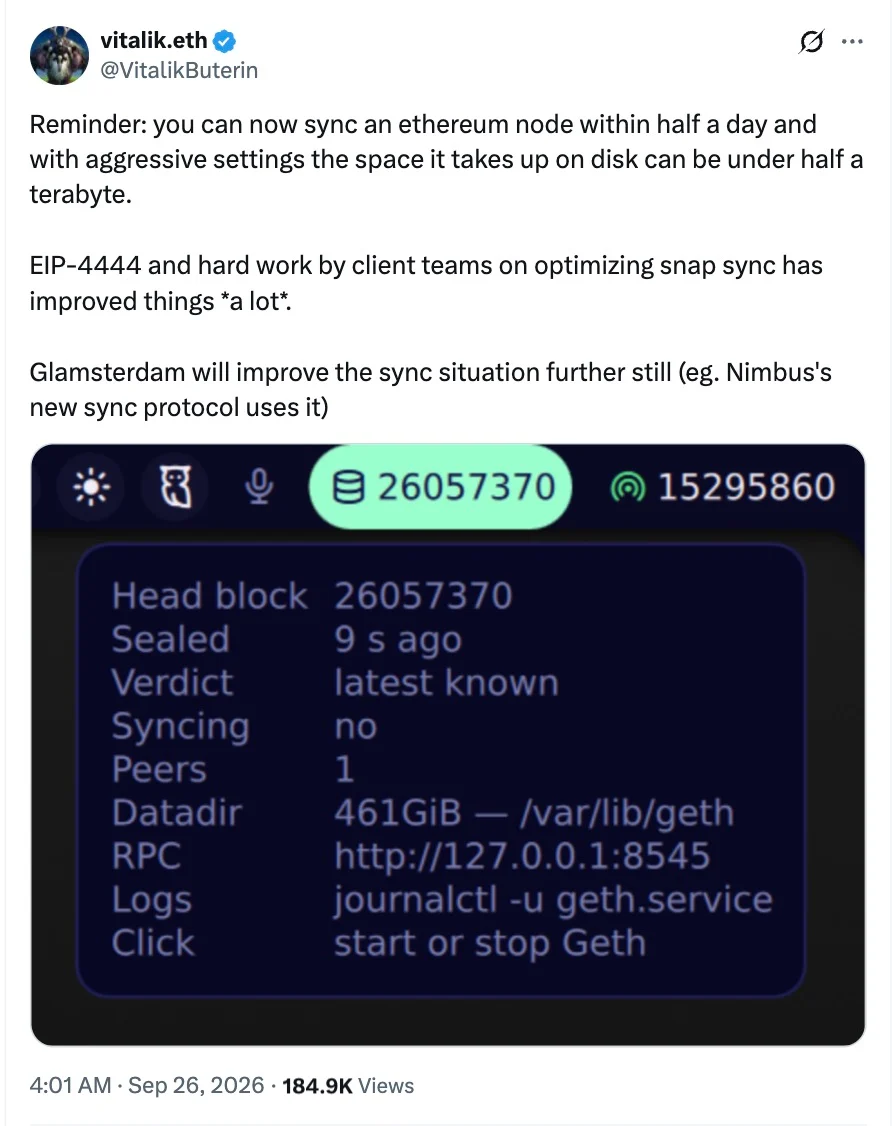
For owners of AI setups powered by GPUs, such as NVIDIA RTX 5090 cards or DGX Spark systems, these requirements are negligible. High-speed, high-capacity NVMe drives are already part of their PC setups for storing AI model weights, so running a node becomes an additional background process. The next hard fork, Glamsterdam, will further accelerate synchronization at the base layer (L1).
The technical upgrade to nodes coincides with growing demand for privacy. Buterin noted that in his own workflow, he is increasingly replacing browser-based dApps with a command-line interface (CLI). The reason is security: web interfaces hardcode calls to commercial RPC providers, allowing them to collect user metadata.
The logical next step in this trend is kohaku-cli, a command-line wallet being developed with support from the Ethereum Foundation. The project is designed to provide privacy "out of the box" and is already alpha-testing private balance-management features that integrate ZK protocols such as Tornado Cash, Railgun and Privacy Pools.