

Author: Zuo Ye Wa Bo Shan
MAGA's red wind lasts a cup of tea; Texas night rain, ten years of blue.
The midterm elections have settled, and Trump has entered his lame-duck period early.
Republicans always appear in the guise of rebels, yet the ending is always co-opted by the establishment, just like the Tea Party in 2010 and today's MAGA. What was promised back then was a fight to the death with the deep state; what needs to be done now is to sit down with the Democrats and jointly celebrate the grand occasion. Trump has officially entered garbage time.
The Democrats have already sharpened their knives: Warren wants to re-examine CZ's pardon process, and the Trump family's WLFI is also on the list; while Coinbase, one of the crypto world's own, has in turn held up crypto legislation. Those who bet on compliance over the past year now have to face the mockery of wild finance.
The bull market that began on August 20, with Robinhood's Meme as its high point and the Binance hack as its end, marked the final window for Perp to enter the U.S. in compliance, and the seasonal monsoon came to an abrupt halt.
How much longer can the red flag be flown, and where does the crypto world go in the post-Trump era?
Binance Time: Monopoly Is a Predicament
"Infinite distant places, countless people, are all related to me."
Sometimes the dead are more useful than the living.
After Lindsey Graham, an extreme supporter of Ukraine and Israel, died suddenly in July this year, his sister Darline took over the remaining Senate term and received strong endorsement from Trump in this midterm election. Trump casually played a card: urging the Senate to pass the clarity bill "in memory of Lindsey."
This is actually very surreal. Lindsey was not a member of the Senate Banking or Agriculture Committee at all, and even joined hands with Democratic anti-crypto standard-bearer Warren in 2023 to demand tighter regulation. Using an anti-crypto dead man to push a pro-crypto bill.
Then the card was lost. Darline lost in South Carolina, where Republicans had stood undefeated for 30 years, and Trump's endorsement is no longer worth anything; the Democrats immediately responded, aiming directly at CZ, with the entry point being whether the pardon was procedurally proper.
Binance is between China and the U.S., CZ is between the two parties, and will always face constant interrogation of his stance. Could Sun Ge really be a genius, having seen Trump's decline in advance?
Under the political climate, whether it's $6 billion stolen or $5 billion in single-day outflows, these are just small numbers relative to $170 billion in assets. The big question is how much longer Binance can dominate the crypto world.
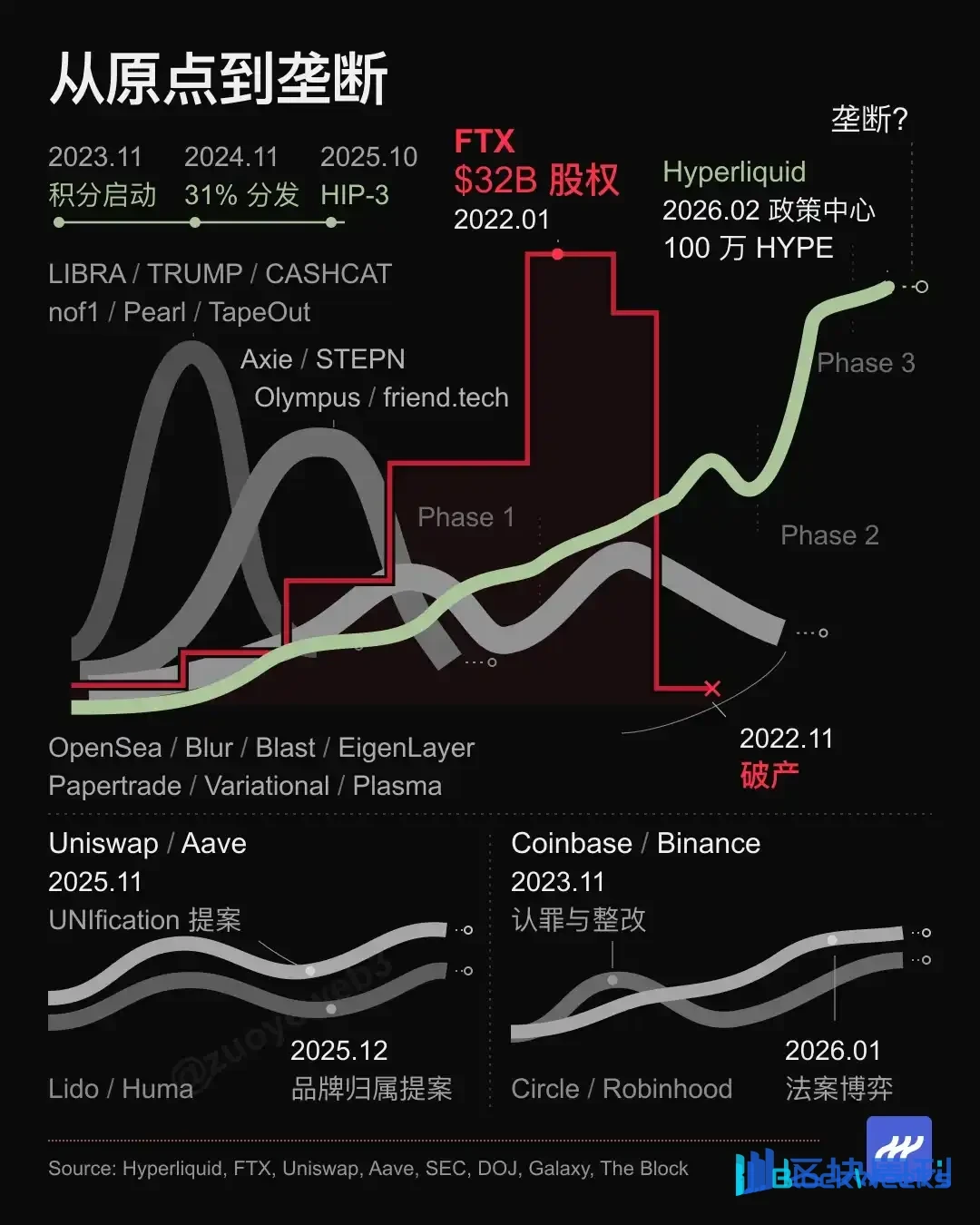
Monopoly is not evil; it is more like a sign that an industry has developed to maturity. Everyone's approach is completely the same, and each player's methods are highly similar. Whether VC, exchanges, or project teams, what they can offer the market is nothing more than a few major categories such as Perp, prediction markets, Meme, and stablecoins, then from points competitions to TGE, and finally the project team Rugs, and retail investors forget everything.

Image: Monopoly is a predicament
Since the approval of the Bitcoin spot ETF in January 2024, the logic of the crypto world has been rapidly homogenized. There are no longer distinctions between tracks, only unfinished gaps.
If we depict its basic portrait, it can be divided into 4 stages overall:
Phase 0: Ignite project-level hotspots to attract capital trading or investment, such as in October 2025, when nof1 launched 6 AI large models trading live contracts on HL, or the October 2026 PaperTrade loss-for-token farce;
Phase 1: If the project can ignite market sentiment, then it next needs to enter the actual operation stage. Normally, after entering Phase 1, marketing methods such as points competitions are needed, using potential token airdrops to attract continuous capital inflows;
Phase 2: If it can withstand the capital fluctuations after token issuance, it may become a key player in a certain track of the crypto industry. At this time, tokens need to be used to coordinate the interests of the protocol itself, the management team, and token holders, such as HYPE's continuous buybacks + the team's own token lockup, while the opposite example is the continuous conflict between Aave Lab and the DAO;
Phase 3: If the interests of all token parties can be smoothly coordinated, then the final hurdle must be faced: regulation. The most classic example is Binance's CZ serving prison time + huge fines. If successful, one can basically sit on monopoly profits.
Various products differ only in consumption capacity. Shaxian and Starbucks differ only in unit price, not in product and image: PumpFun and GMGN both do cross-chain bridges, Uniswap merges Curve and 1inch liquidity, the socialization initiated by Fomo is gradually becoming a trend, PaperTrade is a one-wave flow, and CEX is even racing toward rapid homogenization with brokerages.
These are all opportunities in the gaps. No new assets are created anymore, no new asset issuance methods exist anymore; they are all shelf product combinations.
Summer of Security: The High Cost of Abandoning True Innovation
Abandoning true innovation comes at an extremely high cost.
August 20 is not only the starting point of this round's small bull market, but also the origin point of high-frequency security incidents such as cold wallet theft and exchange hacks. In an era when the industry landscape is increasingly solidified, hackers, empowered by AI, can create wealth opportunities faster and in batches.

Image: Security also since August
At moments of high-frequency innovation, users can tolerate short-term unease, but in the mature stage of the industry, if it cannot achieve the same security as TradFi, additional returns cannot cover potential risks.
It can be predicted that from now to 2028, crypto users will further drain away, and the existing capital in the crypto world will revalue various crypto assets.
After Binance resumed withdrawals, it launched high-interest deposit-taking activities to restore the asset coverage sheet damaged by hackers. This is actually another expression of socializing losses, but Binance's dominant position allows it to recover quickly, yet it is difficult to use this to attract external capital inflows.
In other words, Binance is competing for the existing users of CEXs. This kind of fierce fighting is stereotyped behavior pushed to the extreme of involution, and it cannot bring us the future we want.
Douyin Time makes ByteDance fearful; Binance Time makes crypto lose control. In what way will decentralization actually become reality, or, more seriously interrogating our hearts, if Binance falls, will we witness a revival on-chain, or fall into the deathly silence of stamp and coin cards?
Politics is a perpetual contract. Republicans will lay out around Vance, Democrats will sharpen their knives against the rich. Peter Thiel guessed the direction right and fled to Latin America early (a spiritual white reservation), Musk paid a $400 million price in vain, but they all still have a future.
But crypto now has to pay for Binance.
The U.S. Regulatory Framework: Who Is Paying for Institutional Co-optation
"That monsoon blew so empty, as if everything in the world would vanish without a trace."
The distance between the crypto world and the center of the times is growing ever smaller. Although it has not become the absolute center of this election cycle the way AI has—data centers competing for water and power, AI driving waves of human job losses—crypto, as the future of finance, has thoroughly taken root in the world.
Before the results of the midterm elections were even out, perpetual contract compliance entered the United States, and on a larger scale, the U.S. has already built up a near-complete regulatory framework. Over the next two years, compliant enterprises will stage a "get on board and close the door" market strategy: because I am compliant, you will use me.
This is essentially a market access restriction, and of course it will not become a promised land for free citizens. What we focus on are the new opportunities in the cracks: Better to be a Meme than to be Goldman Sachs.

Figure: The U.S. regulatory framework
One can feel everyone's anxiety in advance. From KOLs complaining about declining traffic to exchanges fiercely competing for new users, all of it shows that the era dominated by CEXs is rapidly collapsing. Although U.S. exchanges are no good at technology, no good at service, and no good at products, they are extremely good at compliance. Countless law firms and former officials waiting hungrily inside the revolving door are all ready to devour the hard-earned money of new money.
"Objects are no longer the direct product of labor; people no longer understand the production environment and manufacturing process of these objects, and the commodities displayed before people become increasingly unfamiliar and magical—this is also the process by which society becomes increasingly fetishistic."
But retail investors cannot refuse. People have already been kept far from the internal links of project production—public chains, tokenomics, project teams. As technology grows increasingly complex and the number of players keeps increasing, it is impossible for people to understand everything by delving into the details. Even with AI, we must ask ourselves honestly: has it enhanced the transparency of information, or has it enriched the material used for filling in the blanks? In the end, it is still a matter of going through one Approve after another while pretending to understand everything.
Admit reality: it is basically impossible now to accompany a project for ten years the way people waited for BTC. You must act quickly and choose the amount of participation, or you will be shorted by the market.
Coming like wind and rain, departing like fine dust.
The Post-Trump Era: The Main Thread of the Crypto Market Shifts

Figure: The main thread of the crypto market
Starting from the last bull market, widely recognized as the most ferocious, the crypto industry since 2021 has seen an average of 2 to 3 market-level rallies, 5 to 7 sector-level rallies, and about 10 project-level hot spots each year.
But it must be acknowledged that this technology cycle began with a market hot spot like Ethereum's transition to PoS, then spawned several sectors such as ZK, L2, and LST/LRT, then absorbed hundreds of billions of dollars in VC funding from a16z and others, gave birth to hundreds of projects, and reached its climax in 2024. We are still in its final stage to this day.
Moreover, since the Bitcoin spot ETF in 2024, the crypto-native playbook of ultra-long cycles and ultra-many projects has increasingly given way to ultra-fast three-in-one projects like $TRUMP: a whole-market hot spot, the Meme sector, and a single project all at once.
And since 2025, only the stablecoin sector after the Genius Act has absorbed Fintech capital. Even privacy narratives popular in the West, such as Zcash/Zama, have consistently failed to persuade the Asian market to buy in.
Ultimately, in 2026 there was not a single market-level, industry-wide hot spot spanning East and West. Only Robinhood seized on Meme and coin-stock pairing to harvest the crypto retail investors who harbor illusions about U.S. stocks.
As Trump becomes a lame-duck president, the policy tailwinds for crypto have temporarily come to a halt. And from the perspective of wildcat finance, the sovereign-state narrative has also come to an end. It is still necessary to return to the most essential innovation: namely, how to use cryptocurrency to replace fiat currency and connect the world.
The future that Crypto wants is something neither the red nor the blue government can give.
Final Reflections: Neither the Red nor the Blue Government Can Give Crypto Its Future
"Money originates from social relations; politics is the violent representative of society."
From Hillbilly Elegy to the MAGA wave sweeping over the deep state, Trump finally completed his own institutionalization in his second term, and crypto's most marginal innovation—Meme—unexpectedly earned the Trump family wealth beyond their wildest dreams.
The whole world shares this same chill and warmth. The fact that crypto can stand alongside AI and witness the entire rise and fall of the most fanatical political forces is itself the best illustration of its vitality. And under the double blow of the Binance hack and Trump's lame-duck status, in the tail end of 2026, there may still lurk an opportunity at the sector level or even the market level.
This is a kind of marking the boat to find the sword, and also a bottom-fishing mindset. Peter Thiel fled before the midterm elections, whereas in 2016 he chose to jump into Washington.