Text | Yuanmei Hui, Author | Xie Chunsheng
Storage price increases have driven up smartphone prices, and consumers no longer want to be the "suckers" paying the bill.
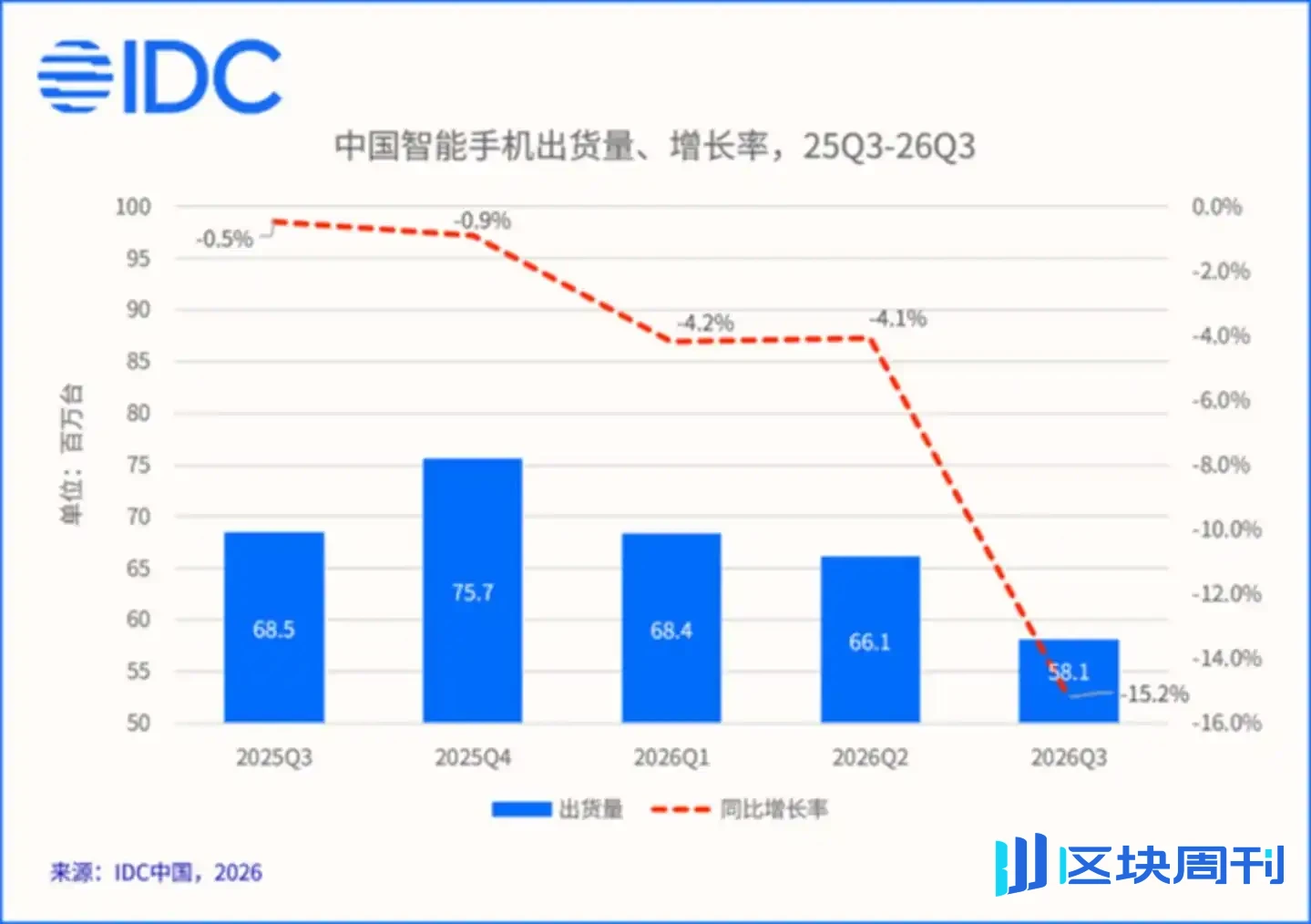
IDC data shows that in Q3 2026, domestic smartphone market shipments fell 15.2% year-on-year to approximately 58.06 million units. According to Counterpoint data, this shipment volume hit the lowest level for the same period since 2012.
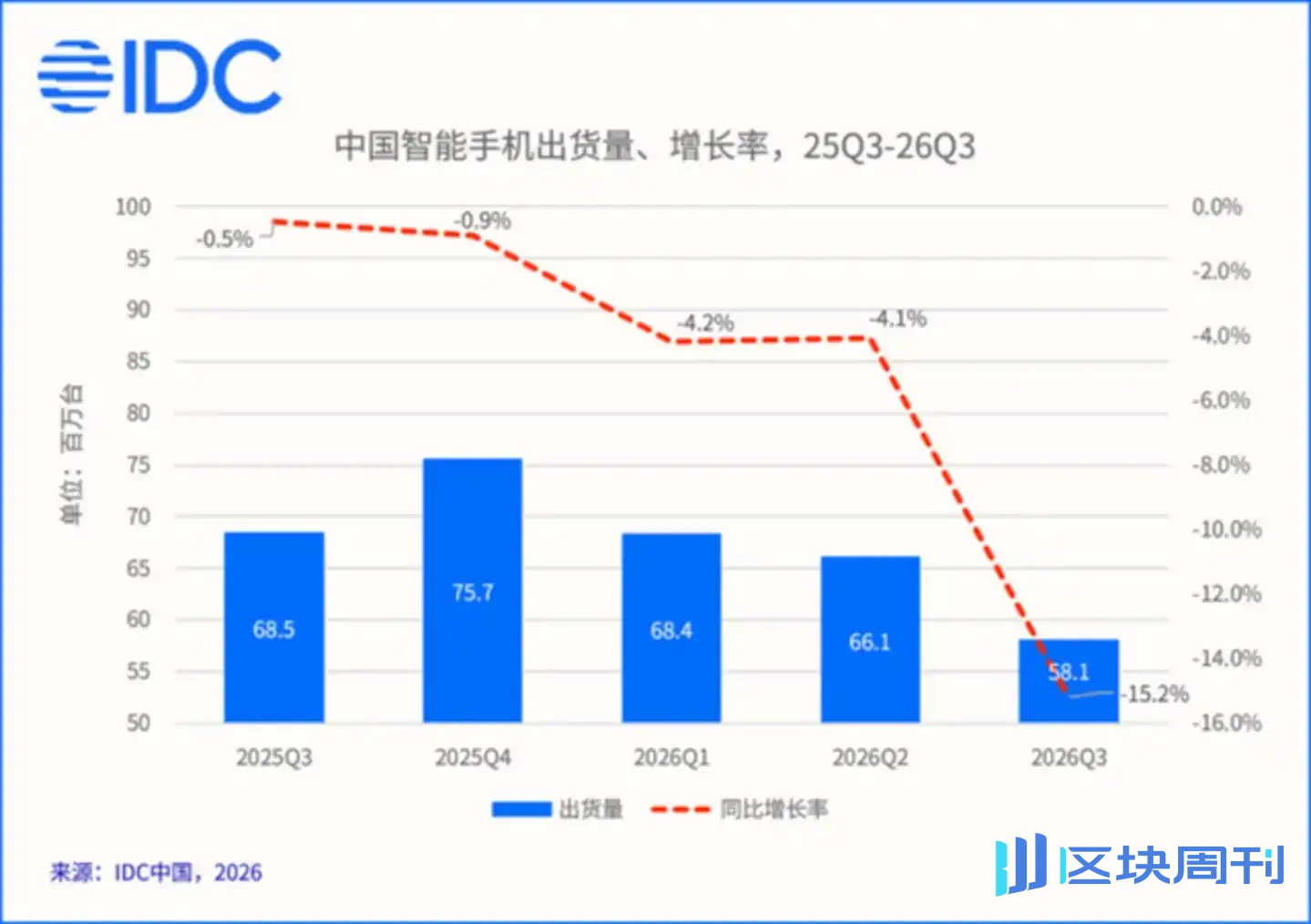
Image source: IDC
The reason for the shipment decline is simple: the costs of memory chips and other components have risen sharply. Data shows that the storage BOM proportion for low-end phones has risen from 10%–15% in normal years to 40%–50%.
Terminal brands are under shipment pressure, and the survival status of ODM giants caught in the middle of the industry chain has also become a market focus.
Joy and sorrow are not shared
In this wave of storage price increases, mid- and upstream storage manufacturers have reaped rich dividends.
GigaDevice is a typical representative. In the first three quarters of this year, its revenue rose 197.11% year-on-year to 20.297 billion yuan; net profit attributable to shareholders surged 921.55% year-on-year to 11.066 billion yuan.
This is not even the most dramatic increase. In the same period, ChangXin Technology's revenue and net profit attributable to shareholders surged 738.5% and 2600.8% year-on-year, respectively, reaching 269.02 billion yuan and 132.04 billion yuan, with a gross margin as high as 89.53%.
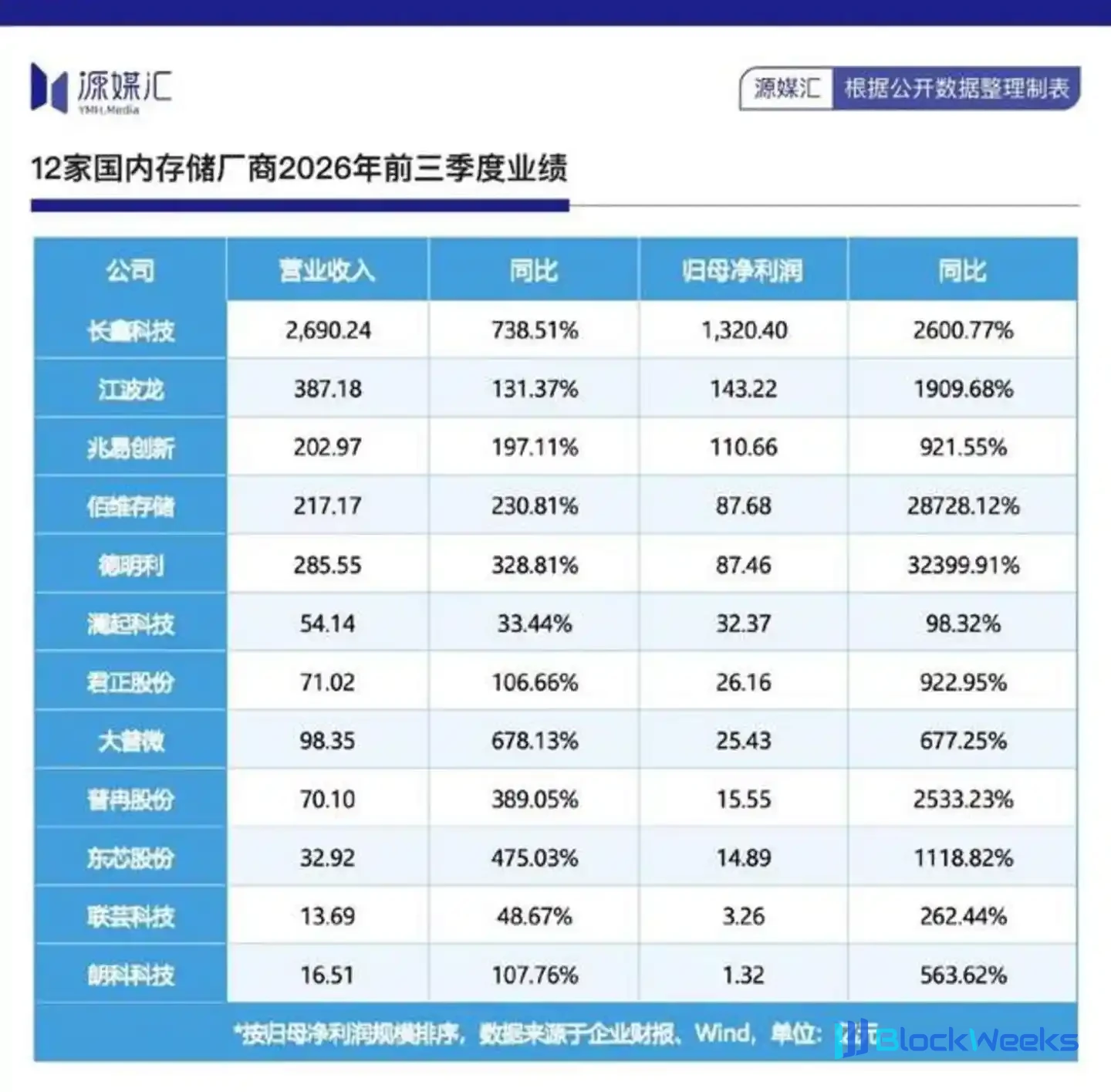
Even with prices already rising like this, Nomura's judgment is that this wave of memory chip price increases is likely to continue until 2028.
The core logic behind the continued boom is not complicated: the strong siphon effect of HBM demand brought by the AI industry explosion has continuously tilted production capacity resources toward high-end storage, squeezing the supply space for consumer-grade DRAM and NAND. This also allows companies like GigaDevice, which are not rule-makers, to become beneficiaries along the way.
The other side of dividends concentrating upstream is that downstream terminal manufacturers are forced to bear the pressure of price increases. The continued downturn in the smartphone market is the most intuitive microcosm, and the traditional PC segment is also under pressure.
IDC data shows that in Q3 2026, global traditional PC shipments were 62.7 million units, down 20.1% year-on-year and 9.1% quarter-on-quarter, marking the second consecutive quarter of year-on-year decline, with the drop significantly larger than in Q2.

Image source: IDC
Leading brands generally suffered double-digit declines. In the third quarter, Lenovo shipped 14.9 million units, down 22.6% year-on-year, with a market share of 23.8%, ranking first globally. HP shipped 10.3 million units, down 30.9% year-on-year, the largest decline among the top five vendors. Dell shipped 7.6 million units, down 25% year-on-year.
Terminal brands are already struggling, and the ODM industry has also bid farewell to its previous boom cycle. Previously, this segment once had a highlight moment: in the first half of 2025, ODM smartphone shipments accounted for 43% of the global total, setting a new high for the same period from 2019 to that time.
As demand for smartphones and PCs weakens simultaneously, the ODM market, which had been rising for two consecutive years, has reached an inflection point.
In the second half of 2025, ODM smartphone shipments fell 10% year-on-year. Institutions further predict that global ODM smartphone shipments will continue to decline in 2026, with a drop of about 10%–15%.
ODM giants are living well
However, despite the overall market downturn, leading ODMs represented by Huaqin Technology and Longcheer Technology are not in as bad a situation as imagined. Their diversified business layouts from earlier years have become a buffer for them to ride out cycles.
Financial reports and Tianyancha information show that in the first three quarters of 2026, Huaqin Technology achieved revenue of 166.014 billion yuan and net profit attributable to shareholders of 4.323 billion yuan, up 28.81% and 39.53% year-on-year, respectively. Among them, in the third quarter, revenue and net profit attributable to shareholders grew 60.86% and 9.43% year-on-year, respectively.
However, Huaqin Technology's gross margin in the third quarter declined quarter-on-quarter, mainly due to the substantial growth in the scale of its data business. In this business, the storage and GPU Buy&Sell model accounts for a relatively high proportion. As the weight of the data business in overall revenue rises, it lowers the comprehensive gross margin.
This also exposes a rule in the smartphone ODM industry that is easily overlooked: most procurement rights for smartphone memory chips are in the hands of brand customers, and ODMs operate under a customer-supplied materials model. Price increases themselves do not directly hit gross margin, but they squeeze profit space through another path.
After brand customers spend more on storage, they will be tighter on ODM processing fees and solution fees.
For Huaqin Technology, its smartphone business was still able to maintain positive revenue growth in the first three quarters, reflecting the head-concentration effect amid industry contraction; what truly supports the income statement is still the rapidly expanding data business. In Q3, revenue from this business reached 22.5 billion yuan, up 228% year-on-year, of which super nodes have achieved large-scale delivery, with revenue reaching 6.19 billion yuan.
The ROI (return on investment) of the super node business is higher than that of AI servers, making it a buffer for Huaqin Technology amid headwinds in the smartphone business.
In its latest institutional research, Huaqin mentioned that the company's ROE (return on equity) has long remained at an excellent level of 15%-20%. The low gross margin on the books is itself precisely part of the company's moat.
In other words, the core measure of whether a business is good is not gross margin, but ROE.
This statement carries more weight than usual against the backdrop of storage price increases. ODM profits have never come from buying low and selling high on memory chips, but from scale, efficiency, customer stickiness, and category expansion.
Storage price increases have made the book gross margins of smartphone ODMs even thinner, but the ROE of leading manufacturers has not deteriorated in tandem. Wearables, AIoT, and data businesses have taken over to fill the growth gap.
The overall smartphone market is shrinking, but ODM penetration is instead rising, with share continuing to concentrate in Huaqin Technology and Longcheer Technology. This is one of the few structural hedges during the industry contraction period. Longcheer Technology's third-quarter report makes this hedging effect even more intuitive.
In Q3 2026, the company achieved revenue of 13.930 billion yuan, a year-on-year increase of 21.94%. In a quarter when industry shipments fell 15%, revenue rose instead of falling.
Basically all business segments grew. Among them, the smartphone business was 8.635 billion yuan, a year-on-year increase of 12%; tablet computers were 1.873 billion yuan, a year-on-year increase of 71.82%; the AIoT business was 3.221 billion yuan, with both year-on-year and quarter-on-quarter growth rates above 40%, accounting for 23% of single-quarter revenue.
Judging from the gross margin disclosed in 2025, the company's AIoT gross margin is significantly higher than that of mobile phones and computers.
In other words, mobile phones are a scale business, while AIoT is a capability business. The more dispersed the categories and the deeper the customization, the higher the cost for customers to switch suppliers, and only then can bargaining power fall into the hands of ODMs.
Longcheer's non-recurring net profit doubled quarter-on-quarter in Q3, with high quarter-on-quarter growth for two consecutive quarters, indicating that an operational inflection point has already emerged.
Can "thousand-yuan phones" make a comeback
Of course, simply dividing the beneficiaries and those under pressure in the industrial chain still remains at the surface level.
The deeper long-term impact of memory price increases on the mobile phone industrial chain does not lie in single-quarter profit fluctuations, but in the irreversible contraction of product structure. In the first nine months of 2026, 286 new phone models were launched in the Chinese market, a year-on-year decrease of 28.1%.
According to Jiemian News, Xiaomi and OPPO cut full-year complete-device orders by more than 20%, vivo by nearly 15%, and Transsion lowered its annual target to below 70 million units, with order cuts concentrated in mid-to-low-end and overseas products.

Image source: China Academy of Information and Communications Technology
Samsung was also forced to recalculate the memory configuration and pricing of mid-range phones, and the domestic thousand-yuan phone sea-of-models strategy quickly receded.
Some institutions judge that the incremental memory cost of thousand-yuan phones has already swallowed all the profits of the complete device, and in 2027, smartphones priced within 1,500 yuan may gradually fade out of the market. This means that memory price increases are not only squeezing profits, but directly "deleting" a sub-category. The exit of low-end phones releases not potential replacement demand, but persistently declining willingness to replace phones.
A senior executive of IDC Global Devices once mentioned that against the backdrop of continuously rising prices, consumers choose to extend the service life of existing devices, and consumers tend to extend the usage cycle of old phones, while the advantage of domestic brands in the low-end market has precisely made them bear greater pressure in this round of adjustment.
As brands cut orders, the ceiling for ODM mobile phone shipments moves down accordingly, and the consumer memory demand of upstream design companies will also feel the same contraction after several quarters.
No one in a chain can forever make a living by price increases. Samsung has given a clear warning: 2027 may be the year with the tightest memory supply in this round, and the supply-demand pattern will hardly become completely loose in 2028. For at least the next two years, it will be difficult for the cost structure of the mobile phone industry to return to the past.
How long GigaDevice's high profitability can be maintained depends on when the siphon effect of AI on high-end memory capacity slows down. Whether Huaqin and Longcheer's mobile phone businesses can stabilize depends on whether second growth curves such as wearables, AIoT, data, and automotive electronics can grow to sufficient scale before mobile phone profits are compressed to the limit.
And whether the thousand-yuan phone category can return may no longer depend solely on memory prices, but on whether the entire industry can accept the new normal of "phones getting more expensive and replacement cycles lengthening."
This third-quarter report is only the first card lifted to reveal the new normal. The game is still going on, and the chips in the industrial chain have already been redistributed.