Global markets are currently flashing extreme signals simultaneously across multiple dimensions, and what Wall Street investors face is not merely a single risk, but a cross-asset structural stress test.
The implied volatility of the Mag 7 is unusually cheap relative to the broader technology sector, while hedge fund exposure to these AI giants is near historical peaks; at the same time, momentum strategy positioning has been dismantled in an almost wipeout-style collapse, the South Korean stock market has rebounded from extreme undervaluation, and the fundamentals of the U.S. housing market continue to deteriorate. These signals do not exist in isolation; rather, they have emerged in concentrated fashion within the same time window.
What unsettles the market even more is that behind the aforementioned extreme phenomena lies pricing confusion and positioning divergence—hedge funds and mutual funds hold almost diametrically opposite positions in the Mag 7, and momentum strategies went from crowded to barren in just a few months. Brazil's fiscal risk adds yet another layer of concern to this already complex picture.
Mag 7 Volatility: Pricing Anomalies and Extreme Positioning Coexist
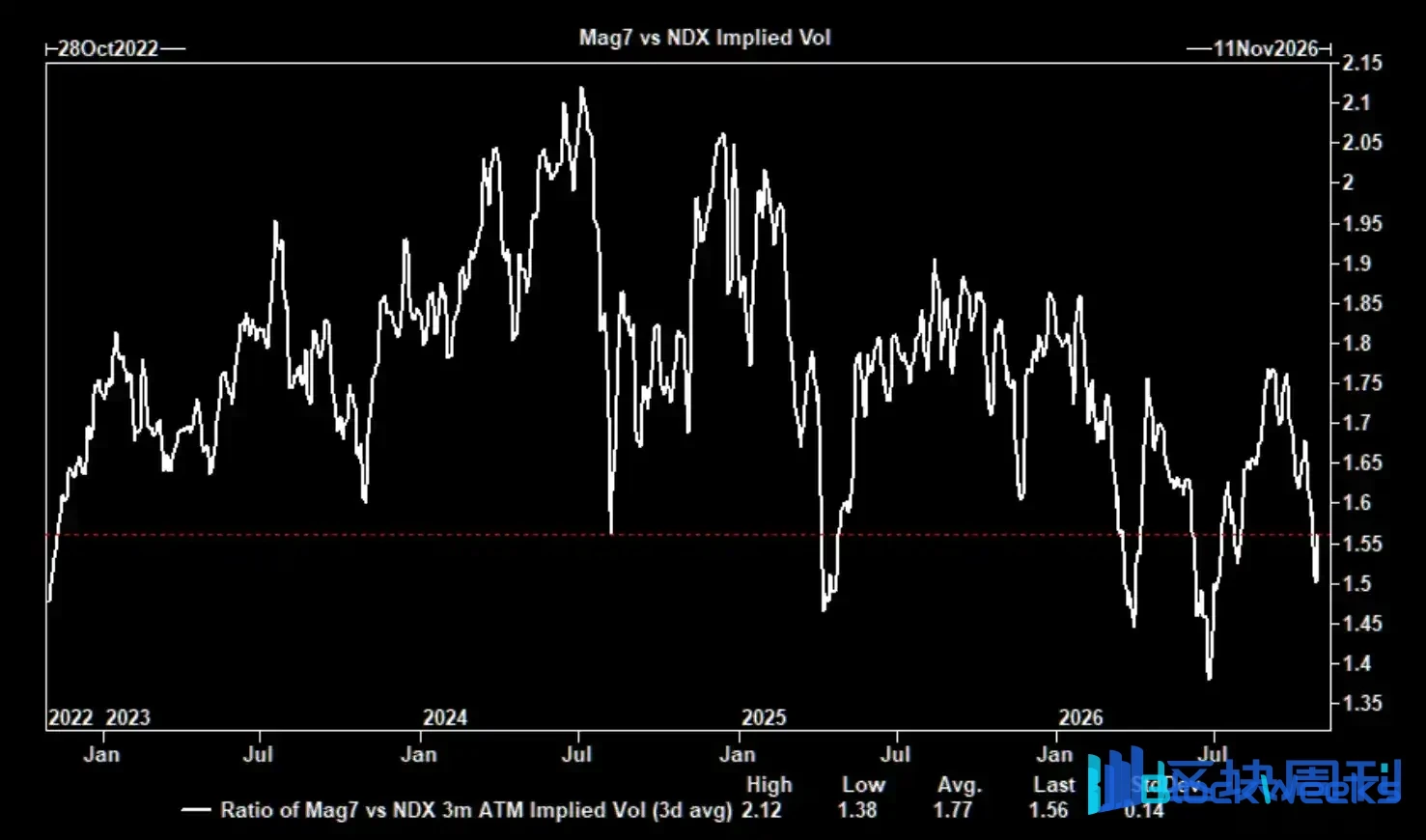
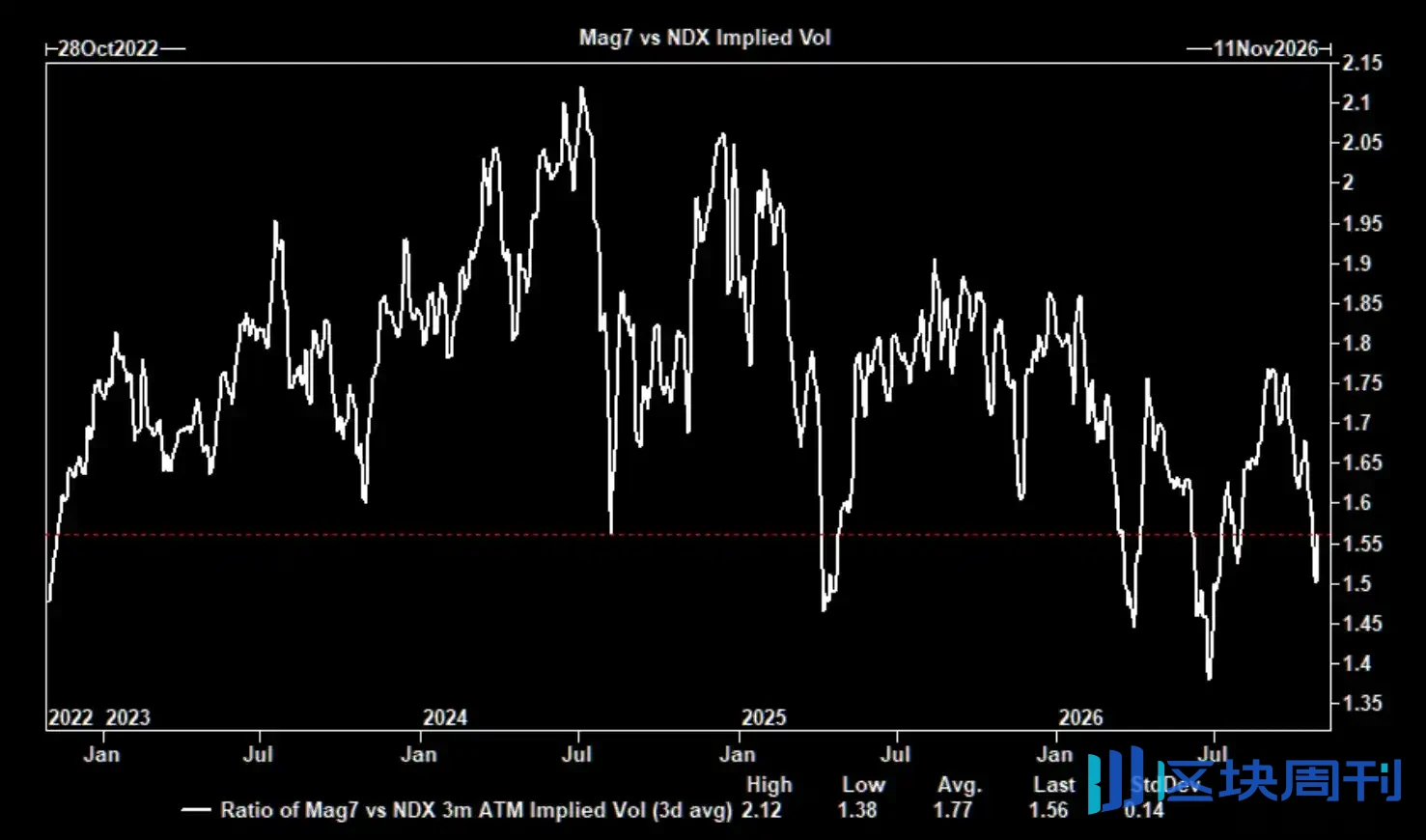
Mag 7 implied volatility currently trades at a significant discount relative to the broader technology sector. According to Goldman Sachs data, this relative volatility ratio is only at the 15th percentile of the past four years, meaning that Mag 7 options are in an unusually cheap range relative to other technology stocks.
At the same time, although the implied volatility spread between the Nasdaq 100 Index and the S&P 500 Index compressed sharply last week—the three-day compression was the largest in four years—the 1-month at-the-money option spread remains at the 94th percentile, and technology sector volatility remains at historically high levels relative to the broad market.
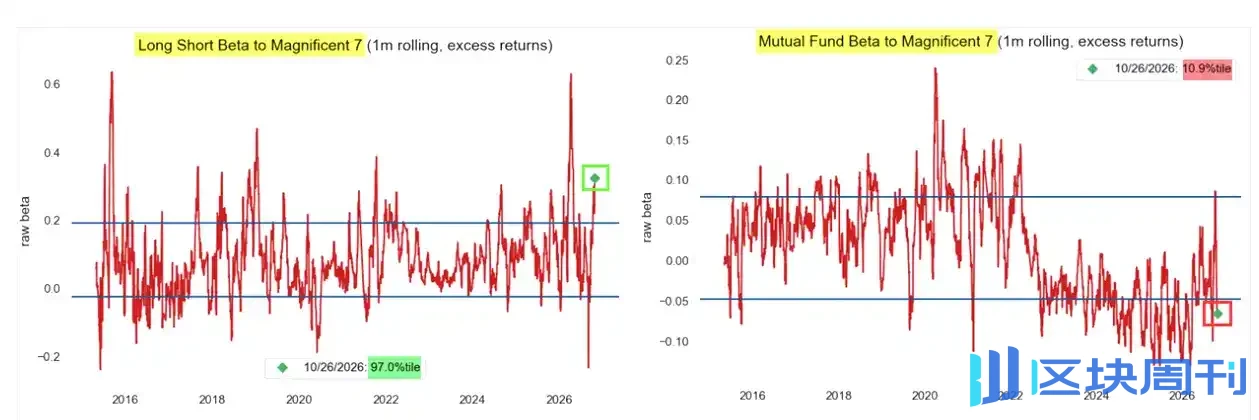
Divergence at the positioning level is equally extreme. Nomura strategist McElligott pointed out that the rolling beta of long-short hedge funds to the Mag 7 has risen to the 97th historical percentile, while the beta exposure of mutual funds is only at the 11th percentile. Hedge funds are heavily positioned in the AI giants, while traditional long-only managers are structurally underweight—under the same group of stocks, two completely different positioning realities exist.
Momentum Strategies: From Crowded to Barren
The collapse of momentum strategies in this round is not a position adjustment in the ordinary sense. Goldman Sachs prime brokerage data show that the momentum exposure of fundamental long-short strategies plunged from nearly 70% at its peak to about 15%, completing the shift from extremely crowded to nearly emptied in just a few months.

The speed and magnitude of this collapse are rare, indicating that the market's concentrated positioning in the momentum factor has undergone a systematic purge rather than a gradual risk rebalancing.
South Korean Stock Market: A Technical Rebound After Extreme Undervaluation
The South Korean stock market had previously fallen to an extreme valuation range. According to JPMorgan data, even excluding the memory chip leader, the forward price-to-earnings ratio of the KOSPI is only 8.4 times, placing it in the 11th percentile historically; the RSI indicator has fallen to its lowest level since "Liberation Day," and the number of oversold stocks has reached an extreme level.

Positioning data also corroborates this judgment. According to Goldman Sachs data, the net allocation ratio to the South Korean market has fallen to 3.4% (29th percentile on a one-year basis, 86th percentile on a five-year basis), and the total allocation ratio has fallen to 2.4% (30th percentile on a one-year basis, 86th percentile on a five-year basis). JPMorgan had accurately captured this阶段性 low point in its October 20 report, arguing that the combination of valuation and technicals was becoming "increasingly attractive."

US Housing: A Double Squeeze on Demand and Profit Margins
Pressure in the US housing market has spread from the demand side to the supply side. According to TS Lombard data, homebuilders' operating profit margins have fallen below pre-COVID levels, with weakening new home prices and rising construction, labor, and financing costs forming a two-way squeeze, and builders are simultaneously suffering profit erosion from both sides.
The demand side is likewise hardly optimistic. Mortgage rates have now returned to about 7.3%, and US housing affordability remains near historic lows. TS Lombard warns that if the Federal Reserve maintains a hawkish stance, interest rates may face further upward pressure, thereby continuing to suppress homebuying demand. Its conclusion is quite blunt: falling home prices alone may not be enough to lure buyers back into the market.
Brazil: Debt Trajectory and Fiscal Cliff
Brazil's fiscal pressure is accumulating to a degree that unsettles the market. According to TS Lombard data, Brazil's debt-to-GDP ratio has climbed from 71.7% when Lula took office in 2023 to 81.9%, and if the current policy path is maintained, that ratio could approach 118% by 2036. The election is over, but the real test has only just begun: how to convince investors that Brazil is capable of stabilizing its debt trajectory.
TS Lombard further warns that, absent substantive fiscal reform, Brazil could face the risk of a partial government shutdown in 2028. Mandatory spending is gradually crowding out discretionary fiscal space, and available funds may fall below the minimum threshold required for the normal operation of the government. Its conclusion is quite grim: Brazil's next round of fiscal adjustment may not be driven by political will, but forced by mathematical logic.