

Written by: Suvashree Ghosh, Bloomberg
Compiled by: Saoirse, Foresight News
As the blockchain with the highest global trading activity, it should in theory be easy to impress Wall Street, but Solana's story is far from that simple. A large part of its early fame was built on various Meme coins and tokens riding on Trump's popularity.
This public chain received investment from Sam Bankman-Fried (SBF) in its early years and was once regarded as the next major hot spot in the crypto industry. In 2022, SBF's FTX exchange collapsed, and Solana survived this crisis, returning to the market's view on the back of the Meme coin boom, with its business highly dependent on speculative trading.
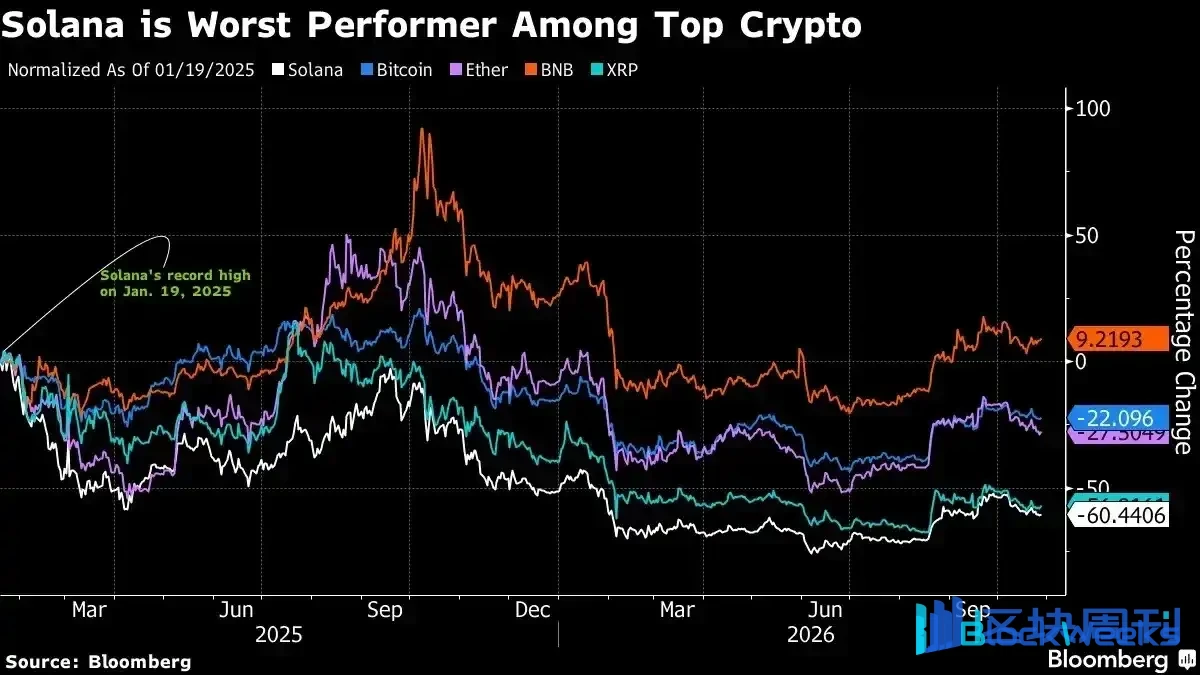
In recent weeks, demand for Solana's native token SOL (one of the few surviving assets among the "Sam Coins" that received SBF funding back then) has continued to weaken, with its year-to-date decline approaching 20%.
Meanwhile, US-listed SOL spot and staking ETFs recorded a combined $50 million in outflows for two consecutive weeks this month. Digital asset management firm SkyAI also liquidated all of its SOL holdings this month, abandoning its original positioning and pivoting fully to the AI sector.
"The biggest risk is mistakenly believing that current trading enthusiasm can guarantee long-term competitiveness," said Michael Weisz, CEO of Solana ecosystem lending platform Kamino.
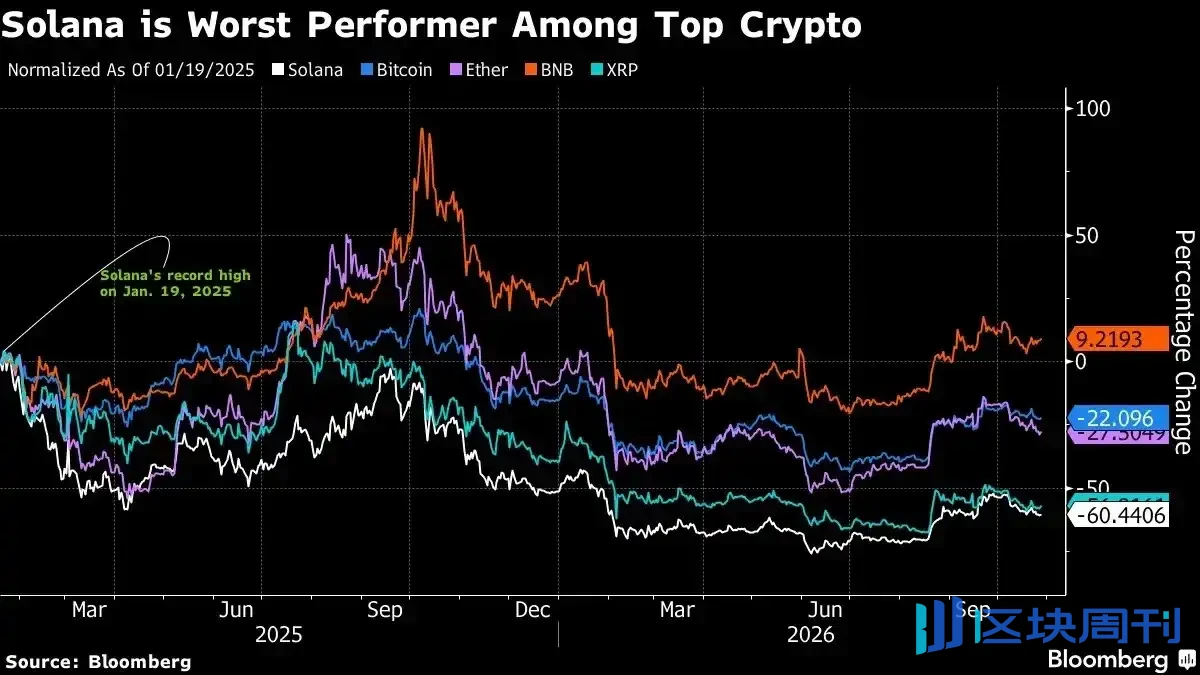
Solana ranks at the bottom among top cryptocurrencies
As Wall Street continues to increase its stake in crypto, the industry's focus is shifting, with applications closer to traditional finance such as dollar stablecoins and tokenized real-world assets becoming the mainstream direction. Solana's long-term investment value remains controversial, but it has actively positioned itself in this track and has made some progress in scenarios such as tokenized stocks.
The overall downturn in the crypto market has further amplified its challenges. After a brief rally following Trump's election, coin prices have continued to fall, with most tokens unable to recover their losses. Some speculative capital has turned to chasing AI-related returns, while a batch of emerging public chains in vertical sectors has risen to become Solana's competitors.
The Solana Foundation, a non-profit organization headquartered in Zug, Switzerland, that supports the network's development, says the transformation is underway. Foundation President Lily Liu said that institutions moving real money and physical assets on-chain has now become the fastest-growing business on this chain. She added that the Solana network is fast and has low fees, enough to support large-scale global payments and capital markets business.
When it launched six years ago, Solana's core selling point was being faster and cheaper than competitors (especially Ethereum). But this characteristic also made it naturally suited to speculative trading, and to this day, speculative trading remains its main source of revenue.
Lucas Tcheyan, Vice President of Research at Galaxy Digital, pointed out: "Compared with Ethereum, Solana's fee revenue is more dependent on speculative trading, and its decline from the 2025 high has also been larger." He also mentioned that Solana's current goal is to encourage users to migrate more financial activities on-chain, covering scenarios such as trading, savings, and payments.
The public chain's ecosystem structure is diversifying. According to a Galaxy Research report, the share of Meme coin trading volume has dropped from more than 50% at the end of 2024 to 15%–20% in the second quarter of this year.
According to the Solana Foundation, major financial institutions such as JPMorgan Chase, Morgan Stanley, and Standard Chartered are all currently conducting business on the network.
Leading payment service providers such as Visa and Fiserv have also chosen Solana. In May of this year, Western Union issued the dollar stablecoin USDPT on the Solana chain.
But recently, the business Solana wants to capture is continuously being diverted by rivals.
Hyperliquid has become a popular platform for on-chain perpetual contracts. Perpetual contracts have no expiration date, and traders can bet on the price movements of cryptocurrencies, stocks, and commodities. According to Tcheyan's data, within one year after Hyperliquid issued the HYPE token, Solana's share of on-chain perpetual contract trading volume fell from 17% to 6%.
On the other hand, Ethereum remains the underlying cornerstone of decentralized finance. Robinhood Chain and Coinbase's Base are both layer-2 networks built on top of Ethereum; Tempo, incubated by Stripe together with Paradigm, and Binance's BNB Chain are independent public chains compatible with the Ethereum ecosystem.
Solana itself is also continuously iterating. On October 21, the network completed the Alpenglow upgrade, further improving transaction speed. But the value of technical optimization can only be demonstrated when it can retain users and liquidity during a bear market.
Weisz said: "Growth will truly reverse only when quality assets, developers, and customers choose to leave because other platforms offer a better experience."