
Original | Odaily Planet Daily (@OdailyChina)
Author|Azuma (@azuma_eth)

Under the shadow of an "AI confidence crisis," Zuckerberg was the first to give the market a reassurance.
Over the past few weeks, doubts have been mounting about tech giants' massive investments in AI that have yet to prove commercial returns, and chip stocks and Nasdaq tech stocks have also experienced a noticeable pullback. As the first trillion-dollar tech giant to "hand in its paper" this earnings season, Meta's third-quarter 2026 earnings report, released after the U.S. market close on October 21, Eastern Time, became the first major test of the commercial viability of AI.
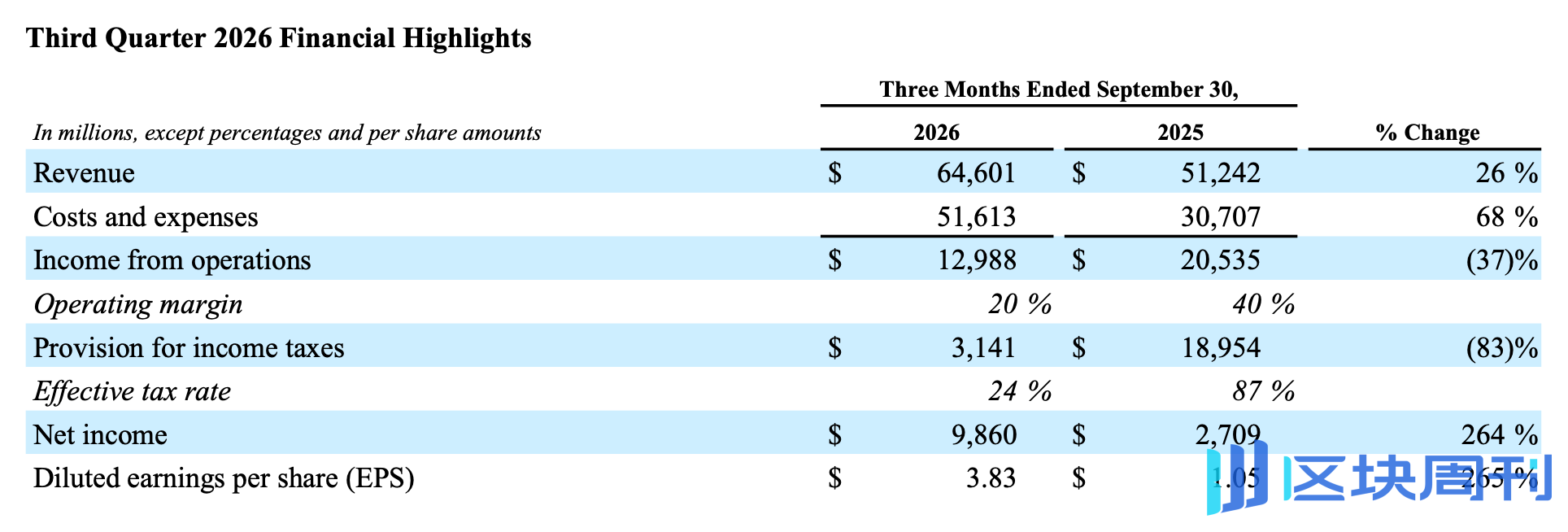
Earnings data shows that Meta's third-quarter revenue reached $64.6 billion, up 26% year-over-year, exceeding analysts' expectations of $63.3 billion; the company expects fourth-quarter revenue to reach $73 billion to $76 billion, with the midpoint also above market expectations. Judging from market reaction, this report card has temporarily passed — with both quarterly revenue and fourth-quarter guidance exceeding Wall Street expectations, Meta's stock price rose as much as 6% after hours (now retreated to 2%).
But if you look carefully at the underlying accounts of this earnings report, you will always feel a strong sense of contradiction. On one hand, there is quarterly revenue of $64.6 billion, a continuously growing advertising business, and the AI assistant Muse, which attracted over 10 million North American users within a month and a half of launch; on the other hand, the company's free cash flow turned negative for the first time since going public, nearly $10 billion in legal settlement expenses were accrued in a single quarter, the full-year capital expenditure guidance was further raised, and Meta even announced a new Class C common stock plan to reserve space for future financing and equity incentives.
Putting these things together, they precisely outline Meta's current situation — existing businesses are still providing ample revenue and cash flow, but Zuckerberg is clearly not satisfied with this; he is directing more resources toward AI and arranging funds in advance for this competition, which may have a longer investment cycle.
Unveiling the Illusion of "Profit Halved": The Advertising Money Printer Remains Fierce
First, look at the income statement that is most likely to cause misinterpretation.
Meta's total costs and expenses in the third quarter increased 68% year-over-year to $51.61 billion, significantly faster than the 26% revenue growth; GAAP operating profit fell 37% year-over-year to $12.99 billion; operating margin also dropped from 40% in the same period last year to 20%.
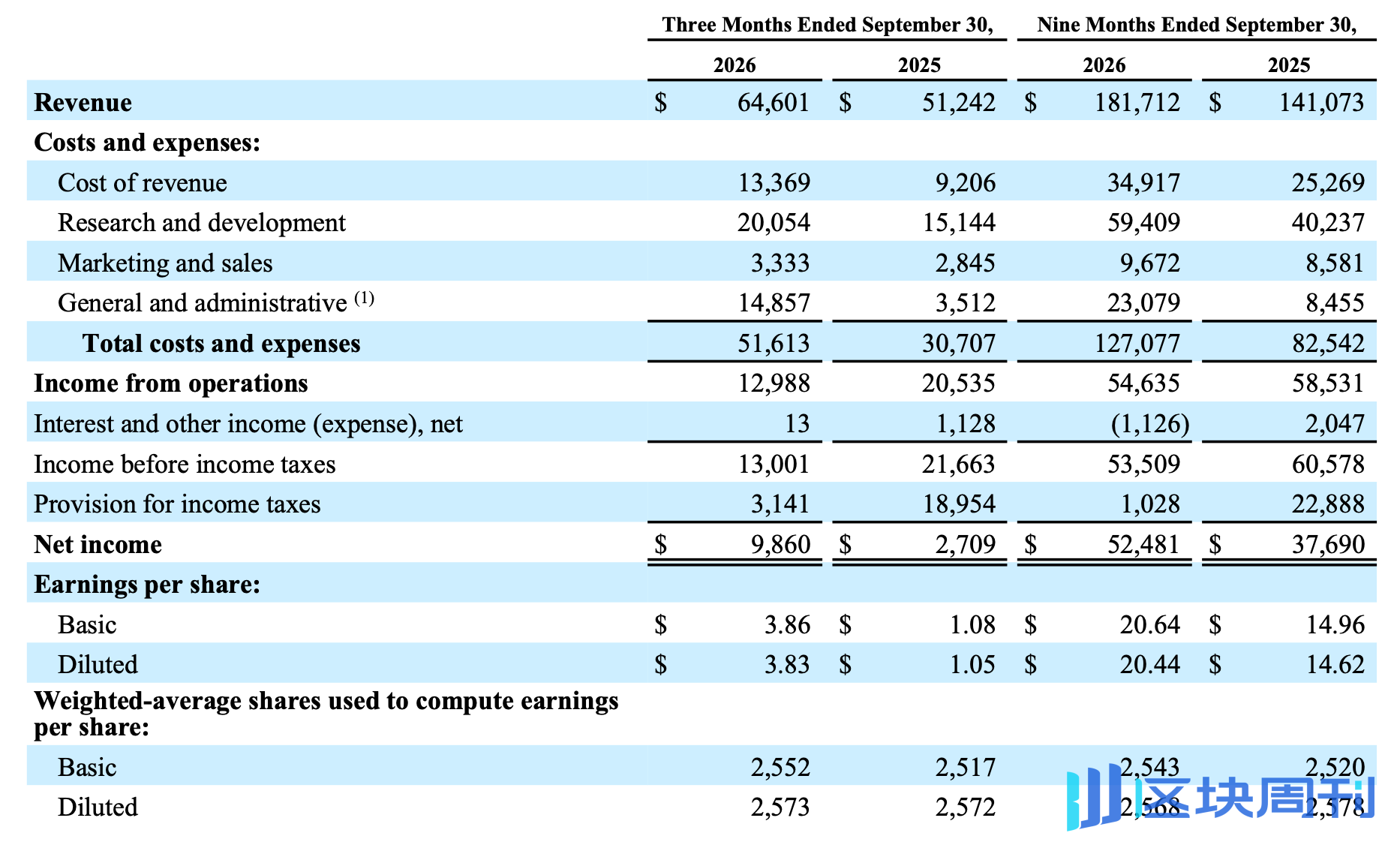
Looking at these numbers alone, it is hard to say this is a beautiful income statement. However, the profit decline was mainly affected by a special expense — in August this year, Meta reached a settlement with the attorneys general of 52 U.S. states and territories over lawsuits related to adolescent mental health and social media addiction. According to the materials cited in the original text, this arrangement involves potential payments of up to approximately $18.59 billion over the next ten years. Meta accrued $9.89 billion in legal settlement expenses in the third quarter, recorded in general and administrative expenses (G&A).
If this non-recurring expense is excluded, Meta's operating profit for the quarter would be approximately $22.88 billion, and diluted earnings per share would be approximately $7.40, significantly higher than the reported $3.83 and also above Wall Street's previous expectation range of about $6.08 to $6.54.
What supports this true profitability is still Meta's unshakable advertising foundation. In the third quarter, Meta's total revenue reached $64.6 billion (up 26% year-over-year), higher than the market expectation of $63.3 billion; among this, advertising revenue from the Family of Apps (FoA) contributed $63.06 billion, also up 26% year-over-year. What reassures investors even more is the internal structure of advertising growth — "both volume and price rising."
- Impressions: Ad impressions across all apps increased 10% year-over-year, and family daily active people (DAP) reached 3.64 billion (up 3% year-over-year);
- Average price per ad: The average price per ad surged 14% year-over-year.
In the current macro environment full of uncertainty, a 14% increase in average ad price is quite valuable. This directly confirms the positive cycle of Meta's massive computing power being poured into recommendation algorithms and automated advertising tools (such as Advantage+, whose annualized revenue run rate has exceeded $75 billion) over the past two years — AI has substantially raised advertising conversion rates and advertiser ROI, allowing Meta to continue to have strong pricing power in an era when social traffic has peaked.
At the same time, Meta's fourth-quarter revenue guidance is as high as $73 billion to $76 billion (midpoint $74.5 billion, corresponding to about 24% year-over-year growth), once again firmly beating Wall Street's consensus expectation of around $73.7 billion, proving that advertising demand during the year-end holiday shopping season remains extremely strong.
Breakthrough in the Second Curve: Muse Brings the Dawn of "AI Monetization"
If the advertising business proved the power of AI in "improving efficiency of existing businesses," then the AI personal assistant Muse, just launched in September, has allowed Wall Street to see for the first time the dawn of Meta's monetization in "incremental AI-native applications."
On the earnings call, Zuckerberg could hardly hide his excitement about Muse and the underlying frontier model Muse Wonder, just released last week. Judging from the disclosed core operating data, Muse is helping Meta complete the narrative shift from "AI money burner" to "AI monetizer."
- User growth and stickiness: In just one and a half months since launch, more than 10 million users in the United States and Canada have created Muse personal agents, of which about 25% have converted into "daily active users" (DAU), and the early retention curve has become more solid as usage time increases.
- Breaking the curse of "chatting only, no money": Unlike many large-model applications that remain at the Q&A level, shopping has become Muse's largest application scenario so far. Zuckerberg revealed that more than a quarter of Muse users have made actual purchases on the platform, with an average order value (AOV) exceeding $200. Combined with the two subscription tiers of $20 per month and $100 per month officially launched in mid-October, Muse has dual monetization potential of "subscription + e-commerce referral commission."
- Software-hardware integration and B-end extension: Starting next month, Muse will officially launch on Meta smart glasses, becoming the core of its hardware business model; on the enterprise side (To B), CFO Susan Li clearly stated that developers will be charged for access to the foundation model and the Muse Code programming agent, and a "Muse Business Agent Network" serving small and medium-sized enterprises will be gradually built.
Of course, hidden concerns remain. Currently, dozens of external websites, including Amazon, have blocked Muse's access due to data security and commercial competition considerations, which to some extent limits the smoothness of its cross-platform price comparison and shopping, but the cost roadmap given by Zuckerberg is still very attractive — it is expected that within the next year, Muse's computational cost efficiency will increase 10 times, and within the next few years it will become a highly profitable business.
Aggressive Capital Bill: $34.9 Billion Spent in a Single Quarter, Cash Flow Turns Negative for the First Time
Turning to the B-side of the earnings report, the price Zuckerberg paid for this AI gamble is equally shocking.
In order to seize a position in the computing power arms race with OpenAI, Anthropic, and Google, Meta's capital expenditure in the third quarter alone (including principal repayments on finance leases) reached as high as $34.91 billion, and its cumulative purchases of property and equipment in the first three quarters had already reached $83.06 billion, nearly double the $48.31 billion in the same period last year.
Such a terrifying speed of cash burn directly led to a historic financial turning point — although Meta's operating cash flow in the third quarter was as high as $32.79 billion, after deducting capital expenditure, its free cash flow came in at -$2.12 billion (compared with $10.63 billion in the same period last year), which is also the first time Meta's free cash flow has turned negative since its listing.
Even so, Zuckerberg has no intention of hitting the brakes at all. In its financial report, Meta raised the lower bound of its full-year 2026 capital expenditure guidance from $130 billion to $135 billion (narrowing the range to $135 billion-$145 billion), and explicitly stated that it will continue to "invest aggressively" in 2027.
When operating cash flow is tight and the balance of long-term debt has already climbed from $58.74 billion at the end of last year to $80.92 billion, where will the hundreds of billions of dollars for computing power in the future come from? Meta gave the answer in its third-quarter financial report — newly added Class C common stock.
According to the plan announced by the company, Meta will distribute Class C shares to existing holders of Class A and Class B common stock on a 1:1 basis, and the relevant arrangement is expected to take effect on January 19, 2027. Because Class C shares carry no voting rights, this plan makes a distinction between the allocation of economic rights and control of the company. For Meta, this arrangement has at least three layers of significance.
- First, it provides more options for future equity financing and mergers and acquisitions. As investment in AI infrastructure continues to increase, what Meta needs to consider is not only how to increase capital expenditure, but also how to strike a balance among cash, debt, and equity financing. Adding a new class of non-voting shares can provide a tool for future financing and equity incentives.
- Second, this helps maintain the existing control structure. Meta's Class A shares carry 1 vote per share, and Class B shares carry 10 votes per share. Creating non-voting Class C shares means the company can, to a certain extent, expand the room for using equity instruments without simultaneously changing the existing voting rights arrangements of shareholders. This is especially important for Zuckerberg, who wants to continue to hold firm control of the company.
- In addition, in order to support the new share plan, the board of directors signed a "Founder Alignment Agreement" with Zuckerberg. Previously, affected by the potential multi-billion-dollar tax burden of the "California wealth tax" (Proposition 40), there had been market rumors that Zuckerberg might leave California, and through this capital structure reorganization and the design of sale clauses, Zuckerberg has also promised to remain in office and stay in California for the next eight years.
It should be emphasized that the creation of Class C shares does not mean that Meta has already decided to raise the next round of AI funding through large-scale additional issuance, nor can it be directly equated with the company being about to face a funding gap. It is more like preparing a financing tool in advance; as the scale of investment grows larger and larger, Meta hopes to retain more choices for the future.
This plan also reveals another signal — the AI race may not just be a few quarters of high investment, but a long-term campaign that requires sustained efforts over many years and advance planning of the capital structure.
Strategic maneuvering: cutting the metaverse, shrinking headcount, and going all in on AI
In order to free up more resources for AI, Meta is also adjusting its internal business and organizational structure.
First, the metaverse division (Reality Labs), which has continued to drag down operations, will officially face a strategic contraction. In the third quarter, Reality Labs had revenue of $443 million and an operating loss of $4.13 billion (the cumulative loss in the first three quarters has reached $13.17 billion). Unlike the previous vague statements that "losses have peaked," the CFO, in this financial report outlook, rarely gave a clear "stop-the-bleeding timetable": it is expected that the full-year 2026 loss for Reality Labs will narrow to $18 billion-$19 billion, and by 2027 the loss will be further sharply reduced to around $15 billion. The billions of dollars in budget saved are expected to be reallocated to AI projects centered on Meta Superintelligence Labs (MSL).
Second is the "blood transfusion" of the organizational structure. As of September 30, 2026, Meta's total number of employees had dropped to 66,775, a sharp year-on-year reduction of 15% (a quarter-on-quarter decrease of about 12%). However, while headcount was significantly streamlined, Meta's research and development expenses (R&D) in the first three quarters soared from $40.24 billion in the same period last year to $59.41 billion — behind the scissors gap of "headcount falling while R&D surges" is the large-scale elimination of ordinary positions, while resources are being concentrated with unprecedented density into sky-high AI computing power and top large-model researchers.
The financial report has passed, but the return on investment still needs time
Overall, with a third-quarter financial report featuring strong revenue and optimistic guidance, plus Muse's impressive start of exceeding 10 million users, Meta successfully won the first defense battle in Wall Street's "AI confidence crisis." The after-hours rise in the stock price proves that as long as the core advertising cash machine is still roaring and new AI products show real transaction conversion, the market is still willing to tolerate a short-term negative free cash flow.
But this does not mean the alarm has been completely lifted. With the full-year total expense guidance raised to $175 billion to $179 billion, and the clouds at the regulatory level far from dispersing, Meta does not have much room for error going forward.
When hundreds of billions of dollars in capital expenditure translate into huge financial depreciation in 2027, and the financing expectations for Class C shares formally materialize, can the incremental revenue brought by Muse and AI advertising truly outrun the exponentially expanding computing power bills? Zuckerberg's bold bet will sooner or later have to answer this ultimate question.