



Author: danny
Original title: "Why I'm Not Optimistic About Protocols That Use Most of Their Revenue for Buyback and Burn"
On April 23, 2023, U.S. home goods retailer Bed Bath & Beyond filed for bankruptcy protection. The company, which sells sheets, towels, and kitchen supplies, also announced it had secured commitments for approximately $240 million in bankruptcy financing to support the wind-down of its business and related proceedings. At this point, what it needed most was money to continue paying its creditors.
Ironically, just over a year earlier, it had been spending heavily to buy its own stock. In the fiscal year ended February 26, 2022, the company spent about $589 million in cash on share repurchases, while net cash provided by operating activities was only about $17.85 million. In the same year, it also needed to invest about $354 million in capital expenditures. In other words, that year's operating cash flow couldn't even cover capital expenditures, yet buybacks continued.
It was renovating stores, upgrading digital channels and supply chains, and promoting private labels. The problem was that these transformations had not yet proven sufficient to turn the business around, and the company was simultaneously handing large amounts of cash back to the stock market. By the summer of 2022, some suppliers began demanding stricter payment terms, including prepayment. Suppliers were no longer willing to extend credit terms as they had in the past, which led to what followed.
Of course, we cannot simply blame Bed Bath & Beyond's bankruptcy filing on buybacks. Because at the time, there were problems with merchandise strategy, competition, supply chain, and operational execution. But buybacks and these problems occurred on the same balance sheet: money used here could not simultaneously be used there. It bought back its own stock, but it did not thereby buy back customers, nor did it make suppliers more willing to extend credit.
The Essence of Business, Building Competitive Advantage
Back to crypto: whenever a crypto protocol announces that it will use 80%, 90%, or even all of its revenue to buy back its own token and then burn it, I think of this company. What the market sees is a reduction in token supply and a reason to buy, but what I want to know is: after the buyback, how much capacity does the protocol have left to keep the business going?
For a company to earn above-peer profits over the long term, it must make itself increasingly difficult to replace and acquire more and more competitive advantages (see Michael Porter's "Competitive Advantage"). Users are willing to stay because liquidity is better, trading is cheaper, the product is more suitable, or switching costs are higher. From a corporate interest perspective, a near-monopoly position is the most comfortable; one step down is an oligopoly; at the very least, it must have an advantage in some market that others find difficult to replicate. Of course, monopoly is not a necessary condition for success, but a business without differentiation will find it hard to retain excess profits.
However, building this kind of advantage, or even deepening this kind of moat, requires money—a lot of money. Trading protocols need to cultivate liquidity, expand distribution channels, and bear R&D and security costs; if they want to transform from a trading tool into infrastructure, they also need to invest in the ecosystem so that other developers are willing to build businesses around it. Spending money does not guarantee success; Bed Bath & Beyond, which failed in its transformation, is a reminder. But when effective investment opportunities exist, buybacks also have a cost: they may crowd out the next-generation product, an important channel, or the ability to survive the next downturn.
The benefits of buybacks are obvious and immediate in the secondary market. How much was spent today, how many tokens were bought, how much supply was burned—it can all be checked on-chain, and the community can make posters the same day. Product improvements and channel building take longer and may fail. As a result, teams are easily trained by the market into a habit: prioritizing resources where applause comes most easily. As for competitiveness two years from now, who cares?
Prerequisites for Buybacks
Some will say Apple also does large-scale buybacks, so why can't decentralized protocols, launchpads, and PerpDexes? Apple spent about $94.95 billion in cash on buybacks in fiscal 2024, but it also recognized $31.37 billion in R&D expenses and $9.45 billion in capital expenditures that year. After deducting the aforementioned capital expenditures from operating cash flow, their free cash flow was about $108.81 billion, and buybacks accounted for about 87.3%. That ratio is not low, but it is not the same as "taking 90% of fees as soon as they come in."
At the end of that year, Apple held about $156.65 billion in cash, cash equivalents, and marketable securities. This figure does not deduct debt, nor is it all cash, and cannot be treated as net assets that can be spent freely; but it reminds us that beyond the buyback ratio there is an entire balance sheet. Citing only the $94.95 billion in buybacks while omitting R&D, capital expenditures, and financial resources means learning only the actions of a mature company, not the prerequisites that allow it to take those actions.
The products and services Apple sells, after bearing these investments, generate profits and free cash flow, which is what makes it possible to discuss how to distribute that cash. A young protocol suddenly earns a large amount of fees from a market cycle, has not yet proven whether users will stay, and then borrows the capital return logic of a mature company, skipping the hardest part of the corporate journey: turning阶段性 revenue into sustained profitability.
Windfall cash flow is not the same as the profitability of a mature company. Bed Bath & Beyond even reminds us that years of operation do not guarantee a company will always remain mature and stable. Competitive advantages erode, customers leave, and when it is time to reinvest, management must be willing to keep the money.
Comparison of Protocols with Buyback Mechanisms
Comparing specific protocols makes this issue much clearer.
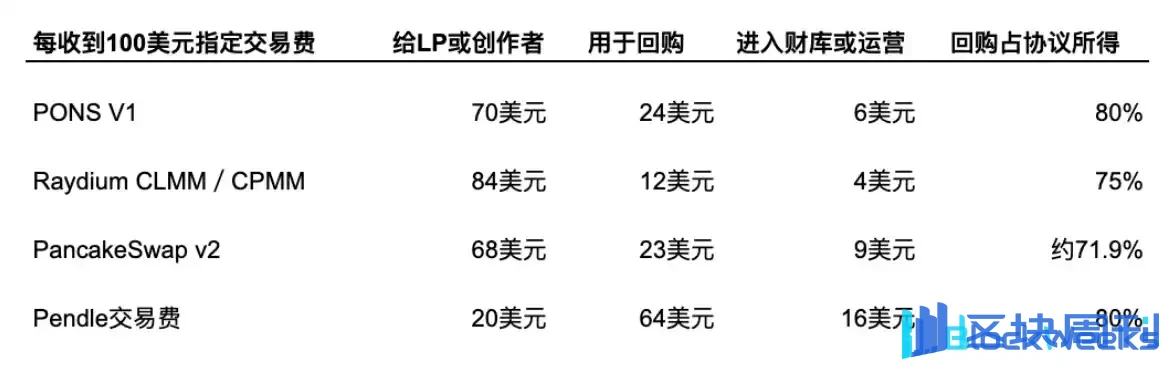
PONS's V1 documentation states that 80% of protocol fees are used to buy back and burn PONS, with the remaining 20% paying for infrastructure and team expansion. But the question is whether the remaining 20% is enough to support operations and withstand risks?

Pump.fun's current official target is 50%, with a one-year programmatic buyback and burn arrangement starting April 28, 2026.
Raydium's CLMM and CPMM pools distribute 84% of total trading fees to liquidity providers, 12% to buy back RAY, and 4% to the treasury. On the surface, only 12% is used for buybacks, but after deducting the LP share, the protocol's income is only 16%, three-quarters of which is again converted into its own token. PancakeSwap v2 is similar: using protocol income as the denominator, buyback and burn accounts for about 71.9%.
It should be noted that the figures in the table are calculated according to official fee-sharing ratios and only represent fee flows. Raydium's bought-back tokens are held by the protocol, while Pendle's bought-back tokens are used for staking rewards. More importantly, the $6, $4, and $9 in the table have not yet become profit: they may next need to pay for R&D, operations, and security.
This is also why I am unwilling to look only at buyback ratio rankings. Protocol fees, foundation assets, and development company funds may belong to different entities. A buyback wallet continuously buying tokens does not mean the entire ecosystem has no money for R&D; but a team holding a large amount of its own tokens does not mean it has an equivalent amount of cash that can pay bills at any time. Only by looking at the funds in these accounts together can we know whether the buyback is using profits, surplus reserves, or money that may be needed in the future.
Measuring the Fluctuations of Open Water with Pool Water
The crypto industry is an extremely cyclical industry. For example, Coinbase's transaction revenue fell from about $6.837 billion in 2021 to $2.356 billion in 2022, a one-year shrinkage of about 65.5%, which is commonplace.
Revenue changes for decentralized protocols are even more dramatic. Take dYdX as an example: during the phase in 2025 when the buyback allocation was 25%, the average monthly buyback budget was about $339,000; by the first half of 2026, the allocation ratio increased to 75%, but the average monthly budget instead fell to about $183,000. The ratio tripled, but the buyback amount decreased by about 46%, because the relevant net protocol revenue fell by about 80%.
PONS's recent data also shows that revenue cannot be viewed only when things are booming. According to DeFiLlama data on October 5, its combined 30-day protocol revenue was about $22.7 million, and its 7-day revenue was about $1.68 million. Converted to daily averages, that is about $757,000 and $240,000 respectively, but you should know that the recent 7-day daily average is about 68% lower than the 30-day average. Taking the performance of the hottest month and multiplying it by twelve (euphemistically called APY) and promoting it as a stable annualized buyback capacity will obviously miss volatility and easily lead one astray.
Looking back at Bed Bath & Beyond, financial strain only invites more people to kick you when you're down. Suppliers tightening credit terms meant it needed to pay earlier to get goods. The same is true for crypto protocols: revenue falls by 70%, but these costs remain the same, or even become harsher. The customer acquisition cost for an FDV of $1 billion is not the same as the customer acquisition cost for an FDV of $10 million.
In addition to operations, the crypto industry also has a security cost: when attacked, how much needs to be paid out? According to Chainalysis statistics, funds stolen from crypto services amounted to about $2.2 billion in 2024, about $3.4 billion in 2025, and about $5 billion in the first half of 2026. It is worth mentioning that in 2025, a single Bybit incident resulted in about $1.5 billion stolen. For a protocol, security reserves are not meant to guard against average losses, but against that one accident capable of emptying the treasury.
In the 2022 incident, Ronin had 173,600 ETH and 25.5 million USDC stolen. When the official cross-chain bridge was restored, it was disclosed that after deducting the Axie DAO portion, the user-related shortfall was 117,600 ETH and 25.5 million USDC.
What users needed to recover was ETH and USDC; nobody cared how many of the project's own tokens had been burned in the past. Safety reserves usually look inefficient—they neither create buy pressure nor reduce supply—but they give the team the confidence to repair the business and restore market trust. Once trust is damaged, raising funds by issuing or selling the project's own tokens becomes far harsher than it was in a bull market.
So I am willing to pay attention to another kind of capital allocation. Aave's 2026 financial post disclosed that about 10 months after buybacks began, it arranged $42 million and bought more than 205,000 AAVE. But borrowing fees had fallen about 25% from their peak, while service provider costs and other growth needs were increasing, so the post proposed cutting the annual buyback budget from $50 million to $30 million, a 40% reduction. (This is only a proposal, not a confirmed result.) Aave's buybacks also go into ecosystem reserves for rewards and other expenditures, rather than permanent burning. But this proposal acknowledged something necessary: the operating environment has changed, and the way buybacks are done should give way. (However, a follow-up post on April 22 disclosed that, affected by the rsETH cross-chain bridge incident, buybacks had been suspended since April 19, precisely to preserve the treasury's ability to respond to potential losses.)
Conversely, if a team cannot reduce buybacks because doing so would destroy the token's most important selling point, then so-called capital allocation begins to constrain operations. The business needs money, but the market demands continued buy pressure; to maintain this promise, the protocol may instead come to rely on financing, foundation token sales, or a new round of incentives.
Today's buybacks are packaged as value return, yet they are merely overdrafting the protocol's future competitive advantages and risk resistance.
Complex buybacks = buying back nothing
After Aster's upgrade on June 17, 2026, 99% of daily platform fees are used to buy back ASTER, but the tokens bought back are distributed to veASTER holders; the protocol then burns an equal amount from reserves, prioritizing the team allocation, until total supply falls to 3 billion tokens. This mechanism simultaneously includes market buying, reward distribution, and inventory burning.
Similarly, PancakeSwap proposed a target of at least about 4% net deflation per year, but at the same time it also has an incentive issuance mechanism. For secondary traders, does this increase or decrease supply?
Burning team inventory can reduce future potential supply, and in the long run this is valuable—but this playbook only applies to mature projects.
But if bought-back tokens are redistributed, they may re-enter circulation. Looking only at the decline in total supply, without looking at how circulating supply changes, and without looking at how much cash decreases, turns three originally bullish messages into one message no one understands. For a still-growing decentralized protocol, this is just pointless attrition.
Just an interlude on the road of chasing trends.
Forced buybacks only create exit conditions
At this point in the discussion, what worries me is not just how the money is distributed, but whether the entire project's operating goal will be changed: making the token easier to sell and more liquid gradually becomes more important than developing the business. For protocols that treat high buybacks as their main selling point and do not clearly explain reinvestment and risk reserves, I am more inclined to understand them as a token-selling-oriented business model.
When a protocol promises to use most of its revenue for buybacks, it provides the secondary market with an easy-to-understand reason to buy: the platform earns money every day, buys tokens every day, and supply keeps shrinking. Buyers may therefore be more willing to take over, and trading heat brings price discussion, social传播, and more attention. The project gains a customer acquisition path built around the token. From a business effect perspective, buyback spending also serves the function of marketing expense: it both creates buy pressure and advertises why others should buy.
The "selling" here does not necessarily mean the team directly selling tokens, but rather that the entire mechanism prioritizes making the market willing to buy, hold, and trade this token. Fees become the buyback budget, buybacks become the reason to buy, and secondary market heat is then used to showcase the project's growth. If the ultimate metrics of success are all token price, trading volume, and discussion热度, then the boundary between operating the token and operating the business will become increasingly blurred.
This is also where it is worth discussing together with "high fdv, low float." The two mechanisms differ: high valuation and low circulation rely on limited chips to form a price, then extrapolate that price to other venues to obtain liquidity; buyback and burn at least may use cash earned by the business, so they cannot be conflated. But if the design focus falls on supporting price and creating a sense of scarcity so that the next buyer is willing to take over, while the company's持续 competitiveness takes a back seat, they may serve similar directions of interest.
Competitive advantage cannot be bought simply by spending money, but maintaining products, security, channels, and ecosystem usually requires continuous investment. Buybacks should not come before these investments.
Especially when team and early investor tokens continue to unlock while the protocol continues to use revenue for buybacks. Buybacks provide buy pressure, and a more active secondary market is used to improve sellers' exit conditions.
Premature buybacks are a stumbling block to building competitive advantage
The problem is that a lively secondary market and a company forming its own competitive advantage are two different things. A person buying a token because the buyback ratio is high does not mean he will use the protocol; even if he starts using it, it does not mean he will still be willing to stay after subsidies decrease and the market turns cold. Users who come today because of token price may leave tomorrow because another token rises faster. Attention can bring traffic, but it does not necessarily leave loyalty, pricing power, or a product competitors cannot replicate.
The attention brought by a rising token price is of course valuable. It may attract developers, market makers, and distribution partners, making liquidity deeper and products better, ultimately forming a network users cannot leave. But every step in between requires investment and validation. More convincing evidence is whether users increase without extra incentives, whether users come back, whether customer acquisition cost per unit falls, and how much cash remains after deducting subsidies. If most of the money continues to be used to create buy pressure, but there are no resources to turn attention into products, channels, and customer relationships, then the project is merely continuously paying the cost of maintaining heat.
Risk reserves also do not automatically increase with discussion热度. How many people on social platforms are bullish cannot pay for the protocol's security audits, team salaries, and incident compensation. Especially in a trough, business revenue, token price, and market attention may all decline together; the mechanism that previously relied on buybacks to maintain heat loses its source of funds exactly when support is most needed. The data set from dYdX, where the buyback ratio increased but the budget instead fell, is a good wake-up call.
I am not opposed to returning excess money to the market. After all, for protocols that are asset-light, have a solid competitive position, have limited reinvestment opportunities, and have ample reserves, this is a suitable reason to maintain a high buyback ratio. The criterion is always how this capital can be used to increase long-term value.
But if the business has not yet stabilized and reserves have not yet been sufficiently built, permanently using most of revenue for token buybacks and burns is a reason I am unwilling to easily endorse.
The confidence to continue operating
You should know that when Bed Bath & Beyond filed for bankruptcy protection, the shares it had bought back in the past could not be turned back into cash flow, nor could they restore its suppliers' trust. This story certainly cannot prove that every buyback is inappropriate, but it reminds us that the value a company leaves to holders ultimately depends on whether it can continue operating and whether it can continue winning customers' trust after a trough.
If a protocol can tell me every day how many tokens it burned, but cannot explain how the attention brought by the secondary market becomes a business harder to replace and a thicker cash reserve, I will treat it as a way of selling tokens, not a reason for long-term holding.
Buybacks can help a token find its next buyer, but only the ability to continue operating can give those who stay a reason not to rush to find the next buyer. Selling tokens can be a successful business, but token holders need a business that can still make money after the excitement has passed.